
Skip to content
Menu
LandWISE – Promoting sustainable land management
  • Welcome
    • About
    • LandWISE Committee and Staff
    • Contact
  • Projects
    • Carbon Positive
      • Carbon Positive Reports
    • Nitrachek: Farmer Friendly Nitrate Testing
    • SLAKES: a cost-effective measure of soil structural stability
    • Soil Repair after Cyclone Gabrielle
    • Vegetable Production Nitrogen Management
    • Best Management of Nitrates in Process Cropping
    • Future Proofing Vegetable Production
    • Herbicide Resistance Management
  • Events
    • Soil Health for Profit
      • Soil Health for Profit Presenters
    • Cyclone Gabrielle Research Symposium
      • Historical North Island Flood Events
      • An extraordinary storm: the severity of Cyclone Gabrielle’s weather in Hawke’s Bay
      • The Science Response in the Year of Storms; A Gisborne/Tairawhiti perspective
      • Insights into causes of landslides triggered by Cyclone Gabrielle
      • The effects of Cyclone Gabrielle on fruit tree health in Hawke’s Bay
      • Impact of Cyclone Gabrielle on stonefruit orchards in Hawke’s Bay: a case study
      • Charting the Course following Cyclone Gabrielle
      • Baseline sediment sampling in Tairawhiti and Hawke’s Bay
      • Impacts on cropping businesses
      • Understanding the flooding caused by Cyclone Gabrielle
      • Building Flood Damage from Ex-Tropical Cyclone Gabrielle
      • Food safety and critical incidents: A unified approach for safer produce
      • Silt nutritional status and contamination concerns
      • Lessons from the horticultural sector response to Cyclone Gabrielle
      • Ecological impacts of Cyclone Gabrielle
      • Cyclone Gabrielle and Poplar Windthrow in Northland
      • Seed Size and Establishment Method Determine Crop Recovery Following Cyclone-Induced Silt Deposition
      • Returning to (some) baseline sampling sites to assess cropping soil recovery
      • Recovery of annual cropping ground – Grower learnings
      • Recovery of Annual Cropping over 2 Years
      • Technical and extension learnings from Cyclone Gabrielle
    • Getting to Carbon Positive!
      • Getting to Carbon Positive – Presenters
    • Rebuilding Our Soils
      • Rebuilding Our Soils – Presenters
    • Events Archive
  • Tools
    • Fertiliser Application Equipment Calibration
      • Fertspread Spreader Calibration
      • Fertspread Placement Calibration
    • Nitrachek Calculator
    • Irrigation Evaluation – IRRIG8
      • IRRIG8: Centre Pivot
        • IRRIG8-online: Centre Pivot User Guide
      • IRRIG8: Linear Move
      • IRRIG8: Travelling Irrigator
        • IRRIG8-online: Travelling Irrigation User Guide
      • IRRIG8: Multiple sprayline calculator
      • IRRIG8: Solid set irrigation
      • IRRIG8: Pressure and energy
        • Pressure and Energy Calculator: User Guide
    • Soil Infiltration Calculator
      • Disc Permeameter User Guide
      • Disc Permeameter Calculator: Frequently Asked Questions
    • Carbon Calculator
    • ANOVA Tool for statistical significance
  • Blog
  • Sign Up
  • Login
  • Members Only
    • Online Learning
  • Account
  • Site Search
LandWISE – Promoting sustainable land management

Carbon Positive

Posted on March 17, 2023
A LandWISE partnership with the Hawke’s Bay Future Farming Trust

Can we regenerate soil carbon in soils used for intensive field cropping?
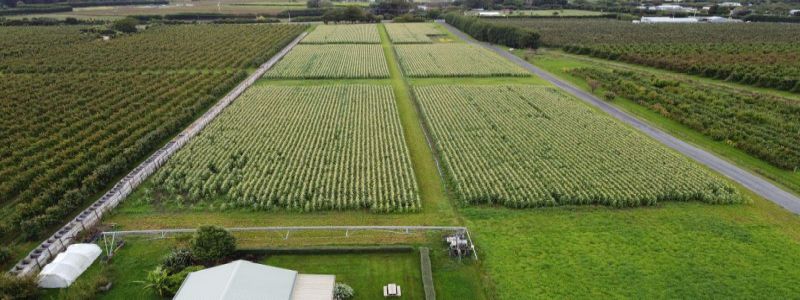
Aerial view of sweetcorn crop grown under three different management systems, each repeated four times

To scientifically test regenerative farming principles within a typical New Zealand cropping system, we have established a six-year trial on the Heretaunga Plains. The trial at the LandWISE MicroFarm is a collaboration with the Hawke’s Bay Future Farming Trust. The information produced will increase understanding of benefits, impacts of conversion, support the development of decision-making tools, and increase confidence in regenerative farming principles through the value chain.

Our trial is a systems comparison, evaluating differences between a conventional high input, high output cropping system and a system producing the same crops managed according to regenerative practice principles. A third ‘hybrid’ treatment can adopt practices from either system, evaluating the effectiveness of selecting only some new practices, or aiming to model a transitional approach to conversion from conventional practice to a regenerative one.

Strict definition of regenerative cropping has been deliberately avoided in favour of adherence to generally agreed principles: minimise soil disturbance, keep the soil covered, keep living roots in the soil at all times, grow a diverse range of crops, and introduce grazing animals. Additional principles are to minimise the use of artificial fertilisers and sprays. Importantly, there is no “ban” on any practice should it be deemed an appropriate management response.

The trial site has moderately degraded soils after almost ten years continuous cropping. It has been split into 12 mini-paddocks, each 12 m wide and 90 m long. This provides four replicates of each treatment. The width enables use of conventional process cropping machinery, fitting 12 m, 6 m, 4 m, 3 m or 2 m equipment. The length ensures equipment is functioning correctly and sampling can avoid ends of rows.

Key parameters measured include soil factors such as carbon stocks, labile carbon, visual soil assessment (VSA), aggregate stability, and worm counts. Also measured are crop development, yield and quality, and profitability assessed via gross margins using input costs and standard contractor rates.
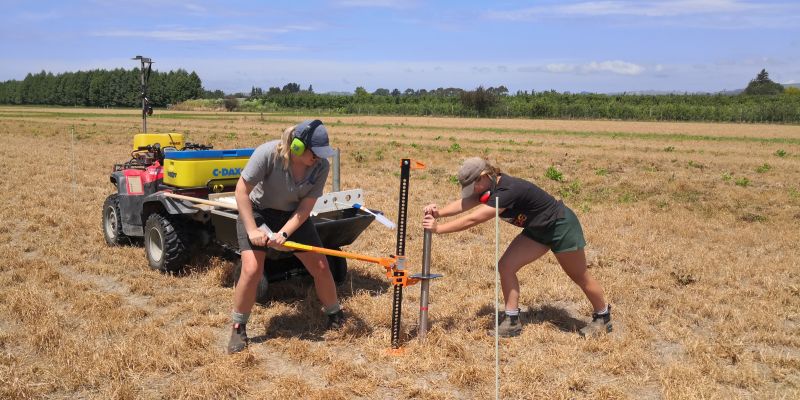
Two people using jack to lift soil coring tube out of the ground
Using a high-lift jack to extract a 50 mm soil corer from 90 cm as part of soil carbon sampling to set project baseline

Project establishment saw baseline measurement via an EM map at 50 and 120 cm, and VSA soil quality assessments. Carbon stocks and labile carbon (HWEC), total nitrogen and labile nitrogen (HWEN) and Olsen P were measured to 90 cm in four depth bands. The EM map shows a high degree of homogeneity across the trial site. The VSA tests were also consistent, showing the soils to be in “moderate” condition, neither good nor poor. This allows for the imposed management to either further decrease quality or regenerate it.

The first crop planted was process sweetcorn for McCain Foods, an industry partner. Land had come out of 18-month pasture that was sprayed out. Everything was strip-tilled, then the conventional treatment also power harrowed. Compost, Trichoderma and biostimulants were added to the regenerative plots. The crop emerged quickly and evenly in all treatments, although slugs and pükeko caused some early damage. During Cyclone Gabrielle, the site was inundated with relatively clean flood water for less than a day. The crop remained healthy.

After winter cover crops, a Kraft-Heinz Watties tomato crop is planned for 2023-24. The project is supported by McCain Foods, Kraft-Heinz Watties, BASF Crop Protection and others.
Corporate logos of the New Zealand Ministry for Primary Industries, McCain Foods, Kraft-Heinz-Watties and Hawke's Bay Regional Council

More information at the Carbon Positive page

Members wanting more involvement, contact Alex, the Project Manager

Related

  • Irrigation Performance Assessment
  • Soil Health for Profit – James Hunter
  • Soil Health for Profit – Charlie White
  • Soil Health for Profit – Josh Wing
  • 2026 Winter cover crops emerged
  • Soil Health for Profit – Pranoy Pal
  • Soil Health for Profit
  • Winter Cover Crops
  • Butternut Harvest Data
  • A Lighter Touch Biodiversity Field Walk
  • Butternut Harvest
  • Measuring Soil Infiltration

RECENT POSTS

  • Irrigation Performance Assessment
  • Soil Health for Profit – James Hunter
  • Soil Health for Profit – Charlie White
  • Soil Health for Profit – Josh Wing
  • 2026 Winter cover crops emerged

CATEGORIES

  • Agritech
  • Asparagus
  • Conference
  • Courses
  • Cover crops
  • Cultivation
  • Events
  • Fresh Vegetables
  • Irrigation
  • Membership
  • Nitrate
  • Nutrition
  • People
  • Permanent crops
  • Pests
  • Process Crops
  • Projects
  • Protected cropping
  • regenerative agriculture
  • Regulations
  • Research
  • soil health
  • Sustainable technology
  • Uncategorized
  • Water resources
  • Weeds
©2023 LandWISE – Promoting sustainable land management

Disclaimer: Any information on the LandWISE website or linked LandWISE resources is of a general nature only. We endeavour to provide accurate and adequate information relating to the subject matters contained in it. It has been prepared and made available to all persons and entities strictly on the basis that LandWISE, its researchers and authors are fully excluded from any liability for damages arising out of any reliance in part or in full upon any of the information for any purpose. No endorsement of named products is intended nor is any criticism of other alternative, but unnamed product.