Skip to content
Menu
LandWISE – Promoting sustainable land management
  • Welcome
    • About
    • LandWISE Committee and Staff
    • Contact
  • Projects
    • Carbon Positive
      • Carbon Positive Reports
    • Nitrachek: Farmer Friendly Nitrate Testing
    • SLAKES: a cost-effective measure of soil structural stability
    • Soil Repair after Cyclone Gabrielle
    • Vegetable Production Nitrogen Management
    • Best Management of Nitrates in Process Cropping
    • Future Proofing Vegetable Production
    • Herbicide Resistance Management
  • Events
    • Soil Health for Profit
      • Soil Health for Profit Presenters
    • Cyclone Gabrielle Research Symposium
      • Historical North Island Flood Events
      • An extraordinary storm: the severity of Cyclone Gabrielle’s weather in Hawke’s Bay
      • The Science Response in the Year of Storms; A Gisborne/Tairawhiti perspective
      • Insights into causes of landslides triggered by Cyclone Gabrielle
      • The effects of Cyclone Gabrielle on fruit tree health in Hawke’s Bay
      • Impact of Cyclone Gabrielle on stonefruit orchards in Hawke’s Bay: a case study
      • Charting the Course following Cyclone Gabrielle
      • Baseline sediment sampling in Tairawhiti and Hawke’s Bay
      • Impacts on cropping businesses
      • Understanding the flooding caused by Cyclone Gabrielle
      • Building Flood Damage from Ex-Tropical Cyclone Gabrielle
      • Food safety and critical incidents: A unified approach for safer produce
      • Silt nutritional status and contamination concerns
      • Lessons from the horticultural sector response to Cyclone Gabrielle
      • Ecological impacts of Cyclone Gabrielle
      • Cyclone Gabrielle and Poplar Windthrow in Northland
      • Seed Size and Establishment Method Determine Crop Recovery Following Cyclone-Induced Silt Deposition
      • Returning to (some) baseline sampling sites to assess cropping soil recovery
      • Recovery of annual cropping ground – Grower learnings
      • Recovery of Annual Cropping over 2 Years
      • Technical and extension learnings from Cyclone Gabrielle
    • Getting to Carbon Positive!
      • Getting to Carbon Positive – Presenters
    • Rebuilding Our Soils
      • Rebuilding Our Soils – Presenters
    • Events Archive
  • Tools
    • Fertiliser Application Equipment Calibration
      • Fertspread Spreader Calibration
      • Fertspread Placement Calibration
    • Nitrachek Calculator
    • Irrigation Evaluation – IRRIG8
      • IRRIG8: Centre Pivot
        • IRRIG8-online: Centre Pivot User Guide
      • IRRIG8: Linear Move
      • IRRIG8: Travelling Irrigator
        • IRRIG8-online: Travelling Irrigation User Guide
      • IRRIG8: Multiple sprayline calculator
      • IRRIG8: Solid set irrigation
      • IRRIG8: Pressure and energy
        • Pressure and Energy Calculator: User Guide
    • Soil Infiltration Calculator
      • Disc Permeameter User Guide
      • Disc Permeameter Calculator: Frequently Asked Questions
    • Carbon Calculator
    • ANOVA Tool for statistical significance
  • Blog
  • Sign Up
  • Login
  • Members Only
    • Online Learning
  • Account
  • Site Search
LandWISE – Promoting sustainable land management

Green Beans and Carbon Positive

Posted on March 30, 2025

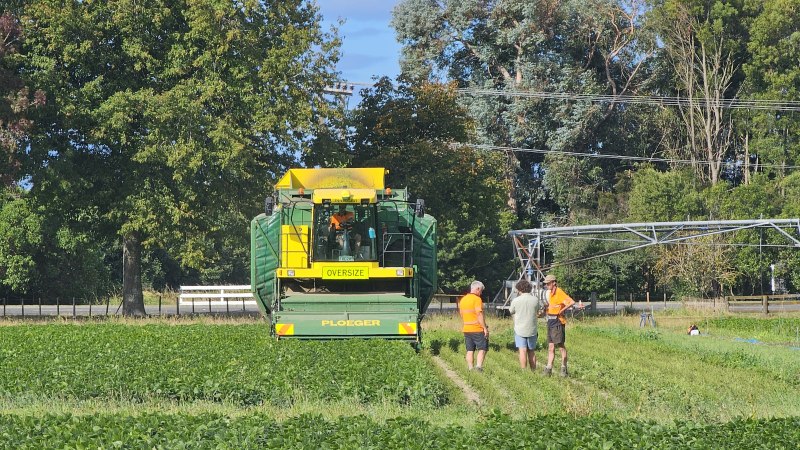
The Carbon Positive programme continues. Our McCain Foods green bean crop has been successfully harvested and yield and quality data captured. Post-harvest, Alex and Oliva completed VSA tests in all the plots, and those and other data are being collated and processed.

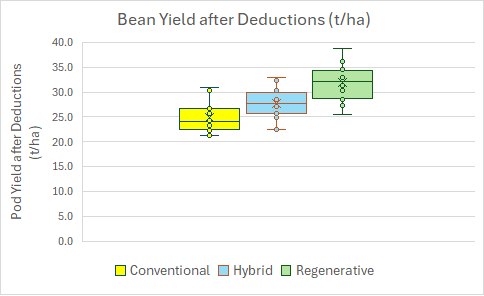
All treatments achieved good yields, but we found significant differences between them. We harvested 1 m2 of crop from each of four sub-plots in each of our 12 plots. That gave us lots of beans which were then removed by hand, weighed and graded. We also got factory results from the different treatments. The box plot graph below shows the average yield (the Xs) and variability in each treatment as determined from our hand harvest plots.

The biggest cause of down-grading at the factory was pod damage associated with harvesting and transport. Other than that, we had a very clean crop.
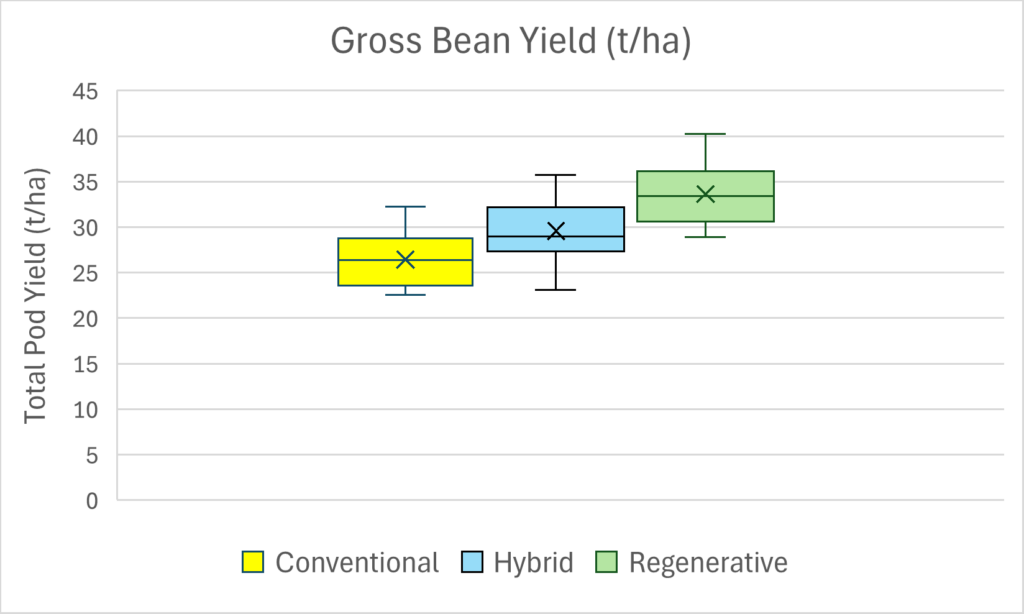
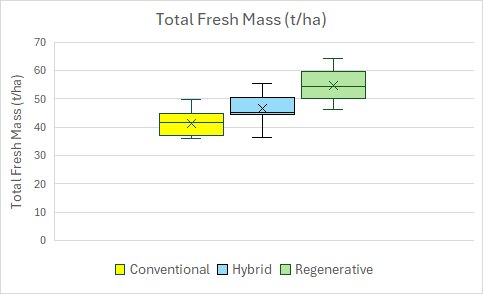
Yield measurements from the three Carbon Positive crops showed significant differences between each treatment. All were good.

So why the differences?

The regenerative plots had the biggest plants. This was seen throughout the season with the canopy ground cover always being ahead in the regenerative plots. Towards harvest, we found the conventional plots had two weeks when their growth appeared to be checked. We know it wasn’t soil moisture or nitrogen availability, but we can’t put a finger on a cause.

Both the conventional and hybrid areas were planted in process peas at the end of August. The soil was cold and wet and we noticed compaction from cultivation and machinery passes. The conventional plots were ploughed and disced, and the hybrid plots direct-drilled before the cover crop was mulched. The regenerative plots were kept in cover crop, which was mechanically terminated before a period of fallow.

All the plots were disc-ripped about three weeks before planting, then sprayed with glyphosate to achieve a stale seedbed before bean planting on 28 December. Both the conventional and hybrid plots received nitrogen fertiliser broadcast near full canopy. The regenerative plots did not receive solid fertiliser, but did get a foliar application as part of spraying for disease and caterpillars. The spray programmes were different from the pre-emergence herbicides through the crop protection programme.

We can’t say what made the differences to the yields that were achieved, because our trial is not set up that way. We are comparing the results of overall management policy over six years rather than assessing the effect of any single input.

So, we can’t say why. Maybe there was less disease pressure by missing peas? Maybe the better soil physical state by avoiding early cultivation and planting in the wet made a difference? Maybe the cover crop biomass was feeding the soil microbes or releasing nutrients?  Maybe all of these? Maybe something else…

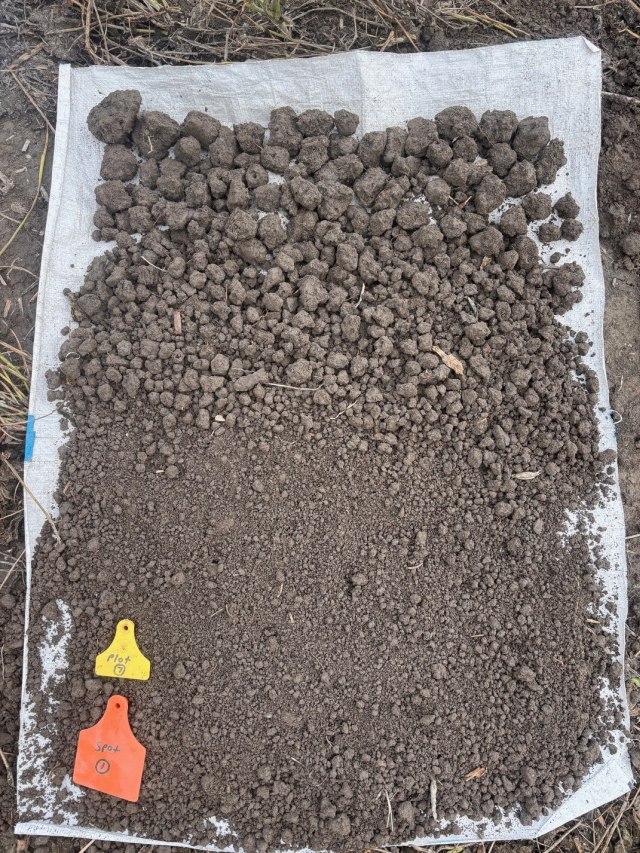
The VSA assessments appear to show differences developing in the different treatments. We need to keep monitoring and see a longer-term trend, but for now, the regenerative plots are starting to score a little better. The soil appears somewhat darker, suggesting it may be building soil carbon levels (we’ll be lab-testing soon so keep an eye out for that) and it has fewer large soil lumps (in our case mainly showing compaction damage). It does suggest that working the soil and driving over it when cold and wet in August had impact.
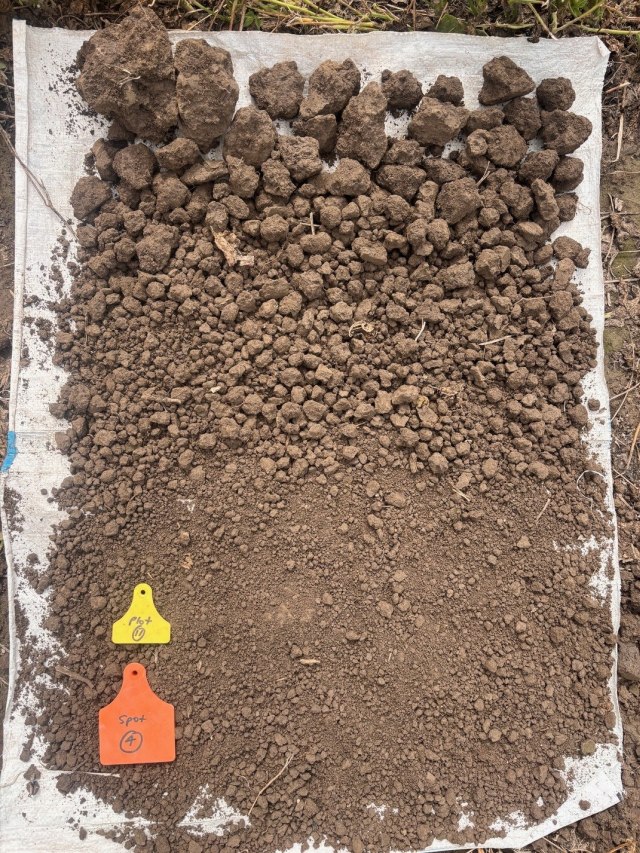
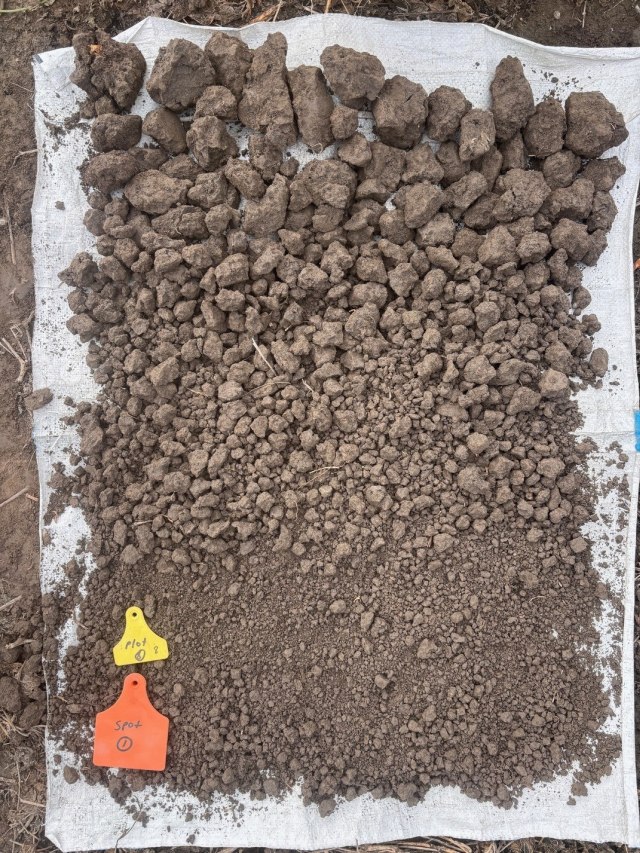
Conventional VSA
Hybrid VSA
Regenerative VSA

We expect to drill the winter cover crops in the first week of April. With continuing dryness, we have applied irrigation to make the soil moist enough for drilling. Our intention is to aerate after drilling to avoid compacting the soil again. Then we’ll leave everything alone until spring to allow the soil to breathe, microbes to do their thing, and roots and earthworms to explore as easily as possible.

Related

  • Soil Health for Profit – James Hunter
  • Soil Health for Profit – Charlie White
  • Soil Health for Profit – Josh Wing
  • Soil Health for Profit – Pranoy Pal
  • Soil Health for Profit – Olivia Webster
  • Soil Health for Profit – Dan Bloomer
  • Soil Health for Profit – John Evans
  • Soil Health for Profit – Bill Ritchie
  • Soil Health for Profit – Andy Mawley
  • Soil Health for Profit – Sally Anderson
  • Soil Health for Profit – Dirk Wallace
  • Soil Health for Profit – Rowland Tsimba

RECENT POSTS

  • Soil Health for Profit – James Hunter
  • Soil Health for Profit – Charlie White
  • Soil Health for Profit – Josh Wing
  • Soil Health for Profit – Pranoy Pal
  • Soil Health for Profit – Olivia Webster

CATEGORIES

  • Agritech
  • Arable crops
  • Asparagus
  • Conference
  • Courses
  • Cover crops
  • Crop protection
  • Cultivation
  • Events
  • Fresh Vegetables
  • Irrigation
  • Membership
  • Nitrate
  • Nutrition
  • People
  • Permanent crops
  • Pests
  • Process Crops
  • Projects
  • Protected cropping
  • regenerative agriculture
  • Regulations
  • Research
  • soil health
  • Sustainable technology
  • Uncategorized
  • Water resources
  • Weeds
©2023 LandWISE – Promoting sustainable land management

Disclaimer: Any information on the LandWISE website or linked LandWISE resources is of a general nature only. We endeavour to provide accurate and adequate information relating to the subject matters contained in it. It has been prepared and made available to all persons and entities strictly on the basis that LandWISE, its researchers and authors are fully excluded from any liability for damages arising out of any reliance in part or in full upon any of the information for any purpose. No endorsement of named products is intended nor is any criticism of other alternative, but unnamed product.