
Skip to content
Menu
LandWISE – Promoting sustainable land management
  • Welcome
    • About
    • LandWISE Committee
    • Contact
  • Projects
    • Carbon Positive
      • Carbon Positive Reports
    • Nitrachek: Farmer Friendly Nitrate Testing
    • SLAKES: a cost-effective measure of soil structural stability
    • Soil Repair after Cyclone Gabrielle
    • Vegetable Production Nitrogen Management
    • Best Management of Nitrates in Process Cropping
    • Future Proofing Vegetable Production
    • Herbicide Resistance Management
  • Events
    • Soil Health for Profit
      • Soil Health for Profit Presenters
    • Cyclone Gabrielle Research Symposium
      • Historical North Island Flood Events
      • An extraordinary storm: the severity of Cyclone Gabrielle’s weather in Hawke’s Bay
      • The Science Response in the Year of Storms; A Gisborne/Tairawhiti perspective
      • Insights into causes of landslides triggered by Cyclone Gabrielle
      • The effects of Cyclone Gabrielle on fruit tree health in Hawke’s Bay
      • Impact of Cyclone Gabrielle on stonefruit orchards in Hawke’s Bay: a case study
      • Charting the Course following Cyclone Gabrielle
      • Baseline sediment sampling in Tairawhiti and Hawke’s Bay
      • Impacts on cropping businesses
      • Understanding the flooding caused by Cyclone Gabrielle
      • Building Flood Damage from Ex-Tropical Cyclone Gabrielle
      • Food safety and critical incidents: A unified approach for safer produce
      • Silt nutritional status and contamination concerns
      • Lessons from the horticultural sector response to Cyclone Gabrielle
      • Ecological impacts of Cyclone Gabrielle
      • Cyclone Gabrielle and Poplar Windthrow in Northland
      • Seed Size and Establishment Method Determine Crop Recovery Following Cyclone-Induced Silt Deposition
      • Returning to (some) baseline sampling sites to assess cropping soil recovery
      • Recovery of annual cropping ground – Grower learnings
      • Recovery of Annual Cropping over 2 Years
      • Technical and extension learnings from Cyclone Gabrielle
    • Getting to Carbon Positive!
      • Getting to Carbon Positive – Presenters
    • Rebuilding Our Soils
      • Rebuilding Our Soils – Presenters
    • Events Archive
  • Tools
    • Fertiliser Application Equipment Calibration
      • Fertspread Spreader Calibration
      • Fertspread Placement Calibration
    • Nitrachek Calculator
    • Irrigation Evaluation – IRRIG8
      • IRRIG8: Centre Pivot
        • IRRIG8-online: Centre Pivot User Guide
      • IRRIG8: Linear Move
      • IRRIG8: Travelling Irrigator
        • IRRIG8-online: Travelling Irrigation User Guide
      • IRRIG8: Multiple sprayline calculator
      • IRRIG8: Solid set irrigation
      • IRRIG8: Pressure and energy
        • Pressure and Energy Calculator: User Guide
    • Soil Infiltration Calculator
      • Disc Permeameter User Guide
      • Disc Permeameter Calculator: Frequently Asked Questions
    • Carbon Calculator
    • ANOVA Tool for statistical significance
  • Blog
  • Sign Up
  • Login
  • Members Only
    • Online Learning
  • Account
  • Site Search
LandWISE – Promoting sustainable land management

Biodiversity Strips Update

Posted on January 19, 2026

We established two new biodiversity strips on the MicroFarm in 2025, in addition to the two from 2024.

One of the new strips, which is located under the irrigator wire, includes alyssum, calendula, and native ground covers. The other strip which is along a fenceline has the A Lighter Touch annual flower strip mix, which includes alyssum, buckwheat, calendula, cornflower, and marigolds. We also added in a few sunflowers.

The first half of the strip under the irrigator wire has established really well, and both the alyssum and calendula are starting to flower. At the other end of the strip, it is a bit patchy and doesn’t have the same ground cover. Some of the native ground covers amongst the strip have dried out or have been eaten by rabbits, while others are thriving.
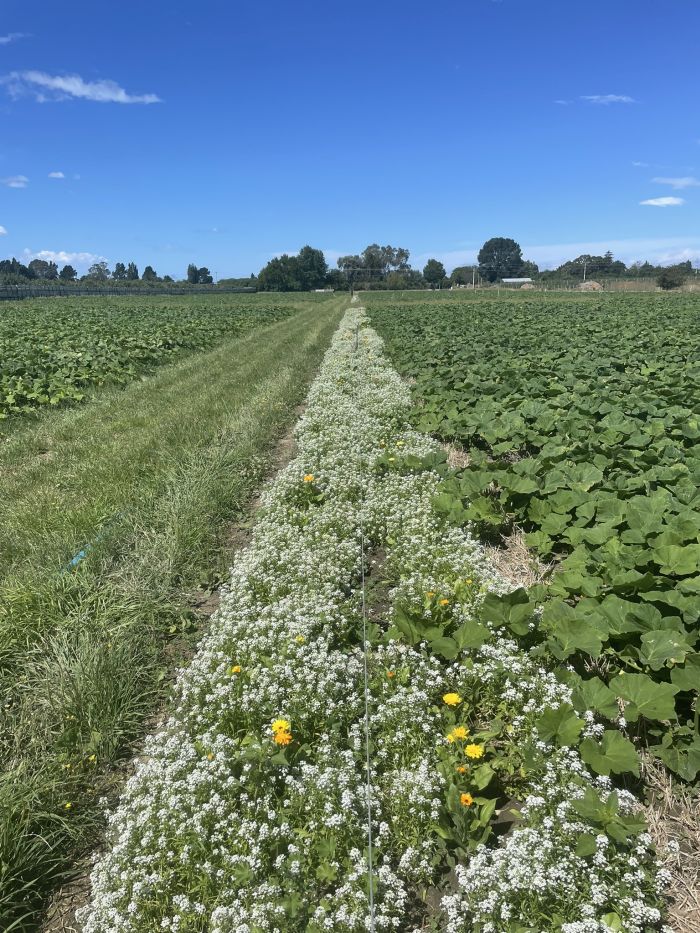
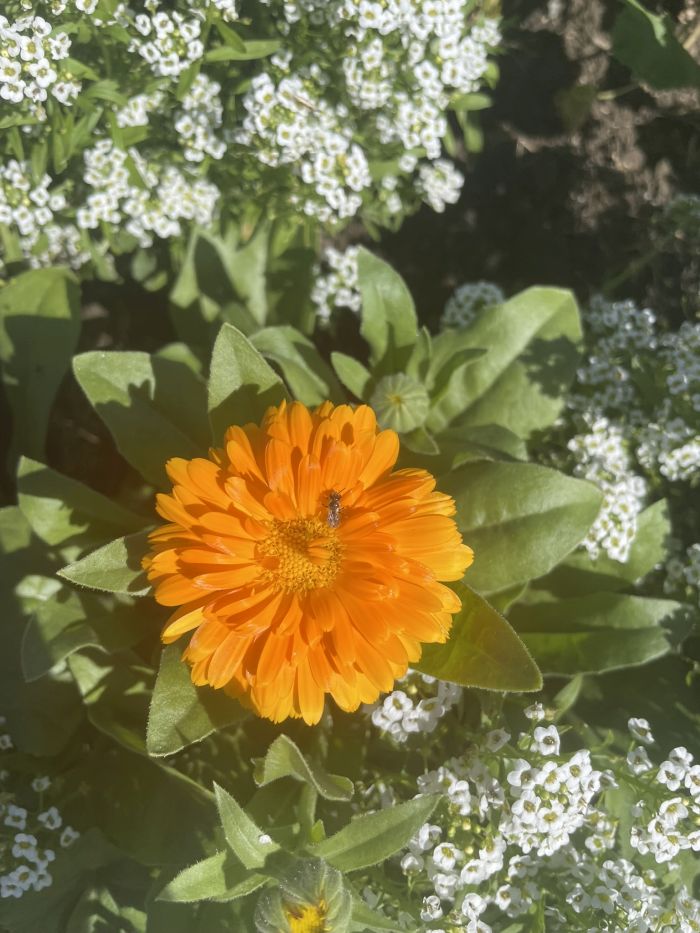
Alyssum, calendula, and native ground covers.
Small black bee on a calendula.

The strip along the fenceline consists mainly of buckwheat and sunflowers at the moment, as they were the first to germinate. However, there are patches where alyssum, marigolds, cornflower, and calendulas have also started to establish.
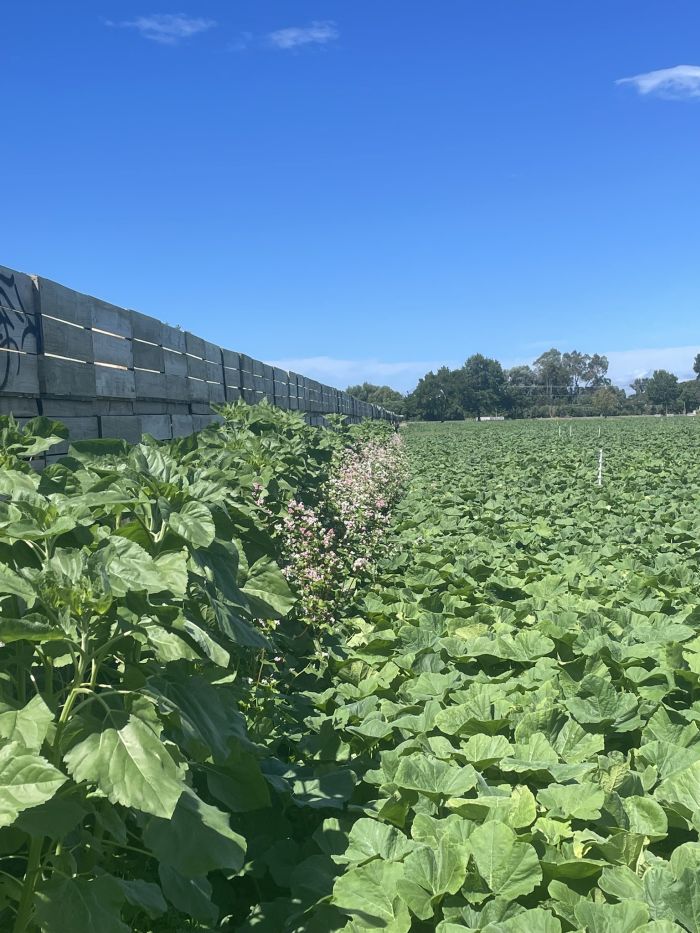
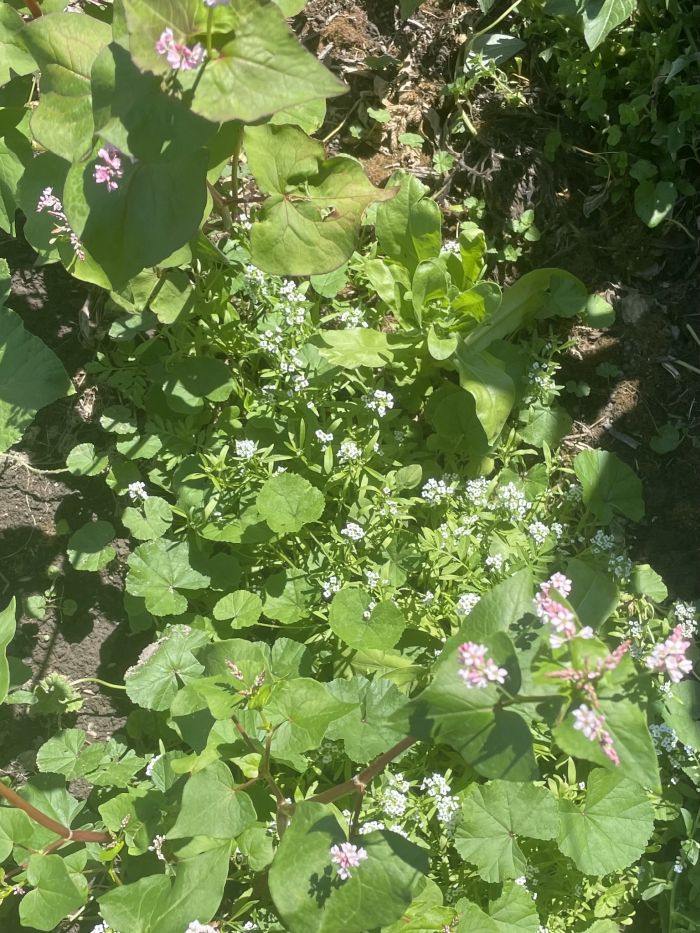
Sunflowers and buckwheat in the fenceline biodiversity strip alongside the butternuts.
Alyssum, calendula, and marigolds under the sunflowers and buckwheat.

The two biostrips planted in 2024 were made up of 9 different flower mixes, first planted in spring and the second in the summer.

The spring 2024 sowings flowered in the summer but were taken over by grass and clover in the winter. We have mown the strip a couple of times to manage the grass and give the flowers a chance to grow. The alyssum, poppies, borage, and phacelia seemed to do the best in spring 2025 after being mown. Now the strip is mainly grass, clover and alyssum. We have mown it back down again and will track what happens.

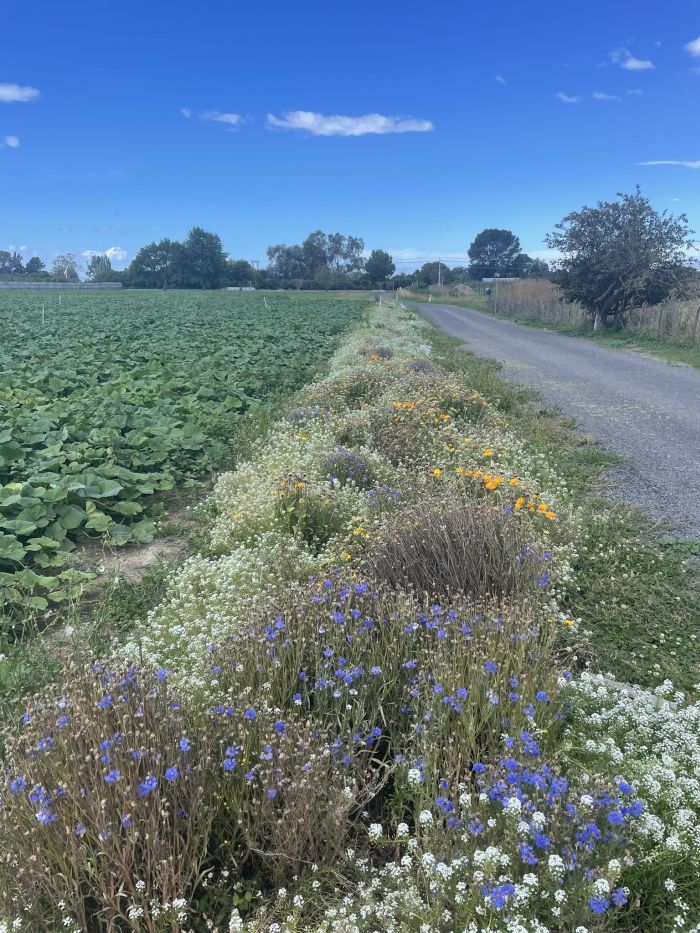
The strip planted in summer 2024 and has continued to flower since it was established. Alyssum is the main flower species that has taken over and provided ground cover, but there are areas where there are still cornflowers and calendulas flowering.
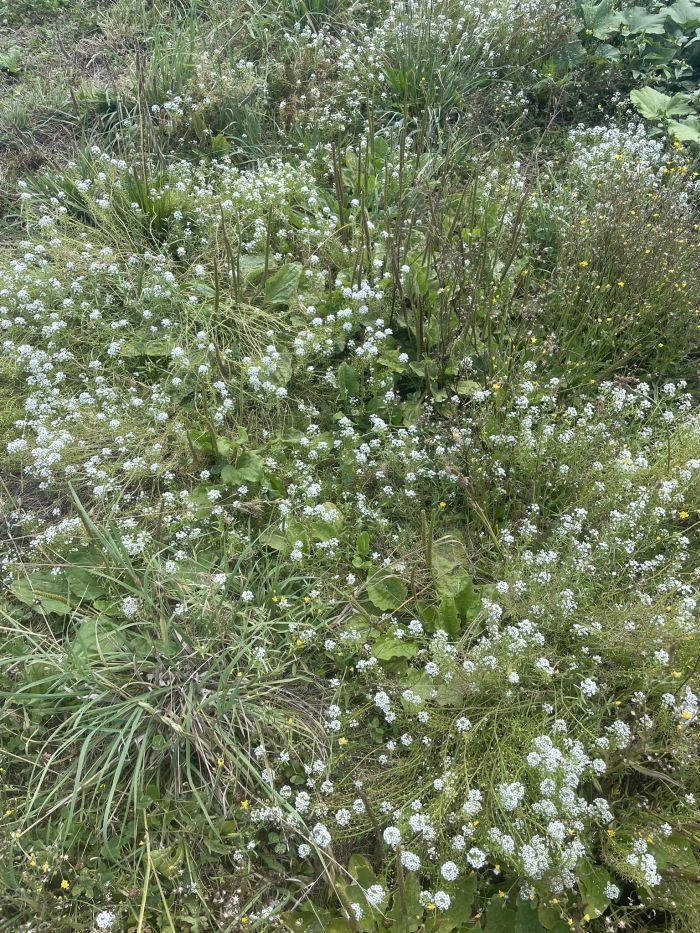
2024 spring-planted strip in January 2026.
2024 summer-planted strip in January 2026.

There are plenty of insects in the strips and within our butternut crop, but we wanted to understand what insects are actually there and how far they are moving into the crop. To do this, we have set up sticky traps within the biostrips and at various distances into the crop. We will continue to monitor the sticky traps and will try to identify what insects are on them.
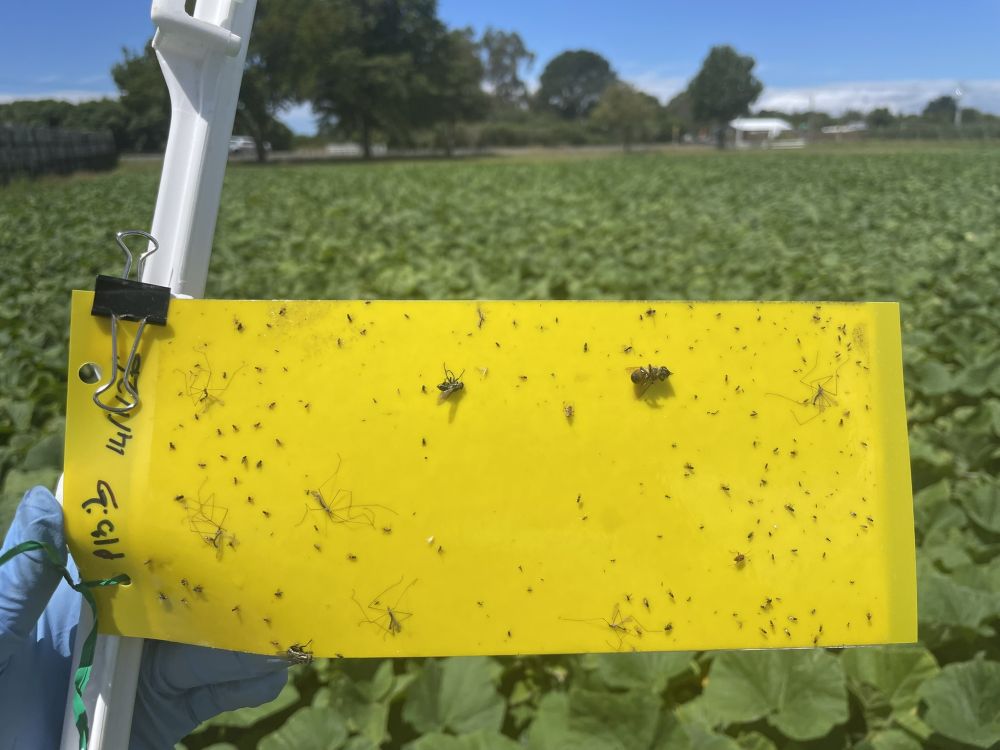
A sticky trap that has been within the butternuts for two days.

We will be holding a grower biodiversity event at the MicroFarm on March 19th. If you are interested in attending, please register here: https://a-lighter-touch.co.nz/biodiversity-grower-group-field-walks/

Related

  • Soil Health for Profit – James Hunter
  • Soil Health for Profit – Charlie White
  • Soil Health for Profit – Josh Wing
  • 2026 Winter cover crops emerged
  • Soil Health for Profit – Pranoy Pal
  • Soil Health for Profit
  • Winter Cover Crops
  • Butternut Harvest Data
  • A Lighter Touch Biodiversity Field Walk
  • Butternut Harvest
  • Measuring Soil Infiltration
  • Cyclone Gabrielle Research Symposium

RECENT POSTS

  • Soil Health for Profit – James Hunter
  • Soil Health for Profit – Charlie White
  • Soil Health for Profit – Josh Wing
  • 2026 Winter cover crops emerged
  • Soil Health for Profit – Pranoy Pal

CATEGORIES

  • Agritech
  • Asparagus
  • Conference
  • Courses
  • Cover crops
  • Cultivation
  • Events
  • Fresh Vegetables
  • Irrigation
  • Membership
  • Nitrate
  • Nutrition
  • People
  • Permanent crops
  • Pests
  • Process Crops
  • Projects
  • Protected cropping
  • regenerative agriculture
  • Regulations
  • Research
  • soil health
  • Sustainable technology
  • Uncategorized
  • Water resources
  • Weeds
©2023 LandWISE – Promoting sustainable land management

Disclaimer: Any information on the LandWISE website or linked LandWISE resources is of a general nature only. We endeavour to provide accurate and adequate information relating to the subject matters contained in it. It has been prepared and made available to all persons and entities strictly on the basis that LandWISE, its researchers and authors are fully excluded from any liability for damages arising out of any reliance in part or in full upon any of the information for any purpose. No endorsement of named products is intended nor is any criticism of other alternative, but unnamed product.