Skip to content
Menu
LandWISE – Promoting sustainable land management
  • Welcome
    • About
    • LandWISE Committee
    • Contact
  • Projects
    • Carbon Positive
      • Carbon Positive Reports
    • Nitrachek: Farmer Friendly Nitrate Testing
    • SLAKES: a cost-effective measure of soil structural stability
    • Soil Repair after Cyclone Gabrielle
    • Vegetable Production Nitrogen Management
    • Best Management of Nitrates in Process Cropping
    • Future Proofing Vegetable Production
    • Herbicide Resistance Management
  • Events
    • Cyclone Gabrielle Research Symposium
      • Historical North Island Flood Events
      • An extraordinary storm: the severity of Cyclone Gabrielle’s weather in Hawke’s Bay
      • The Science Response in the Year of Storms; A Gisborne/Tairawhiti perspective
      • Insights into causes of landslides triggered by Cyclone Gabrielle
      • The effects of Cyclone Gabrielle on fruit tree health in Hawke’s Bay
      • Impact of Cyclone Gabrielle on stonefruit orchards in Hawke’s Bay: a case study
      • Charting the Course following Cyclone Gabrielle
      • Baseline sediment sampling in Tairawhiti and Hawke’s Bay
      • Impacts on cropping businesses
      • Understanding the flooding caused by Cyclone Gabrielle
      • Building Flood Damage from Ex-Tropical Cyclone Gabrielle
      • Food safety and critical incidents: A unified approach for safer produce
      • Silt nutritional status and contamination concerns
      • Lessons from the horticultural sector response to Cyclone Gabrielle
      • Ecological impacts of Cyclone Gabrielle
      • Cyclone Gabrielle and Poplar Windthrow in Northland
      • Seed Size and Establishment Method Determine Crop Recovery Following Cyclone-Induced Silt Deposition
      • Returning to (some) baseline sampling sites to assess cropping soil recovery
      • Recovery of annual cropping ground – Grower learnings
      • Recovery of Annual Cropping over 2 Years
      • Technical and extension learnings from Cyclone Gabrielle
    • Getting to Carbon Positive!
      • Getting to Carbon Positive – Presenters
    • Rebuilding Our Soils
      • Rebuilding Our Soils – Presenters
    • Events Archive
  • Tools
    • Nitrachek Calculator
    • Carbon Calculator
    • Nutrient Budget
    • Irrigation Evaluation – IRRIG8
      • IRRIG8: Centre Pivot
        • IRRIG8-online: Centre Pivot User Guide
      • IRRIG8: Linear Move
      • IRRIG8: Travelling Irrigator
        • IRRIG8-online: Travelling Irrigation User Guide
      • IRRIG8: Multiple sprayline calculator
      • IRRIG8: Solid set irrigation
      • IRRIG8: Pressure and energy
        • Pressure and Energy Calculator: User Guide
    • ANOVA Tool for statistical significance
    • Fertspread Spreader Calibration
    • Fertspread Placement Calibration
    • Soil Infiltration Calculator
      • Disc Permeameter User Guide
      • Disc Permeameter Calculator: Frequently Asked Questions
  • Blog
  • Sign Up
  • Login
  • Members Only
    • Online Learning
  • Account
  • Site Search
LandWISE – Promoting sustainable land management

January 2024 Tomato Update

Posted on January 26, 2024

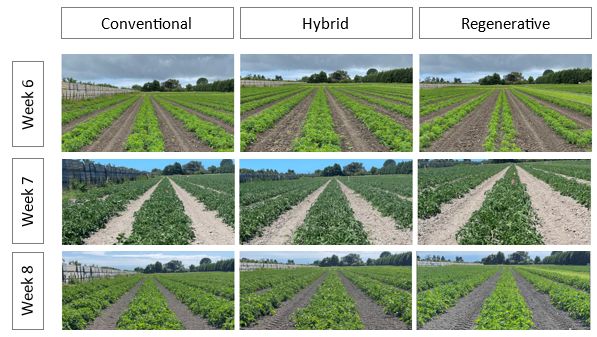
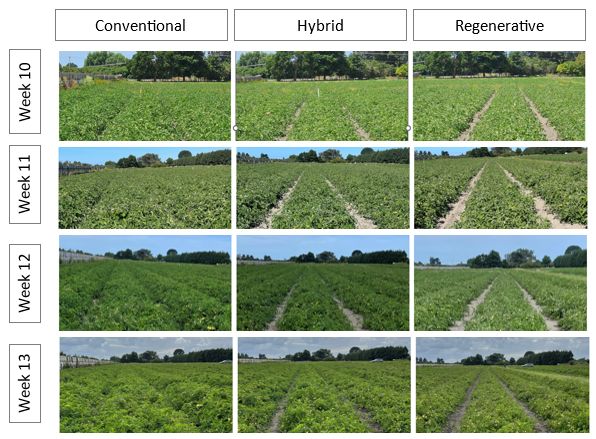
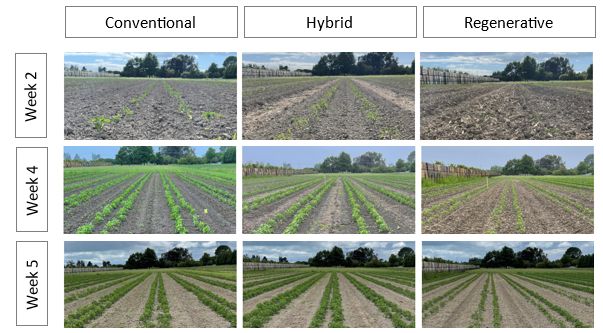
The Carbon Positive tomato crop has now been growing for 13 weeks. Our estimated harvest date is the 5th March, so just under six weeks remaining until harvest. All treatments have had a good fruit set and are reasonably disease free (minus a small amount of bacterial speck). We are on track for a good result at harvest. There are visual differences between the treatments. The conventional treatment has a dense canopy, the regenerative treatment has a more open canopy and the fruit is more exposed. The hybrid is somewhere in between. Management for the month of January has included three spray applications, two irrigations and one granular fertiliser application. More on this below.

Canopy Development Week 2 – 13
Pest Management

In mid-January we started to see holes appearing in tomatoes, caused by corn ear worm/tomato fruit worm. The first insecticide application we used (Benevia) is registered for chewing insects, so caterpillars were targeted early in the season. However, subsequent insecticides have predominantly targeted sucking insects (psyllid/thrips/aphids/whitefly). We applied Uphold (spinetoram) across all treatments to control fruit worm. The crop was inspected five days after application, and found no active caterpillars. Additionally, we still haven’t seen any psyllid on the sticky traps in the field, which is positive!
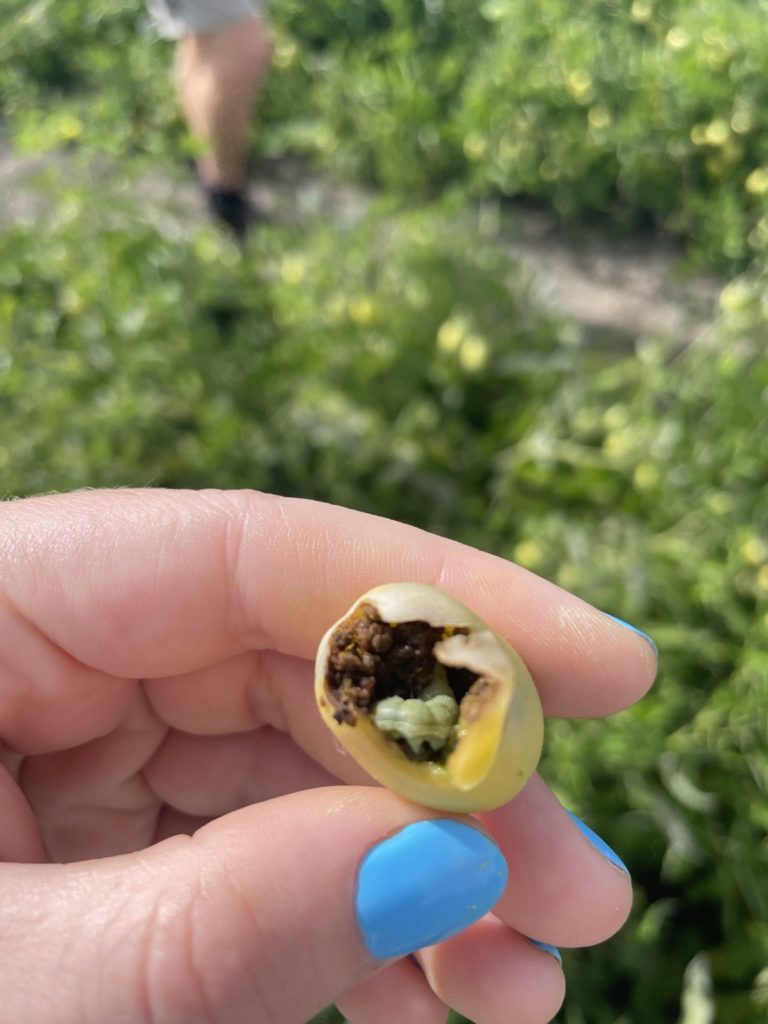
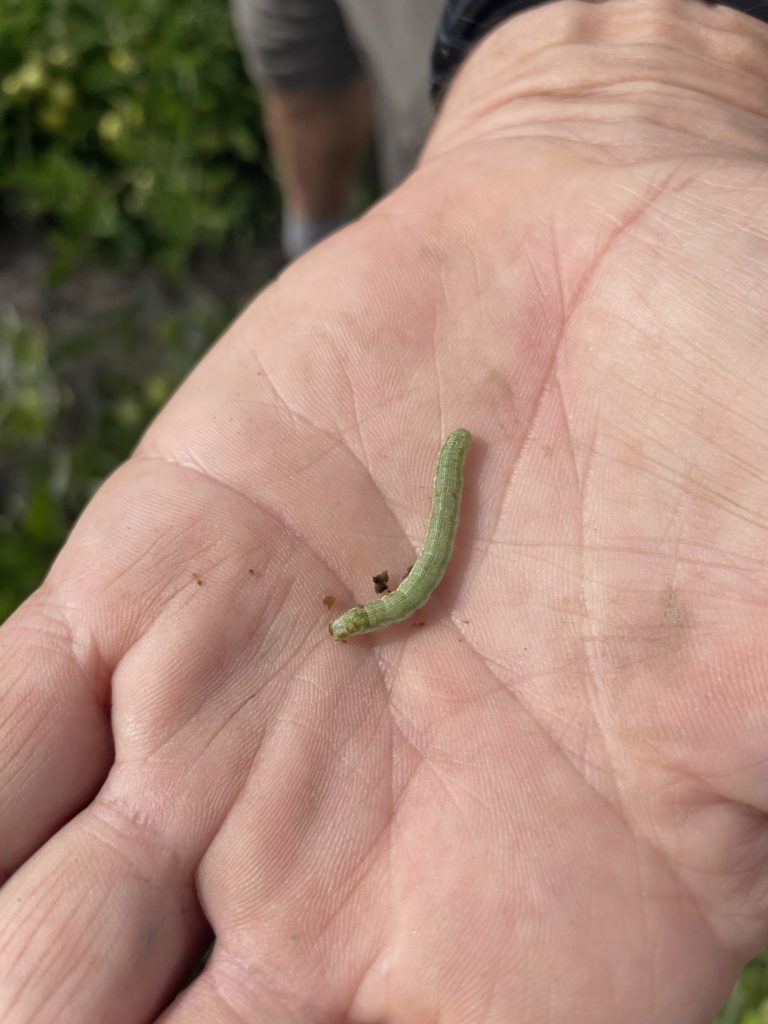
Images of tomato fruit worm found in trial plots

Nutrient Management

We have been regularly monitoring soil nitrate levels using the Nitrate Quick Test method. Nitrate levels have been declining since side dressing, which indicates that plant demand is exceeding supply of nitrogen. Fruit set has been good and we want to ensure there is enough energy in the canopy to increase fruit size (and yield).
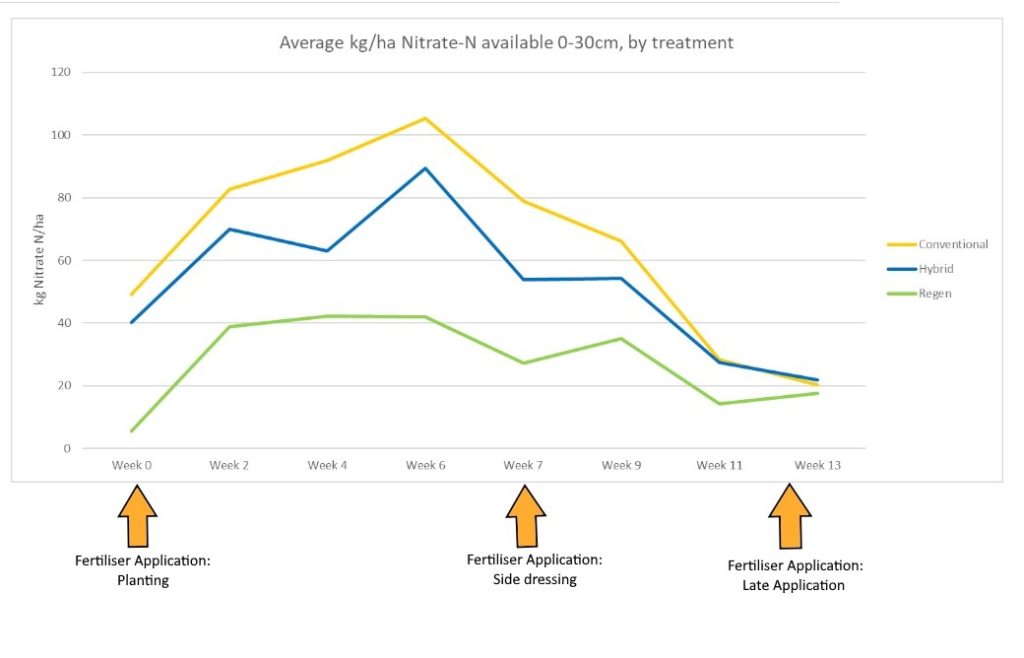
Graph showing average Nitrate-N in top 30cm of soil profile, in each treatment, and timing of fertiliser applications.

Additionally, we have been doing monthly leaf tests to look at nutrient levels in the tomato leaves. There have been signs of leaf rolling, and purpling along the leaf margins in all treatments in January. This was more distinct in the Regen treatment. This is an indication of low phosphorus or potassium causing plant stress.
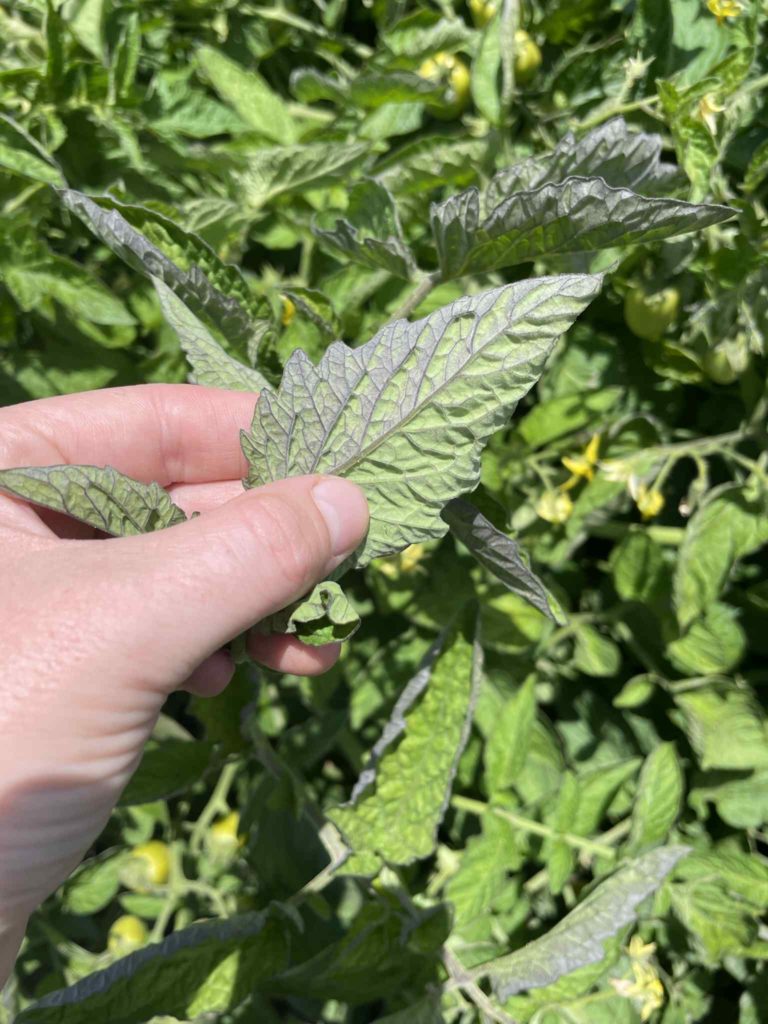
Image of purpling on underside of leaf (Plot 3- Regen Treatment)

Leaf tests showed lower than optimum Nitrogen percentages in the leaf for this stage in the season, as well as low P and K percentages (graph below showing N%). The Operations Advisory Group decided to apply a late application of fertiliser across all treatments. The Regenerative treatment has appeared stressed compared to the other treatments in recent weeks. There has been concern as to whether the canopy is big enough to size the fruit already set. The OAG used the information available to make a justified ‘grower decision’ to address the apparent nutrient deficiencies.
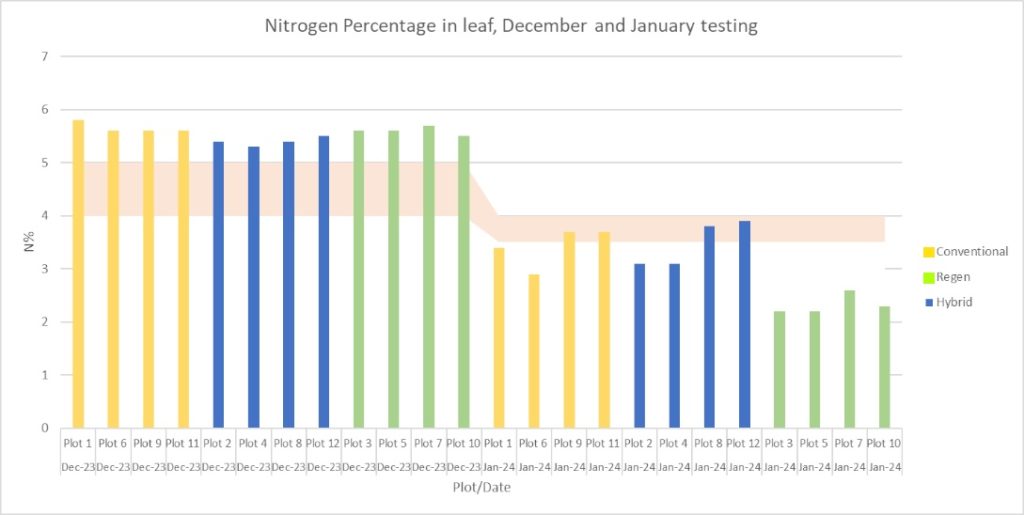
Graph showing Nitrogen percentage in tomato leaf, by treatment by plot, December and January analysis. Optimum range at different growth stages displayed as pink band.

Nitrogen concentrations in the leaf were lower in the Regen treatment than the other two treatments, so we decided to apply a higher rate of N, to support the plants to harvest. The OAG decided to apply YaraRega 9-0-27.5. The Conventional and Hybrid treatment had 9kg N and 27.5kg K applied (100kg/ha). The Regen treatment had 18kg N and 55kg K applied (200kg/ha). This is somewhat counter intuitive for the Regen treatment, however all of the treatments have now received the same amount of N, around 90kgN/ha. Even with this application the Regen plots have had much less potassium applied compared to the other two treatments.

Drone Application

Fertiliser applied late in the season is normally done using a tractor mounted spreader. However, because our plots are 12m wide, we are unable to get the desired spread width this way. We worked with Airborne Solutions to apply the fertiliser with their drone, to be more targeted with our application, plus avoids damaging the plants by driving over with a ground spreader. The spread of the product was uniform and spread to the 12m width of our plots. The drone carries 40kg of product so was a quick job to get done on our 1.5ha.
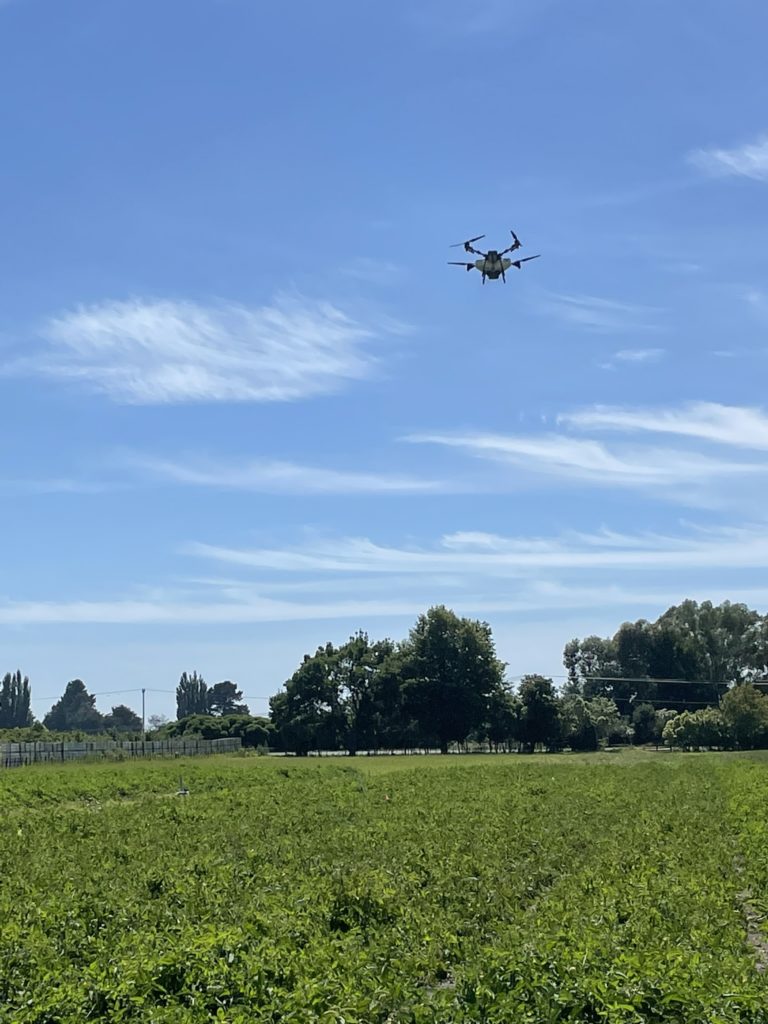
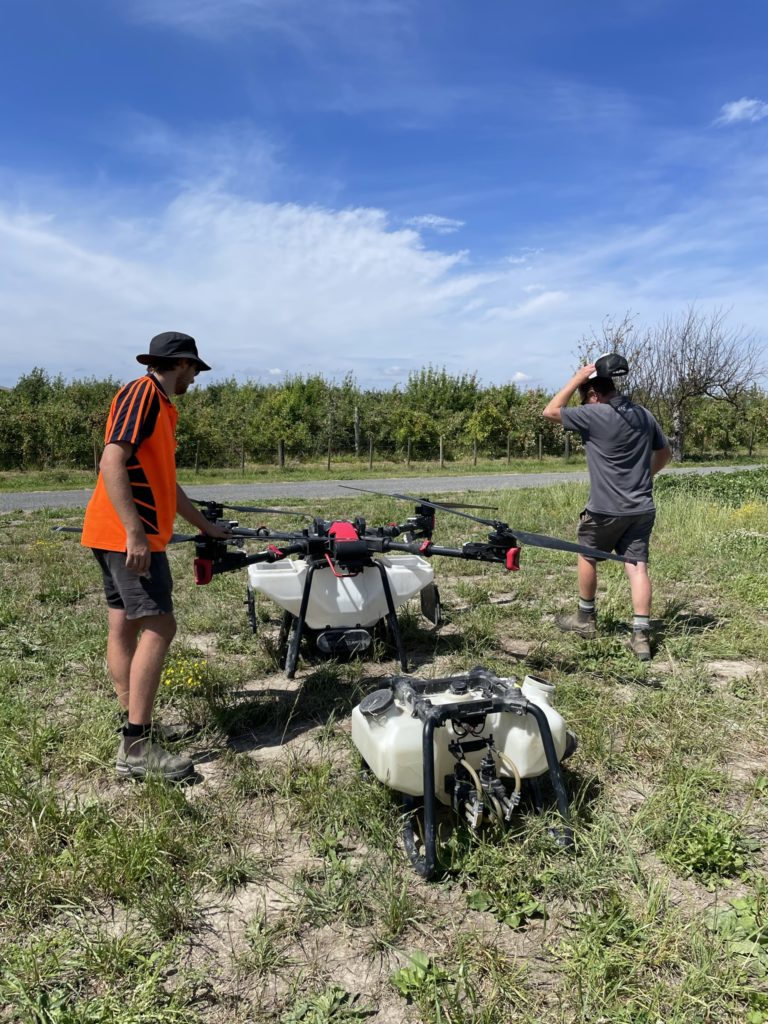
Images of Airborne Solutions drone spreading fertiliser over trial area
  • Cyclone Gabrielle Research Symposium
  • Biodiversity Strips Update
  • Carbon Positive: Butternuts
  • Carbon Positive: Butternut Planting to Side Dressing
  • Nitrate Levels on the MicroFarm
  • Cyclone Gabrielle Research Symposium
  • Introducing Carys Luke, our Summer Intern
  • Soil Infiltration Calculator
  • MicroFarm Biodiversity Update
  • Irrigation System Testing
  • Carbon Positive: Butternut Planting
  • NZARM Conference 2025

RECENT POSTS

  • Cyclone Gabrielle Research Symposium
  • Biodiversity Strips Update
  • Carbon Positive: Butternuts
  • Carbon Positive: Butternut Planting to Side Dressing
  • Nitrate Levels on the MicroFarm

CATEGORIES

  • Agritech
  • Asparagus
  • Conference
  • Courses
  • Cover crops
  • Cultivation
  • Events
  • Fresh Vegetables
  • Irrigation
  • Membership
  • Nitrate
  • Nutrition
  • People
  • Permanent crops
  • Pests
  • Process Crops
  • Projects
  • Protected cropping
  • regenerative agriculture
  • Regulations
  • Research
  • soil health
  • Sustainable technology
  • Uncategorized
  • Water resources
  • Weeds
©2023 LandWISE – Promoting sustainable land management

Disclaimer: Any information on the LandWISE website or linked LandWISE resources is of a general nature only. We endeavour to provide accurate and adequate information relating to the subject matters contained in it. It has been prepared and made available to all persons and entities strictly on the basis that LandWISE, its researchers and authors are fully excluded from any liability for damages arising out of any reliance in part or in full upon any of the information for any purpose. No endorsement of named products is intended nor is any criticism of other alternative, but unnamed product.