Skip to content
Menu
LandWISE – Promoting sustainable land management
  • Welcome
    • About
    • LandWISE Committee
    • Contact
  • Projects
    • Carbon Positive
      • Carbon Positive Reports
    • Nitrachek: Farmer Friendly Nitrate Testing
    • SLAKES: a cost-effective measure of soil structural stability
    • Soil Repair after Cyclone Gabrielle
    • Vegetable Production Nitrogen Management
    • Best Management of Nitrates in Process Cropping
    • Future Proofing Vegetable Production
    • Herbicide Resistance Management
  • Events
    • Cyclone Gabrielle Research Symposium
      • Historical North Island Flood Events
      • An extraordinary storm: the severity of Cyclone Gabrielle’s weather in Hawke’s Bay
      • The Science Response in the Year of Storms; A Gisborne/Tairawhiti perspective
      • Insights into causes of landslides triggered by Cyclone Gabrielle
      • The effects of Cyclone Gabrielle on fruit tree health in Hawke’s Bay
      • Impact of Cyclone Gabrielle on stonefruit orchards in Hawke’s Bay: a case study
      • Charting the Course following Cyclone Gabrielle
      • Baseline sediment sampling in Tairawhiti and Hawke’s Bay
      • Impacts on cropping businesses
      • Understanding the flooding caused by Cyclone Gabrielle
      • Building Flood Damage from Ex-Tropical Cyclone Gabrielle
      • Food safety and critical incidents: A unified approach for safer produce
      • Silt nutritional status and contamination concerns
      • Lessons from the horticultural sector response to Cyclone Gabrielle
      • Ecological impacts of Cyclone Gabrielle
      • Cyclone Gabrielle and Poplar Windthrow in Northland
      • Seed Size and Establishment Method Determine Crop Recovery Following Cyclone-Induced Silt Deposition
      • Returning to (some) baseline sampling sites to assess cropping soil recovery
      • Recovery of annual cropping ground – Grower learnings
      • Recovery of Annual Cropping over 2 Years
      • Technical and extension learnings from Cyclone Gabrielle
    • Getting to Carbon Positive!
      • Getting to Carbon Positive – Presenters
    • Rebuilding Our Soils
      • Rebuilding Our Soils – Presenters
    • Events Archive
  • Tools
    • Nitrachek Calculator
    • Carbon Calculator
    • Nutrient Budget
    • Irrigation Evaluation – IRRIG8
      • IRRIG8: Centre Pivot
        • IRRIG8-online: Centre Pivot User Guide
      • IRRIG8: Linear Move
      • IRRIG8: Travelling Irrigator
        • IRRIG8-online: Travelling Irrigation User Guide
      • IRRIG8: Multiple sprayline calculator
      • IRRIG8: Solid set irrigation
      • IRRIG8: Pressure and energy
        • Pressure and Energy Calculator: User Guide
    • ANOVA Tool for statistical significance
    • Fertspread Spreader Calibration
    • Fertspread Placement Calibration
    • Soil Infiltration Calculator
      • Disc Permeameter User Guide
      • Disc Permeameter Calculator: Frequently Asked Questions
  • Blog
  • Sign Up
  • Login
  • Members Only
    • Online Learning
  • Account
  • Site Search
LandWISE – Promoting sustainable land management

LandWISE 2023 Lynn Sosnoskie – Keynote Speaker

Posted on April 24, 2023

Weeds Research in North America

Lynn Sosnoskie joined Cornell AgriTech in September 2019 as an Assistant Professor of Weed Ecology and Management in Specialty Crops, which includes tree and vine crops in addition to fresh and processing vegetables. A native of Shamokin, Pennsylvania, she earned a B.Sc. in Biology from Lebanon Valley College, a M.Sc. in Plant Pathology at the University of Delaware, and a Ph.D. in Weed Science at Ohio State.

Prior to taking her position at Cornell, Lynn worked as a research scientist at the University of Georgia, the University of California – Davis, and Washington State University. Her work has focused on a variety of crops (almonds, cotton, melons, peppers, pistachios, tomatoes, walnuts, and wheat) and a variety of weeds (field bindweed and glyphosate resistant Palmer amaranth, hairy fleabane, horseweed, and junglerice). She was most recently employed by the University of California as a Farm Advisor working with agronomic crops in the Central Valley, which is California’s agricultural hub.

In New York, Lynn’s research is multifaceted. In partnership with commodity groups, agricultural manufacturers, and the IR-4 Project, her lab is screening novel products for potential labeling. However, repeated use of some herbicides or modes of action over time and space can lead to intense pressure that selects for biotypes that are insensitive to commonly used chemistries. Consequently, another area of focus is confirming and describing herbicide resistance in weed species that have grown increasingly difficult to control. This includes glyphosate resistance and resistance to the ALS-inhibiting chemistries in Palmer amaranth (Amaranthus palmeri) and waterhemp (Amaranthus tuberculatus); it also includes resistance to paraquat and diquat in horseweed (Conyza canadensis). Other weed species-herbicide combinations of concern and under investigation include common lambsquarters (Chenopodium album)/bentazon, Powell amaranth (Amaranthus powellii)/PSII- and PPO-inhibiting herbicides, and common ragweed (Ambrosia artemisiifolia)/clopyralid.

Although herbicides are an important component of weed management, they are not a silver bullet; sustainable programs must investigate other tools and technologies for controlling unwanted vegetation. Lynn’s lab is also exploring non-chemical strategies for weed suppression including cover crops and mulches, vision-guided sprayers and cultivators, and electric weeders.
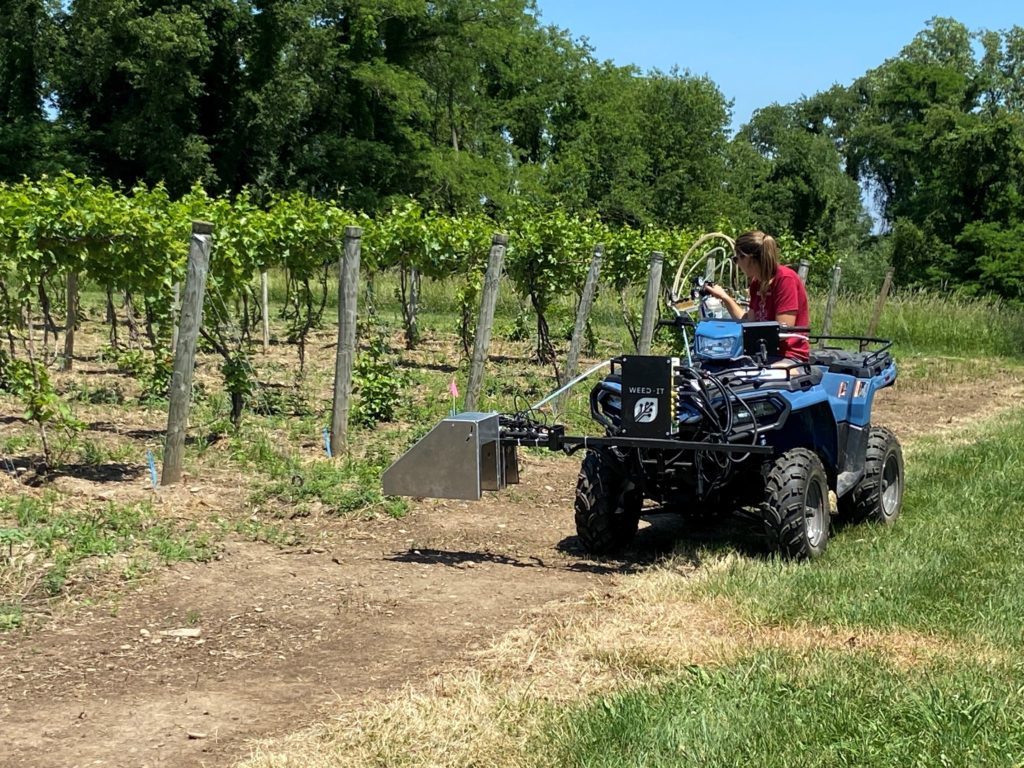
Hi NY grape and tree fruit growers. I’ve using a custom-built system to investigate weed and sucker control performance in NY perennial crops. Follow me to see our trials as they develop in 2023. @LynnSosnoskie

LandWISE 2023: Normal Practice Revisited
  • Cyclone Gabrielle Research Symposium
  • Biodiversity Strips Update
  • Carbon Positive: Butternuts
  • Carbon Positive: Butternut Planting to Side Dressing
  • Nitrate Levels on the MicroFarm
  • Cyclone Gabrielle Research Symposium
  • Introducing Carys Luke, our Summer Intern
  • Soil Infiltration Calculator
  • MicroFarm Biodiversity Update
  • Irrigation System Testing
  • Carbon Positive: Butternut Planting
  • NZARM Conference 2025

RECENT POSTS

  • Cyclone Gabrielle Research Symposium
  • Biodiversity Strips Update
  • Carbon Positive: Butternuts
  • Carbon Positive: Butternut Planting to Side Dressing
  • Nitrate Levels on the MicroFarm

CATEGORIES

  • Agritech
  • Asparagus
  • Conference
  • Courses
  • Cover crops
  • Cultivation
  • Events
  • Fresh Vegetables
  • Irrigation
  • Membership
  • Nitrate
  • Nutrition
  • People
  • Permanent crops
  • Pests
  • Process Crops
  • Projects
  • Protected cropping
  • regenerative agriculture
  • Regulations
  • Research
  • soil health
  • Sustainable technology
  • Uncategorized
  • Water resources
  • Weeds
©2023 LandWISE – Promoting sustainable land management

Disclaimer: Any information on the LandWISE website or linked LandWISE resources is of a general nature only. We endeavour to provide accurate and adequate information relating to the subject matters contained in it. It has been prepared and made available to all persons and entities strictly on the basis that LandWISE, its researchers and authors are fully excluded from any liability for damages arising out of any reliance in part or in full upon any of the information for any purpose. No endorsement of named products is intended nor is any criticism of other alternative, but unnamed product.