
Skip to content
Menu
LandWISE – Promoting sustainable land management
  • Welcome
    • About
    • LandWISE Committee
    • Contact
  • Projects
    • Carbon Positive
      • Carbon Positive Reports
    • Nitrachek: Farmer Friendly Nitrate Testing
    • SLAKES: a cost-effective measure of soil structural stability
    • Soil Repair after Cyclone Gabrielle
    • Vegetable Production Nitrogen Management
    • Best Management of Nitrates in Process Cropping
    • Future Proofing Vegetable Production
    • Herbicide Resistance Management
  • Events
    • Cyclone Gabrielle Research Symposium
      • Historical North Island Flood Events
      • An extraordinary storm: the severity of Cyclone Gabrielle’s weather in Hawke’s Bay
      • The Science Response in the Year of Storms; A Gisborne/Tairawhiti perspective
      • Insights into causes of landslides triggered by Cyclone Gabrielle
      • The effects of Cyclone Gabrielle on fruit tree health in Hawke’s Bay
      • Impact of Cyclone Gabrielle on stonefruit orchards in Hawke’s Bay: a case study
      • Charting the Course following Cyclone Gabrielle
      • Baseline sediment sampling in Tairawhiti and Hawke’s Bay
      • Impacts on cropping businesses
      • Understanding the flooding caused by Cyclone Gabrielle
      • Building Flood Damage from Ex-Tropical Cyclone Gabrielle
      • Food safety and critical incidents: A unified approach for safer produce
      • Silt nutritional status and contamination concerns
      • Lessons from the horticultural sector response to Cyclone Gabrielle
      • Ecological impacts of Cyclone Gabrielle
      • Cyclone Gabrielle and Poplar Windthrow in Northland
      • Seed Size and Establishment Method Determine Crop Recovery Following Cyclone-Induced Silt Deposition
      • Returning to (some) baseline sampling sites to assess cropping soil recovery
      • Recovery of annual cropping ground – Grower learnings
      • Recovery of Annual Cropping over 2 Years
      • Technical and extension learnings from Cyclone Gabrielle
    • Getting to Carbon Positive!
      • Getting to Carbon Positive – Presenters
    • Rebuilding Our Soils
      • Rebuilding Our Soils – Presenters
    • Events Archive
  • Tools
    • Nitrachek Calculator
    • Carbon Calculator
    • Nutrient Budget
    • Irrigation Evaluation – IRRIG8
      • IRRIG8: Centre Pivot
        • IRRIG8-online: Centre Pivot User Guide
      • IRRIG8: Linear Move
      • IRRIG8: Travelling Irrigator
        • IRRIG8-online: Travelling Irrigation User Guide
      • IRRIG8: Multiple sprayline calculator
      • IRRIG8: Solid set irrigation
      • IRRIG8: Pressure and energy
        • Pressure and Energy Calculator: User Guide
    • ANOVA Tool for statistical significance
    • Fertspread Spreader Calibration
    • Fertspread Placement Calibration
    • Soil Infiltration Calculator
      • Disc Permeameter User Guide
      • Disc Permeameter Calculator: Frequently Asked Questions
  • Blog
  • Sign Up
  • Login
  • Members Only
    • Online Learning
  • Account
  • Site Search
LandWISE – Promoting sustainable land management

Revitalise Te Taiao – mātauranga-led, science-informed research

Posted on May 22, 2024

In a special event after the LandWISE Conference “Rebuilding Our Soils”, we hosted a wānanga/workshop led by Erina Wehi-Barton, Taonui Campbell and Clare Bradley. Clare introduced the Our Land and Water project “Revitalise Te Taiao” at the conference, and it attracted considerable interest. They have been integrating Matauranga Maori, farming, and scientific knowledge to promote soil health in the Rere Ki Uta Rere Ki Tai project. 

We were delighted to join with regenerative agriculture and cropping research colleagues from Massey University’s “Whenua Haumanu – nurturing the land through exploring pastoral farming“, Leaderbrand’s “Farming for a Healthy Future“, On-Farm Research’s “Evaluating Regen Ag and developing farmer resilience on a dryland demonstration farm” and our own team from LandWISE and HB Future Farming Trust with “Carbon Positive – regenerative intensive process cropping“.
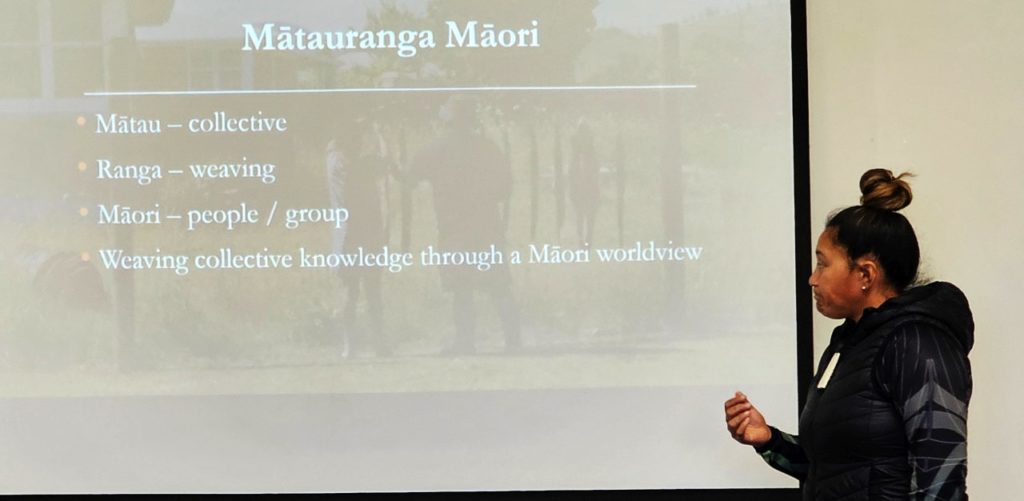
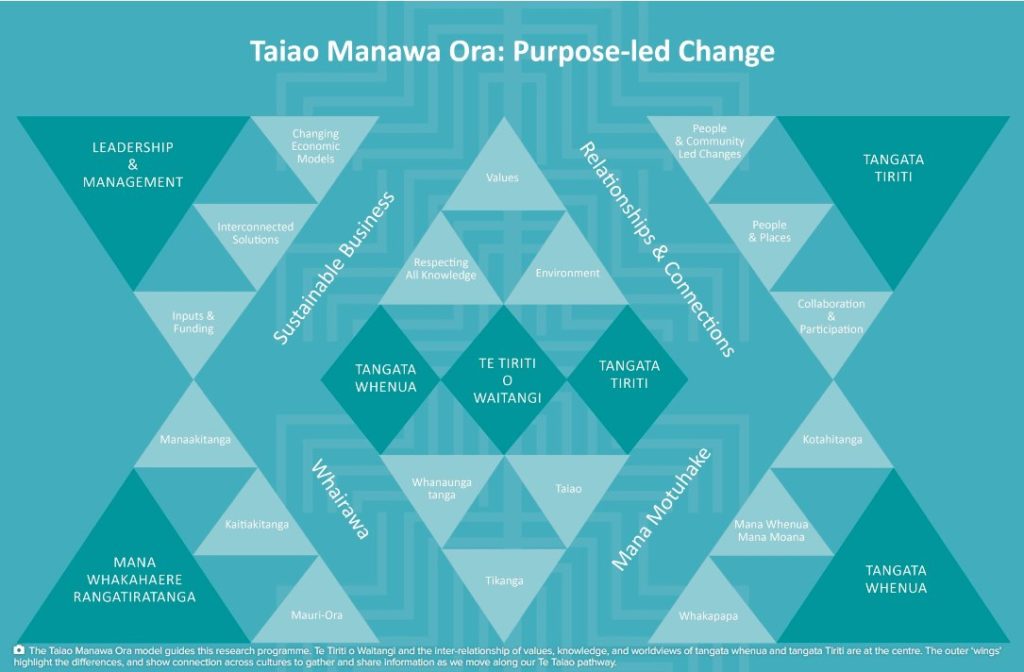
Each of the projects has commitment to mātauranga Māori and as largely pakeha researchers trained in Western science, we can feel somewhat lost. Taonui and Erina provided a structure to explore the threads of mātauranga and the commonalities and differences between the Māori and Western knowledge systems. There are many parallels and overlaps.

Te Taiao is a Māori concept that refers to the natural world, including land, water, climate, and living beings, and their inter-relationships. These are all elements in farm and orchard management and in agricultural and horticultural research, so are familiar to those trained in agricultural or environmental science. Perhaps though, our tendency to focus in closer and closer when using reductionist methodologies puts us at risk of forgetting the context within which we work. A farm input decision is based partly on agronomic research but always includes economic oversight. Increasingly we are conscious that application takes place in a regulatory and social licence context, and within limits set or expected by markets and by importers’ regulations. At another level, we know but can lose sight of the fact, that adjusting one factor is very likely to affect how other factors respond.

Mātauranga can be held by different groupings so exists at Māori level, at iwi, hapū and whānau and even individual level. Just as there is knowledge held by me, shared by my immediate family and with my cousins, among my professional groups and with the population generally. That knowledge is built over time as a result of many observations and understandings and it is everchanging over time and space. Like Western science. Our understanding at one point in time may be revised as new observations are made, lessons learned, and our synthesised understanding evolves. And as agronomists, we understand that knowledge of good agricultural practice that applies in one area or to one crop may not transfer to another.

As farmers and growers and Western science people, we are familiar with bodies of knowledge about physics, biology, chemistry and agronomy, and can extend that to law and finance etc. We know these as subjects we study at school and university. In a 2012 essay, Sir Hirini Moko Mead suggested that tikanga Māori, āhuatanga Māori, kaupapa Māori, manaakitanga, te reo Māori, waiata, tā moko, kapa haka etc. are subjects within mātauranga Māori.

It seems to me that there are many parallels between these knowledge systems – the same, but different.

We are most grateful to Clare and Agrisea NZ Seaweed Ltd for their support, and especially to Taonui and Erina for leading the wānanga. And we also thank the other participants who travelled to be with us and shared their stories, confusions and questions openly in a safe environment. While we had a very informative day, many more lessons await us. We look forward to following this wānanga with others as we grow our knowledge.

Dan

mātauranga: knowledge, wisdom, understanding, skill – sometimes used in the plural. Education – an extension of the original meaning and commonly used in modern Māori with this meaning.

wānanga: to meet and discuss, deliberate, consider. A seminar, conference, forum, educational seminar.

Te Aka Māori Dictionary
  • Cyclone Gabrielle Research Symposium
  • Biodiversity Strips Update
  • Carbon Positive: Butternuts
  • Carbon Positive: Butternut Planting to Side Dressing
  • Nitrate Levels on the MicroFarm
  • Cyclone Gabrielle Research Symposium
  • Introducing Carys Luke, our Summer Intern
  • Soil Infiltration Calculator
  • MicroFarm Biodiversity Update
  • Irrigation System Testing
  • Carbon Positive: Butternut Planting
  • NZARM Conference 2025

RECENT POSTS

  • Cyclone Gabrielle Research Symposium
  • Biodiversity Strips Update
  • Carbon Positive: Butternuts
  • Carbon Positive: Butternut Planting to Side Dressing
  • Nitrate Levels on the MicroFarm

CATEGORIES

  • Agritech
  • Asparagus
  • Conference
  • Courses
  • Cover crops
  • Cultivation
  • Events
  • Fresh Vegetables
  • Irrigation
  • Membership
  • Nitrate
  • Nutrition
  • People
  • Permanent crops
  • Pests
  • Process Crops
  • Projects
  • Protected cropping
  • regenerative agriculture
  • Regulations
  • Research
  • soil health
  • Sustainable technology
  • Uncategorized
  • Water resources
  • Weeds
©2023 LandWISE – Promoting sustainable land management

Disclaimer: Any information on the LandWISE website or linked LandWISE resources is of a general nature only. We endeavour to provide accurate and adequate information relating to the subject matters contained in it. It has been prepared and made available to all persons and entities strictly on the basis that LandWISE, its researchers and authors are fully excluded from any liability for damages arising out of any reliance in part or in full upon any of the information for any purpose. No endorsement of named products is intended nor is any criticism of other alternative, but unnamed product.