
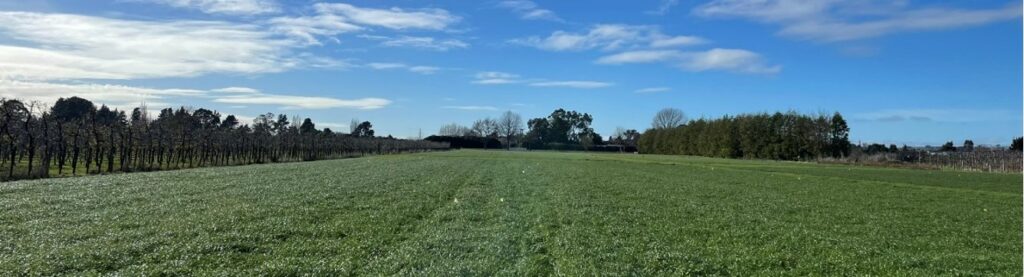
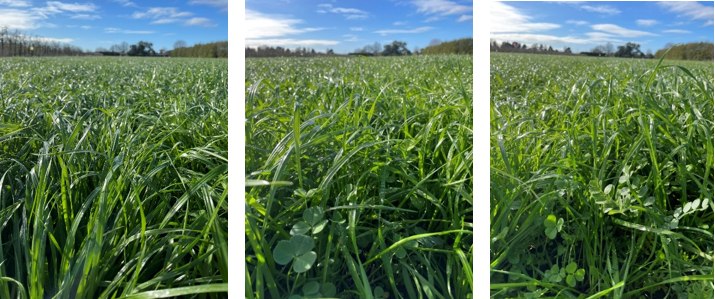
The cover crops were direct drilled by Kettle Contracting on the 7th of April. The Conventional treatment was planted with Moata annual ryegrass. The Hybrid treatment also has Moata with crimson and Balansa clover added. The Regenerative treatment has the same cover crop mix as the Hybrid treatment with the addition of vetch. As in previous years, the Conventional treatment will be grazed by sheep over the winter, while the Regenerative and Hybrid treatments will not.
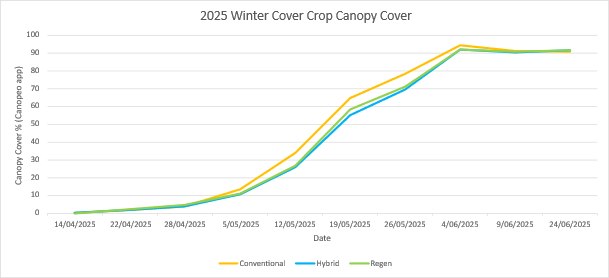
In the chart above, the last two measurements are artificially lower than the actual covers. The Canopeo app has difficulty identifying deep shadow in bright sunshine conditions. We would expect all treatments to be very close to 100% ground cover if images were collected on a cloudy day.
The cover crops established well, with all treatments nearly reaching full canopy cover after 8 weeks. This is an improvement from last year’s cover crops, when the Hybrid and Regenerative treatments struggled to reach full canopy cover before termination.
A key difference in 2025 is that the regenerative treatment has been planted with ryegrass and three legumes, rather than multispecies mixes with oats, radishes, sunflowers, buckwheat, vetch and clovers. One reason for this is the get maximum ground cover as quickly as possible at a manageable cost. The multispecies mixes took a long time to reach 80% ground cover in 2024, and never fully covered the ground. Seed rates could have been increased, but costs were already high compared to annual ryegrass.
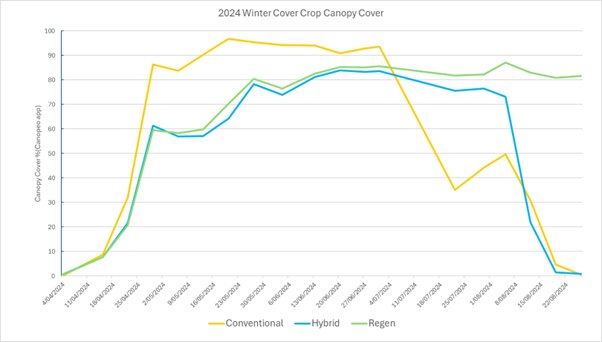
The 2024 ground cover chart shows the difference between the annual ryegrass (yellow line) and the multispecies (blue and green lines) cover crop growth rates. Gaps in the Hybrid and Regenerative plot covers allowed weeds to emerge but still did not cover all the soil. (The weekly dips are caused by the bright sun image analysis issue noted above.) The Conventional ryegrass was sprayed out early for process peas, hence the drop from early July. The multispecies cover crop in the Hybrid (blue line) was sprayed out later, also for peas. The Regenerative treatment (green line) stayed high because the cover crop was retained, rather than growing a pea crop.
What is next?
The 2025-2026 summer crop is butternuts for Heinz-Wattie’s, with a mid-November planting date expected. This gives a lot of time for any cover crop benefits to be captured and raises the possibility of a second crop in spring if desired. The Carbon Positive Operations Advisory Group will meet in July to confirm management plans for each treatment.
