
Hi, I’m Carys, I have just completed study for my Bachelor of Agricultural Science with honours at Lincoln University. My honours project investigated the potential of struvite (a recycled, acid-soluble phosphate fertiliser) as an alternative to single superphosphate for potato production. This experiment compared results when used on soils of high and low phosphate-retention capacities.
I grew up in Taranaki, and this is my first time in Hawke’s Bay. I have previous experience working as university research scholar investigating nutrient dynamics in high country soils, alongside soil description and classification experience.
Through my time at university and involvement with the Lincoln University Soil Society, I have picked up my hobby of soil judging.
It is an annual competition that involves classifying different soil profiles through understanding and interpreting geology, landforms, and morphology of the soil and its surrounding landscape. Soil descriptions can then be used to determine best land use. I have competed in Marlborough, Darwin, Rotorua, and most recently Armidale, NSW. Soil judging has taught me the importance of how landscape influences soil capability, and has given me skills, learning, and connections that cannot be gained inside a classroom. Soil judging has introduced me to a community of passionate individuals who all appreciate soil as a valuable and vulnerable resource that needs to be looked after.
From my internship at LandWISE I look forward to meeting new people and learning more about horticultural systems unique to this beautiful region! What excites me about the Carbon Positive project is its comparison of different cropping systems from both an environmental and financial lens. The intersection between environmental and financial sustainability was a key idea that initially sparked my passion to pursue a career in agricultural science.
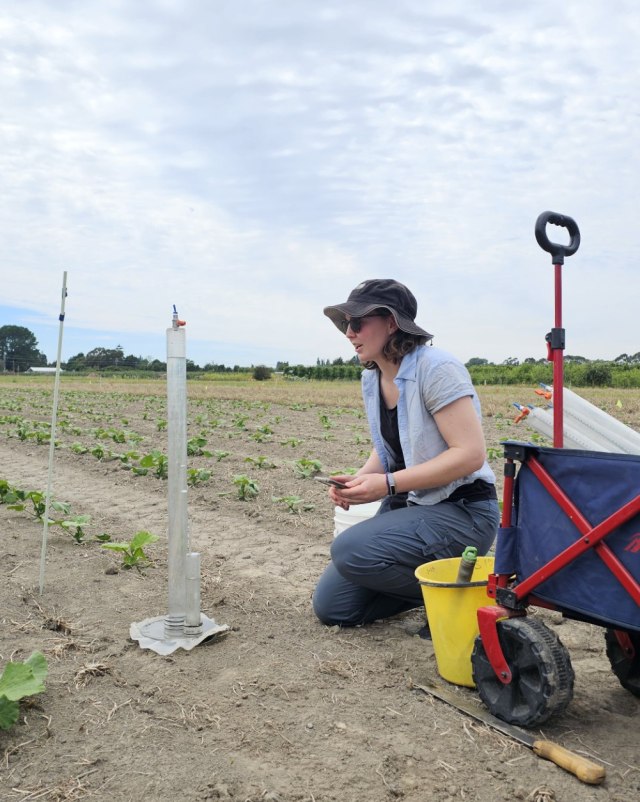
So far, I have been involved in weekly data collection to monitor soil moisture and canopy development, alongside fortnightly soil sampling to undertake nitrate quick testing across the plots. I have completed one round of soil infiltration rate testing using disc permeameters. The permeameters measure the rate at which water infiltrates the soil under different water tensions, which gives an indication into soil hydraulic conductivity and pore size distribution. This can indicate how soil structure and compaction vary between treatments.