
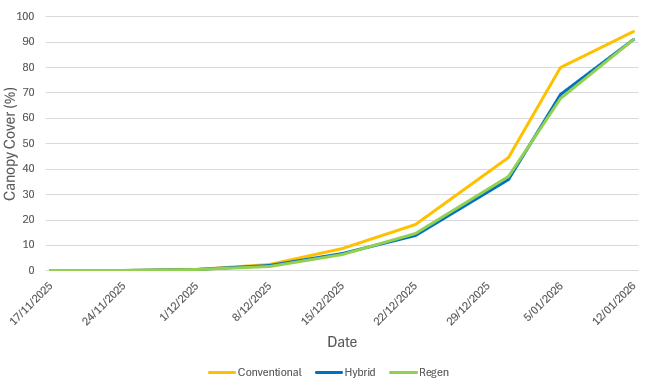
The butternuts have grown rapidly since being planted on the 15th of November. All three treatments have nearly reached full canopy cover. At this stage, the main differences we’re observing are between plots within treatments, rather than clear differences between the three treatments.
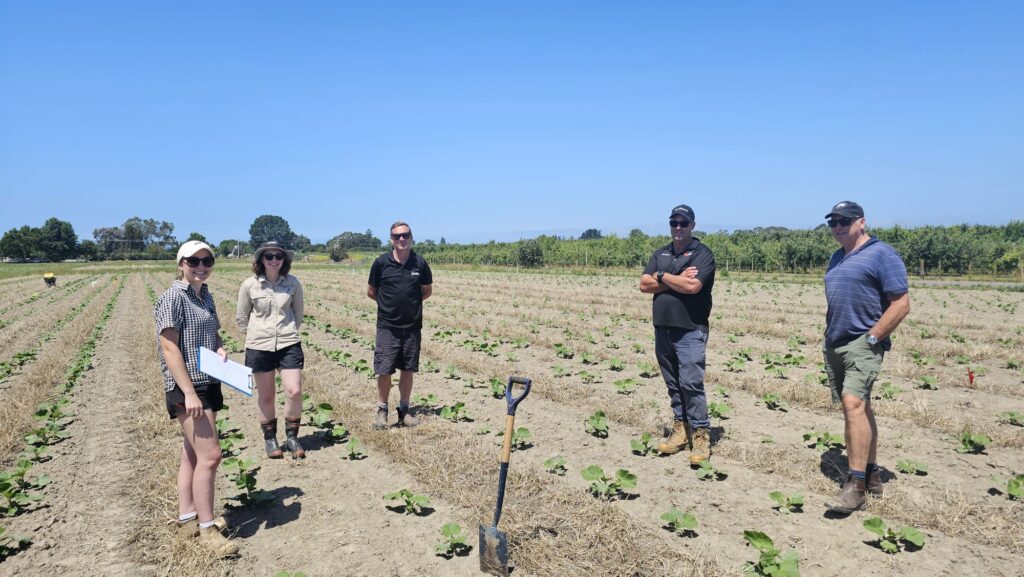
The Operation Advisory Group has met weekly to observe how the butternuts are growing and to make management decisions for the upcoming week. The main decisions have been about what fungicides to spray, if the Regenerative treatment needs a foliar application, and if a bactericide needs to be applied. Rob Nichol from Horticentre has played a key role in the decision making prosess, helping us identify angular leaf spot in the paddock and providing us with product recommendations.
The first fungicide application went on about a month after planting. Since then, all treatments have had a fungicide and bactericide sprayed each fortnight. With the varying temperatures and rain we have had, it has created the perfect conditions for angular leaf spot, and we have started seeing patches of it within the butternuts.
Table: Fungicide and Bactericide applications to all three treatments in the Carbon Positive Trial.
| Product | Product type | Active Ingredient | Rate/ha | Water Rate | Application Date |
| Talendo | Fungicide | Proquinazid | 0.25 | 300 | 19/12/2025 |
| Talendo | Fungicide | Proquinazid | 0.25 | 300 | 2/01/2026 |
| Kocide Opti | Bactericide | Copper | 0.70 | 300 | 2/01/2026 |
| Vivando | Fungicide | Metrafenone | 0.3 | 300 | 16/01/2026 |
| Copper Hydroxide 300 | Bactericide | Copper | 0.80 | 300 | 16/01/206 |
The Regenerative treatment also had an application of Bio Marinus during the first fungicide application, and a Megafol application the day before the third fungicide.
EIQ is a tool available online through Cornell University, which can be used to determine the environmental impact of specific agrichemicals. The Field Use EIQ is a score based on how toxic the product’s active ingredients are and how much has been used per hectare. The Field Use EIQ Score for each product has been low (around 10). This is why all three treatments have received the same spray applications. For comparison, when the paddocks were broadcast-sprayed with Glyphosate at the beginning of the season, the Field Use EIQ Score was 60.
We will continue to monitor disease pressure and will determine if we can use an alternative product in the Regenerative and Hybrid treatments later in the season.
Throughout the rest of the season, the Operations Advisory Group will continue to meet weekly to make management decisions.
A big thank you to all the Operation Advisory Group members who have attended our weekly field walks.
Carbon Positive is a partnership between LandWISE, the HB Future Farming Trust, McCain Foods, Heinz-Wattie’s and Process Vegetables NZ.