
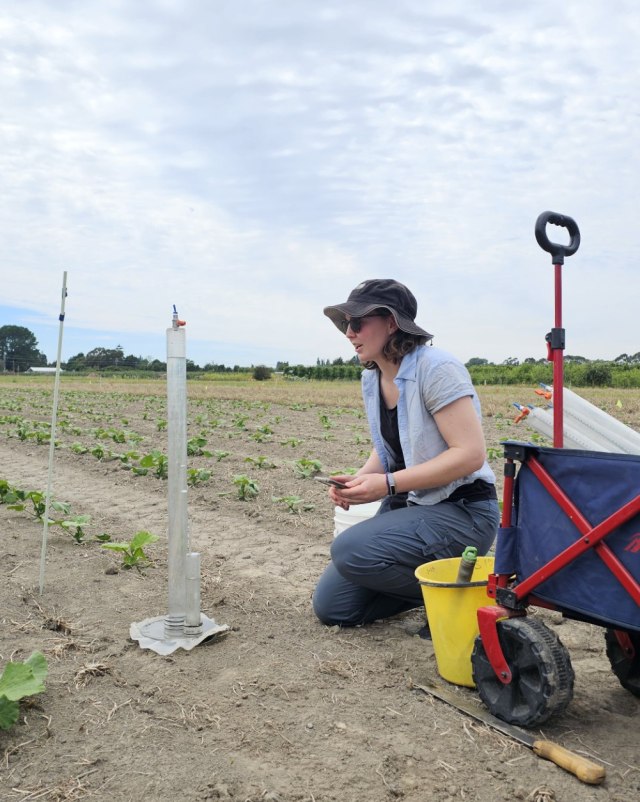
We were delighted to have Carys Luke join us as our Summer Intern in 2025-2026. Carys’ key project was measuring soil infiltration rates using disc permeameters. These devices work under tension, so water has to be pulled into the soil by capillary forces. By controlling the amount of tension, we can set the soil pore sizes that are dragging water in, and so we can get an estimate of the soil’s pore size distribution.
There’s a fair bit of maths and interpretation so to help, we made an online calculator and published interpretation guidance. We would like to hear your feedback if you go looking. The equipment is not commonly available and is mostly a research tool rather than for everyday farmer use. If you think you would benefit from measurements, contact us and we can discuss options.
This report evaluates soil water infiltration across conventional, hybrid, and regenerative
management treatments in a randomised block design (12 plots) within the LandWISE
Carbon Positive experiment. Infiltration rates were measured using disc permeameters
at the soil surface and at 10 cm depth under supply tensions of −15, −6, and −3 cm.
Applying water at these tensions enabled hydraulic conductivity to be assessed across
three pore-size domains (<0.2 mm, <0.5 mm, and <1.0 mm), providing insight into pore
size distribution and how it varies between treatments.
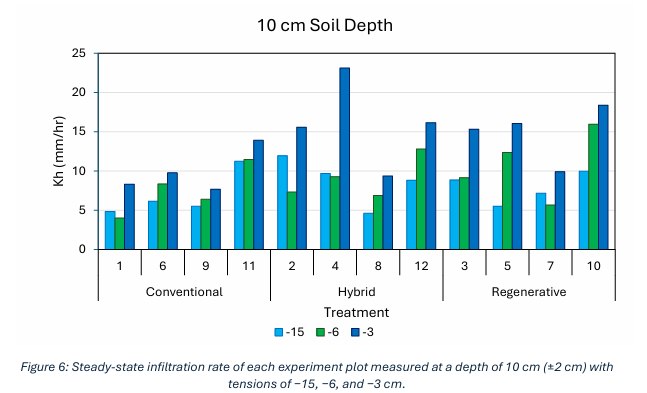
Infiltration generally increased as water tension became less negative; however, contrary to published literature, infiltration often plateaued or declined between −15 cm and −6 cm tensions. The readings at lower tension (-3cm head vs -15cm head) should icrease because more mores are taking water. These results indicate that our measurements at −15 cm tension frequently did not reach true steady state. You can see this in Figure 6.
A key recommendation is to ensure sufficient time is allowed, and that more measurements, possibly at greater intervals, are made than were done for this study. In a soil such as ours, it can take a very long time (hours) to get to the steady state, and it may not be apparent until data gets analysed. Ooops.
Carys’ full report is available in our file stack.