
Skip to content
Menu
LandWISE – Promoting sustainable land management
  • Welcome
    • About
    • LandWISE Committee and Staff
    • Contact
  • Projects
    • Carbon Positive
      • Carbon Positive Reports
    • Nitrachek: Farmer Friendly Nitrate Testing
    • SLAKES: a cost-effective measure of soil structural stability
    • Soil Repair after Cyclone Gabrielle
    • Vegetable Production Nitrogen Management
    • Best Management of Nitrates in Process Cropping
    • Future Proofing Vegetable Production
    • Herbicide Resistance Management
  • Events
    • Soil Health for Profit
      • Soil Health for Profit Presenters
        • What makes a farm “regenerative”?
        • Soil and Plant Nutrition at Harvest Moon
        • Regenerative agriculture principles in Kiwifruit production
        • Carbon Positive: Applying Regenerative Principles to Intensive Process Vegetable Production 2025-2026
        • Carbon Positive: making sense of carbon data
        • A Career in Cropping ? building soil
        • Cyclone Gabrielle Research Symposium: Lessons for the management of highly productive land
        • Cyclone Recovery: Turning sediment to soil
        • Cascading impacts of Cyclone Gabrielle ? and why soil health is business resilience
        • Lessons Learned from 20 Years of Cover Crop and Soil Health Research and Extension
        • Technologies at Harvest Moon
        • Do all nitrogenamendmentshave the same footprint?
        • Answers Under Foot: Should Soil Health Be Our #1 Sustainability Goal?
        • Going way back: LandWISE?s History of Minimum Tillage
        • Crop Stacking: The best practice of tomorrow
        • Long-term evaluation of tillage systems for maize silage in New Zealand
        • Minimising Tillage at Ludlow Farms
        • Long-Term Maize Establishment andCover Crop Research in the Waikato
        • Minimum tillage discussion panel
    • Cyclone Gabrielle Research Symposium
      • Historical North Island Flood Events
      • An extraordinary storm: the severity of Cyclone Gabrielle’s weather in Hawke’s Bay
      • The Science Response in the Year of Storms; A Gisborne/Tairawhiti perspective
      • Insights into causes of landslides triggered by Cyclone Gabrielle
      • The effects of Cyclone Gabrielle on fruit tree health in Hawke’s Bay
      • Impact of Cyclone Gabrielle on stonefruit orchards in Hawke’s Bay: a case study
      • Charting the Course following Cyclone Gabrielle
      • Baseline sediment sampling in Tairawhiti and Hawke’s Bay
      • Impacts on cropping businesses
      • Understanding the flooding caused by Cyclone Gabrielle
      • Building Flood Damage from Ex-Tropical Cyclone Gabrielle
      • Food safety and critical incidents: A unified approach for safer produce
      • Silt nutritional status and contamination concerns
      • Lessons from the horticultural sector response to Cyclone Gabrielle
      • Ecological impacts of Cyclone Gabrielle
      • Cyclone Gabrielle and Poplar Windthrow in Northland
      • Seed Size and Establishment Method Determine Crop Recovery Following Cyclone-Induced Silt Deposition
      • Returning to (some) baseline sampling sites to assess cropping soil recovery
      • Recovery of annual cropping ground – Grower learnings
      • Recovery of Annual Cropping over 2 Years
      • Technical and extension learnings from Cyclone Gabrielle
    • Getting to Carbon Positive!
      • Getting to Carbon Positive – Presenters
    • Rebuilding Our Soils
      • Rebuilding Our Soils – Presenters
    • Events Archive
  • Tools
    • Fertiliser Application Equipment Calibration
      • Fertspread Spreader Calibration
      • Fertspread Placement Calibration
    • Nitrachek Calculator
    • Irrigation Evaluation – IRRIG8
      • IRRIG8: Centre Pivot
        • IRRIG8-online: Centre Pivot User Guide
      • IRRIG8: Linear Move
      • IRRIG8: Travelling Irrigator
        • IRRIG8-online: Travelling Irrigation User Guide
      • IRRIG8: Multiple sprayline calculator
      • IRRIG8: Solid set irrigation
      • IRRIG8: Pressure and energy
        • Pressure and Energy Calculator: User Guide
    • Soil Infiltration Calculator
      • Disc Permeameter User Guide
      • Disc Permeameter Calculator: Frequently Asked Questions
    • Carbon Calculator
    • ANOVA Tool for statistical significance
  • Blog
  • Sign Up
  • Login
  • Members Only
    • Online Learning
  • Account
  • Site Search
LandWISE – Promoting sustainable land management

2026 – Food Quality Maize

Posted on August 16, 2026

Plans for the 2026-2027 Carbon Positive summer crop
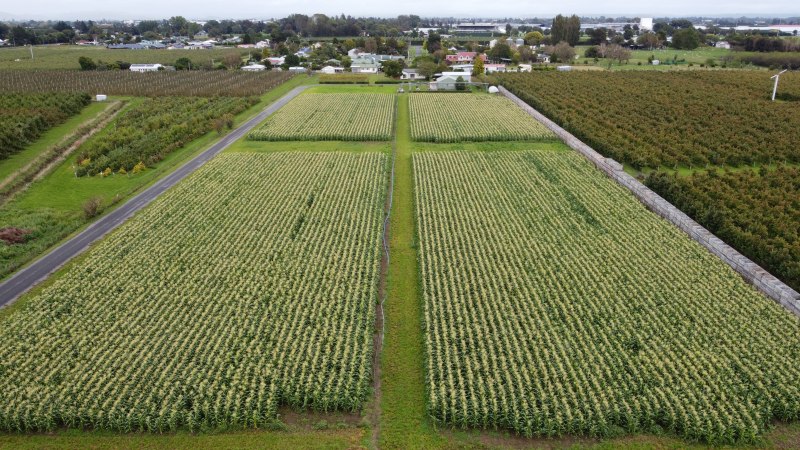
The sweetcorn crop grown in 2022 will be replaced by maize in 2026.

Our 2026-2027 summer crop will be a crop of maize grown for Nicolle Grain. The ultimate destination is your plate of nachos, once the grain has been turned into corn chips. We’re grateful that Patrick and Tom Nicolle have agreed to work with us this summer, providing an alternative to the sweetcorn crop that had been planned prior to McCain Foods’ factory closure.

The plan for the coming season is an adaptation of the sweetcorn plan that was our first crop in the Carbon Positive trial. One change is that none of the treatments have been grazed over winter. We have sent soil samples to Hill Labs for Basic, Sulphur profile and potentially available nitrogen PMN testing. We will use those results and our regular soil nitrate monitoring to determine the crop nutrition programme for each treatment.
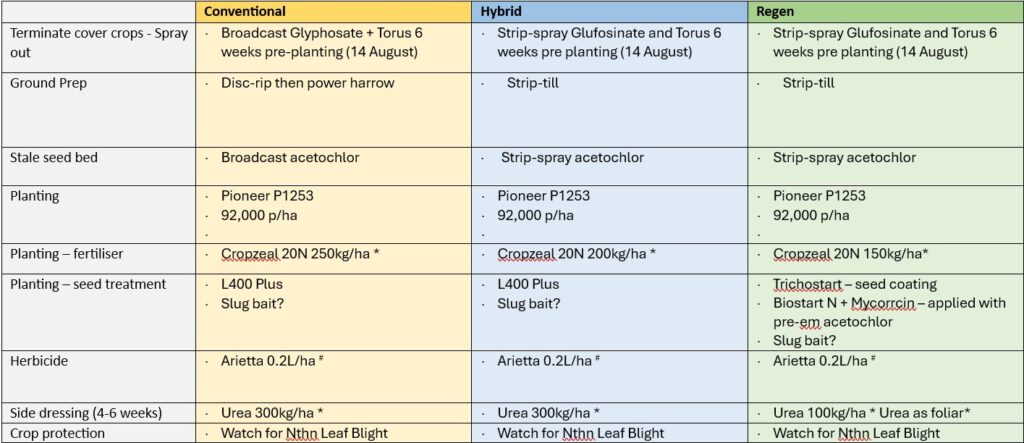
Draft cropping plan by treatment for the 2026 food maize crop.

* fertiliser rates to be reviewed when lab test results received.
# use later in crop if needed for escapes. Maybe the interrow cover crop mulch in the strip-till plots will be enough.

With rain in mid-August, we already missed our planned spray-out date! We wanted a 6-week interval before cultivation. Given the crop is maize and the harvest date is less important than for process crops, we are not overly concerned, but we do want to get the crop out early enough for good winter cover crop establishment in 2027.

Our latest soil nitrate testing showed that levels continue to be very low and often non-detectable (<5ppm) using the Nitrate Quick Test. They do suggest that the regenerative plots might be a little higher than the others, perhaps a reflection of the vetch component in the cover crop. It will be interesting to see if there are any differences in the PMN in the Conventional and Hybrid ryegrass, and Regenerative triticale and vetch plots.

We will have regular field walks so everyone has opportunity to view the trials firsthand. Make sure you’re signed up to receive notifications.

We recall that 2022-2023 was a la Nina year and 2026 -2027 is looking to be the opposite, an el Nino year. You may recall that our 2022 sweetcorn was impacted by Cyclone Gabrielle. In the end, the yields in the treatments were good, but we don’t know how the flooding impacted any of our results.
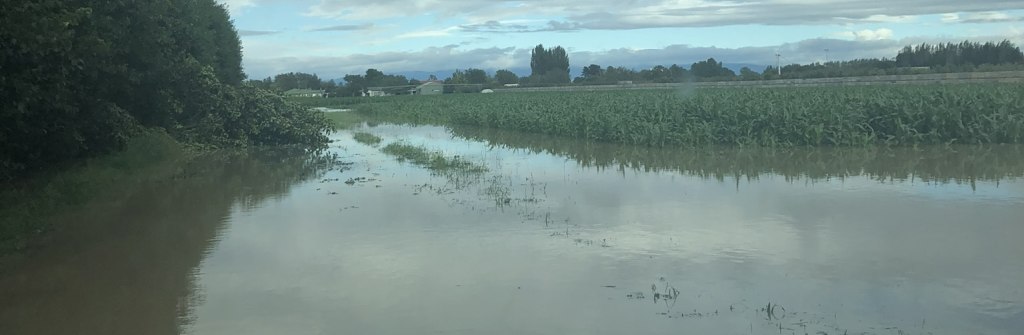

Flooded sweetcorn in February 2023 had unknown effects on our trial. Yields were good for that time of year.

Related

Leave a Reply Cancel reply

Your email address will not be published. Required fields are marked *

  • Carbon Positive Update
  • 2026 Winter Cover Crops
  • 2026 – Food Quality Maize
  • Soil Health for Profit – James Hunter
  • Soil Health for Profit – Charlie White
  • Soil Health for Profit – Josh Wing
  • Soil Health for Profit – Pranoy Pal
  • Soil Health for Profit – Olivia Webster
  • Soil Health for Profit – Dan Bloomer
  • Soil Health for Profit – John Evans
  • Soil Health for Profit – Bill Ritchie
  • Soil Health for Profit – Andy Mawley

RECENT POSTS

  • Carbon Positive Update
  • 2026 Winter Cover Crops
  • 2026 – Food Quality Maize
  • Soil Health for Profit – James Hunter
  • Soil Health for Profit – Charlie White

CATEGORIES

  • Agritech
  • Arable crops
  • Asparagus
  • Conference
  • Courses
  • Cover crops
  • Crop protection
  • Cultivation
  • Events
  • Fresh Vegetables
  • Irrigation
  • Membership
  • Nitrate
  • Nutrition
  • People
  • Permanent crops
  • Pests
  • Process Crops
  • Projects
  • Protected cropping
  • regenerative agriculture
  • Regulations
  • Research
  • soil health
  • Sustainable technology
  • Uncategorized
  • Water resources
  • Weeds
©2023 LandWISE – Promoting sustainable land management

Disclaimer: Any information on the LandWISE website or linked LandWISE resources is of a general nature only. We endeavour to provide accurate and adequate information relating to the subject matters contained in it. It has been prepared and made available to all persons and entities strictly on the basis that LandWISE, its researchers and authors are fully excluded from any liability for damages arising out of any reliance in part or in full upon any of the information for any purpose. No endorsement of named products is intended nor is any criticism of other alternative, but unnamed product.
