

What has been happening over Winter?
Things have been a little quiet over the last few months. We’ve had our usual regular monitoring tasks, tracking cover crop development with the Canopeo app and soil nitrate levels with the Nitrate Quick Test protocol, Nitrachek device and our conversions to kg/ha. Now we are focusing on getting ready for our summer crop – food quality maize with Nicolle Grain.
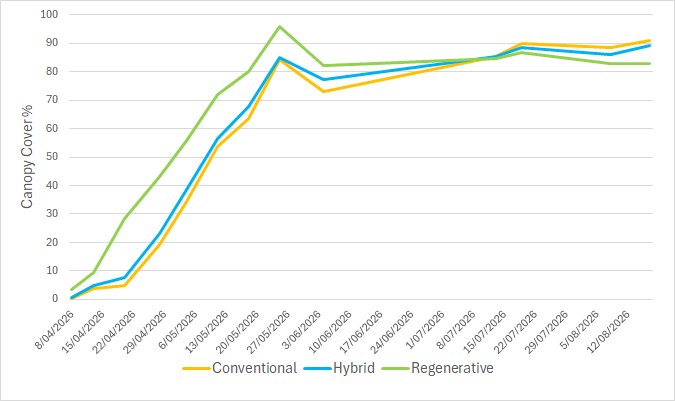
We fully discuss the winter cover crop in an earlier post, but in essence, triticale and vetch took off more strongly than annual ryegrass but were overtaken in mid-July after aerating through fill cover and as the triticale was affected by rust. Generally, we are happy with the covers but think growth may be a little less than previous winters. The vetch this year was a standout success after a few years of disappointment.
The free nitrate in the soil has been very low all winter. The chart below tracks the nitrate in the top 30 cm of soil since cover crop establishment. Note this is twice the standard sampling depth.
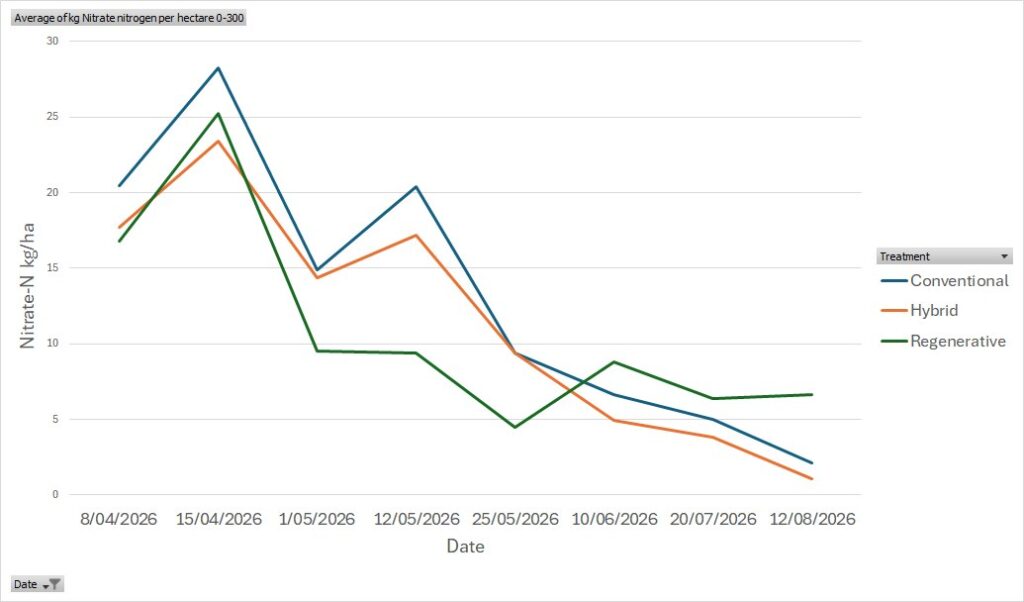
After being the lowest treatment from mid-April to mid-June, the Regenerative triticale and vetch plots showed a jump and have remained higher (although still very low) than the Conventional and Hybrid ryegrass plots. Is there a link with the canopy cover levels? If the vetch starting to release free nitrate from the nodules?
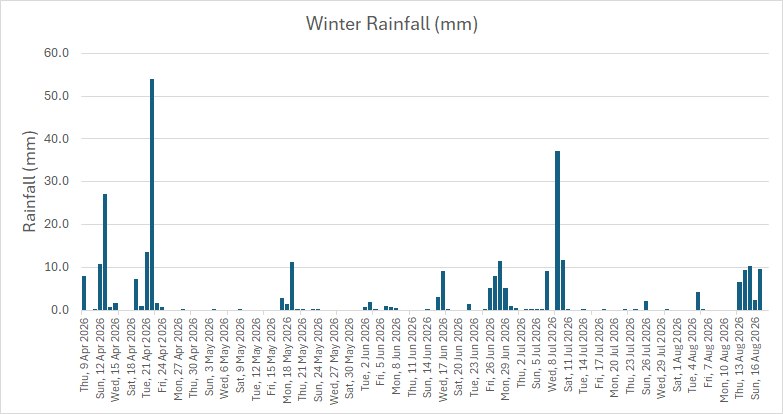
No fertiliser was added at planting, so the increase in April is assumed to be the result of mineralisation after the butternut crop was harvested and the plots disced and planted. As the cover crops established, they appear to have taken up nitrate although significant rain from 18-21 April may have had some influence.
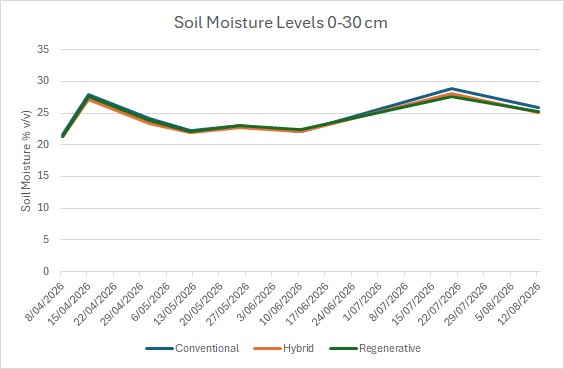
Soil moisture measured by Hydrosense or oven drying shows no differences between any of the treatments.
Outreach
We had a few opportunities to talk about the Carbon Positive trial over winter. Notable events were taking part in Lincoln University’s State of the Land Event “Regenerative Agriculture in NZ Landscapes: From Practice to Evidence” at which Dan presented the mid-project soil carbon results and use of AI to develop a model to explain changes in and within the various carbon pools. Notably, the emerging science around photosynthates as a key driver of soil carbon suggests the significant fallow and low ground cover typical of an intensive vegetable growing programme is a major block to nett carbon sequestration.
What can we do about that? We think strip-spraying and strip-tillage is one approach. Not only does it retain actively growing (photosynthesising) plants as long as possible, strip-till also minimises tillage – a major cause of carbon burn-off. Several LandWISE Conference presentations addressed this, and the videos have been uploaded to the website.
Another technique would be getting a cover crop growing within the main crop, so that after harvest, it is already growing an “catching some rays”. This however might be a little trickier. Numerous attempts have been made by numerous groups in numerous places and results have been varied. But our Operations Advisory Group is keen that we have a goo. So, we are looking at establishing some legumes in the maize this summer, but leaving sowing until as late as possible to minimise the risk and scale of competition with the money earning maize.
Dan was also asked to present to the annual ICD Group conference. He introduced LandWISE and our history from our roots in wind erosion minimisation, through strip-till, autosteer, precision ag and various nitrate minimisation projects. It was a good opportunity to reflect on 25 or so years on LandWISE activity. While immensely varied, the focus throughout has been on sustainable production through technology and system choice. We have a large legacy of work in soil health, optimal nutrient management and making the best possible use of scare water resources. If you haven’t already, have a look at the various tools and calculators and the online learning courses on our website.
