
Skip to content
Menu
LandWISE – Promoting sustainable land management
  • Welcome
    • About
    • LandWISE Committee
    • Contact
  • Projects
    • Carbon Positive
      • Carbon Positive Reports
    • Nitrachek: Farmer Friendly Nitrate Testing
    • SLAKES: a cost-effective measure of soil structural stability
    • Soil Repair after Cyclone Gabrielle
    • Vegetable Production Nitrogen Management
    • Best Management of Nitrates in Process Cropping
    • Future Proofing Vegetable Production
    • Herbicide Resistance Management
  • Events
    • Cyclone Gabrielle Research Symposium
      • Historical North Island Flood Events
      • An extraordinary storm: the severity of Cyclone Gabrielle’s weather in Hawke’s Bay
      • The Science Response in the Year of Storms; A Gisborne/Tairawhiti perspective
      • Insights into causes of landslides triggered by Cyclone Gabrielle
      • The effects of Cyclone Gabrielle on fruit tree health in Hawke’s Bay
      • Impact of Cyclone Gabrielle on stonefruit orchards in Hawke’s Bay: a case study
      • Charting the Course following Cyclone Gabrielle
      • Baseline sediment sampling in Tairawhiti and Hawke’s Bay
      • Impacts on cropping businesses
      • Understanding the flooding caused by Cyclone Gabrielle
      • Building Flood Damage from Ex-Tropical Cyclone Gabrielle
      • Food safety and critical incidents: A unified approach for safer produce
      • Silt nutritional status and contamination concerns
      • Lessons from the horticultural sector response to Cyclone Gabrielle
      • Ecological impacts of Cyclone Gabrielle
      • Cyclone Gabrielle and Poplar Windthrow in Northland
      • Seed Size and Establishment Method Determine Crop Recovery Following Cyclone-Induced Silt Deposition
      • Returning to (some) baseline sampling sites to assess cropping soil recovery
      • Recovery of annual cropping ground – Grower learnings
      • Recovery of Annual Cropping over 2 Years
      • Technical and extension learnings from Cyclone Gabrielle
    • Getting to Carbon Positive!
      • Getting to Carbon Positive – Presenters
    • Rebuilding Our Soils
      • Rebuilding Our Soils – Presenters
    • Events Archive
  • Tools
    • Nitrachek Calculator
    • Carbon Calculator
    • Nutrient Budget
    • Irrigation Evaluation – IRRIG8
      • IRRIG8: Centre Pivot
        • IRRIG8-online: Centre Pivot User Guide
      • IRRIG8: Linear Move
      • IRRIG8: Travelling Irrigator
        • IRRIG8-online: Travelling Irrigation User Guide
      • IRRIG8: Multiple sprayline calculator
      • IRRIG8: Solid set irrigation
      • IRRIG8: Pressure and energy
        • Pressure and Energy Calculator: User Guide
    • ANOVA Tool for statistical significance
    • Fertspread Spreader Calibration
    • Fertspread Placement Calibration
    • Soil Infiltration Calculator
      • Disc Permeameter User Guide
      • Disc Permeameter Calculator: Frequently Asked Questions
  • Blog
  • Sign Up
  • Login
  • Members Only
    • Online Learning
  • Account
  • Site Search
LandWISE – Promoting sustainable land management

Best Management of Nitrates in Process Cropping

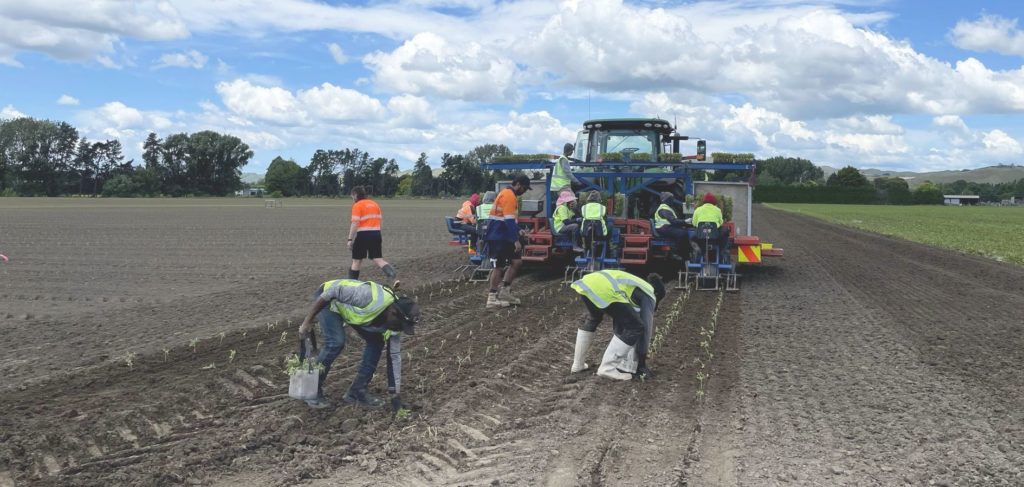
Tomato planting in one of our nitrogen fertiliser rate trials

With funding from MPI’s Sustainable Food and Fibre Futures fund, McCain Foods, Kraft-Heinz Watties and Hawke’s Bay Regional Council, we are testing nitrogen application rates on some of the most important process crops.

The purpose of this project is to retain the right to successfully grow process crops in Hawke’s Bay. This is under threat if new and anticipated regulations restrict nutrient use and make production unaffordable. Processors McCain Foods and Heinz-Watties represent about $1.8B of value and form the largest single employment sector in Hawke’s Bay. These low margin businesses compete on a global stage will not continue if on-farm production is restricted or costs increase.

Our goal is to have accepted best nutrient management guidelines for beetroot, sweetcorn, tomato and bean crops that optimise production and nitrogen fertiliser use efficiency, whilst minimising nitrogen leaching and CO2-equivalent emissions.  Trial results will be published and able to inform regional and national best practice.

A comprehensive research plan has been developed covering the four key process crops. In the main comparison trials, each crop will be represented in four paddocks, with two paddocks included each year.

Paddock selection will be based on processor agronomist and grower knowledge of sites, seeking those where variability is expected to be low. The project team is considering which soil types to include.

Measurements will be replicated and for each crop, the overall set of paddocks combined for analysis as one trial. At these sites, the 2019 Best Practice Guidelines will be compared with either current practice or soil test driven nitrogen recommendations.

To ensure fertiliser application rates are known, farm application equipment will be calibrated, with the added benefit of knowledge transfer to the grower and staff.
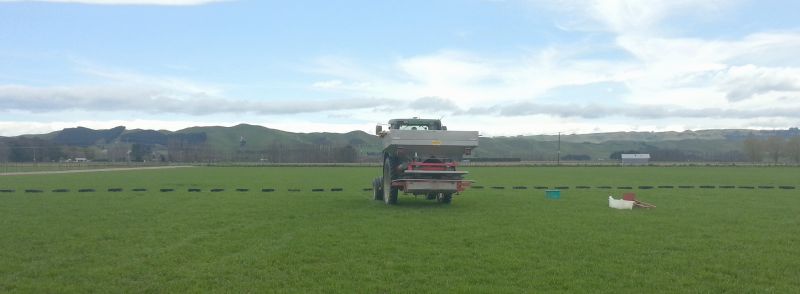
Calibration testing a broadcast spreader

Nitrogen pools including soil mineral N, mineralisable N, crop yield N and crop residue N will be measured, budgets prepared, and losses estimated. Pre-plant the soil will be sampled to the standard 150 mm depth and samples sent to commercial laboratories for testing.

Mineral N tests using the Nitrate Quick Test will be conducted at a series of profile depths (0-15, 15-30, 30-60 depending on site) before planting, and before any side-dressing and after the crop is harvested. Available nitrate levels will be calculated using the FAR Nitrate Mass Balance calculator.

Standard yield quantity and quality assessments will test for crop yield differences.

Plant tissues will be harvested, oven dried, and dry mass determined. Samples will be sent to commercial laboratories for nutrient testing.

Key metrics will be analysed statistically using ANOVA, unless data show an alternative to be more robust.

Unfortunately, 2022-2023 was a disaster season, and almost all the trial sites we established were destroyed by Cyclone Hale, the next massive rain event, or Cyclone Gabrielle. Of 11 trials set up this season, only one was successfully harvested and analysed.

Full Members can access detailed project reports here

  • Cyclone Gabrielle Research Symposium
  • Biodiversity Strips Update
  • Carbon Positive: Butternuts
  • Carbon Positive: Butternut Planting to Side Dressing
  • Nitrate Levels on the MicroFarm
  • Cyclone Gabrielle Research Symposium
  • Introducing Carys Luke, our Summer Intern
  • Soil Infiltration Calculator
  • MicroFarm Biodiversity Update
  • Irrigation System Testing
  • Carbon Positive: Butternut Planting
  • NZARM Conference 2025

RECENT POSTS

  • Cyclone Gabrielle Research Symposium
  • Biodiversity Strips Update
  • Carbon Positive: Butternuts
  • Carbon Positive: Butternut Planting to Side Dressing
  • Nitrate Levels on the MicroFarm

CATEGORIES

  • Agritech
  • Asparagus
  • Conference
  • Courses
  • Cover crops
  • Cultivation
  • Events
  • Fresh Vegetables
  • Irrigation
  • Membership
  • Nitrate
  • Nutrition
  • People
  • Permanent crops
  • Pests
  • Process Crops
  • Projects
  • Protected cropping
  • regenerative agriculture
  • Regulations
  • Research
  • soil health
  • Sustainable technology
  • Uncategorized
  • Water resources
  • Weeds
©2023 LandWISE – Promoting sustainable land management

Disclaimer: Any information on the LandWISE website or linked LandWISE resources is of a general nature only. We endeavour to provide accurate and adequate information relating to the subject matters contained in it. It has been prepared and made available to all persons and entities strictly on the basis that LandWISE, its researchers and authors are fully excluded from any liability for damages arising out of any reliance in part or in full upon any of the information for any purpose. No endorsement of named products is intended nor is any criticism of other alternative, but unnamed product.