
Skip to content
Menu
LandWISE – Promoting sustainable land management
  • Welcome
    • About
    • LandWISE Committee
    • Contact
  • Projects
    • Carbon Positive
      • Carbon Positive Reports
    • Nitrachek: Farmer Friendly Nitrate Testing
    • SLAKES: a cost-effective measure of soil structural stability
    • Soil Repair after Cyclone Gabrielle
    • Vegetable Production Nitrogen Management
    • Best Management of Nitrates in Process Cropping
    • Future Proofing Vegetable Production
    • Herbicide Resistance Management
  • Events
    • Cyclone Gabrielle Research Symposium
      • Historical North Island Flood Events
      • An extraordinary storm: the severity of Cyclone Gabrielle’s weather in Hawke’s Bay
      • The Science Response in the Year of Storms; A Gisborne/Tairawhiti perspective
      • Insights into causes of landslides triggered by Cyclone Gabrielle
      • The effects of Cyclone Gabrielle on fruit tree health in Hawke’s Bay
      • Impact of Cyclone Gabrielle on stonefruit orchards in Hawke’s Bay: a case study
      • Charting the Course following Cyclone Gabrielle
      • Baseline sediment sampling in Tairawhiti and Hawke’s Bay
      • Impacts on cropping businesses
      • Understanding the flooding caused by Cyclone Gabrielle
      • Building Flood Damage from Ex-Tropical Cyclone Gabrielle
      • Food safety and critical incidents: A unified approach for safer produce
      • Silt nutritional status and contamination concerns
      • Lessons from the horticultural sector response to Cyclone Gabrielle
      • Ecological impacts of Cyclone Gabrielle
      • Cyclone Gabrielle and Poplar Windthrow in Northland
      • Seed Size and Establishment Method Determine Crop Recovery Following Cyclone-Induced Silt Deposition
      • Returning to (some) baseline sampling sites to assess cropping soil recovery
      • Recovery of annual cropping ground – Grower learnings
      • Recovery of Annual Cropping over 2 Years
      • Technical and extension learnings from Cyclone Gabrielle
    • Getting to Carbon Positive!
      • Getting to Carbon Positive – Presenters
    • Rebuilding Our Soils
      • Rebuilding Our Soils – Presenters
    • Events Archive
  • Tools
    • Nitrachek Calculator
    • Carbon Calculator
    • Nutrient Budget
    • Irrigation Evaluation – IRRIG8
      • IRRIG8: Centre Pivot
        • IRRIG8-online: Centre Pivot User Guide
      • IRRIG8: Linear Move
      • IRRIG8: Travelling Irrigator
        • IRRIG8-online: Travelling Irrigation User Guide
      • IRRIG8: Multiple sprayline calculator
      • IRRIG8: Solid set irrigation
      • IRRIG8: Pressure and energy
        • Pressure and Energy Calculator: User Guide
    • ANOVA Tool for statistical significance
    • Fertspread Spreader Calibration
    • Fertspread Placement Calibration
    • Soil Infiltration Calculator
      • Disc Permeameter User Guide
      • Disc Permeameter Calculator: Frequently Asked Questions
  • Blog
  • Sign Up
  • Login
  • Members Only
    • Online Learning
  • Account
  • Site Search
LandWISE – Promoting sustainable land management

Herbicide Resistance Management

Weed Management Research

Herbicide resistant weeds are a real and increasing issue globally and evident in New Zealand. Herbicide resistant ryegrass is for example, a problem in both arable farms and vineyards.

We are working with Trevor James and AgResearch in a project focused on improved weed control and vegetation management to minimise future herbicide resistance. The project is funded through the Ministry of Business, Innovation and Employment (MBIE) and major co-funder, the Foundation for Arable Research (FAR).

The project has four main work areas:

Anticipating herbicide resistance

A Lincoln University team is seeking to predict likely herbicide-resistant weed assemblages worldwide and identify weeds most likely to develop herbicide resistance in new regions. The world-wide mega-database of herbicide resistance will be used to create a matrix of 100 regions and 200 weeds for each major herbicide group. Those relevant to New Zealand will be ranked on their likelihood of occurring in New Zealand. Outputs will be a risk index that indicates a) weeds currently in NZ with a history of herbicide resistance elsewhere in the world pose the greatest risk to our agriculture b) herbicide resistant weeds currently absent from NZ that pose the greatest risk of establishment if unintentionally introduced here and c) weeds worldwide that have a high likelihood of becoming resistant in the future and the risk they pose to NZ.
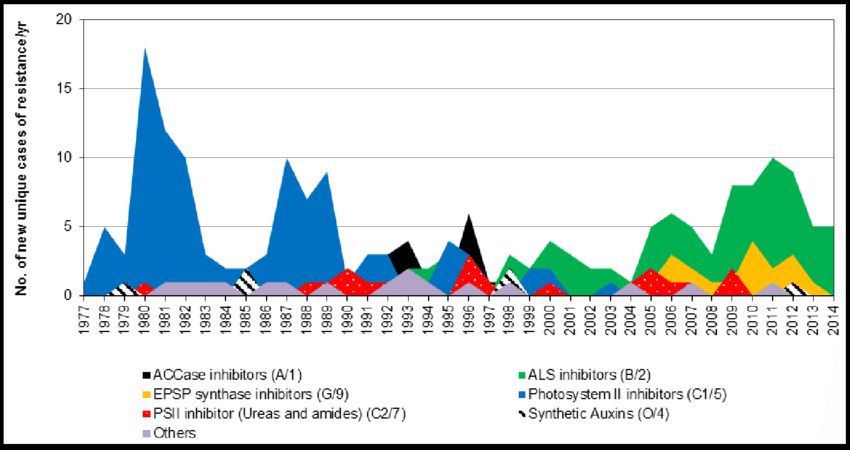
New unique cases of weed resistance in the EU Member States, 1977-2014. Source: David Ervin – calculations based on data from Heap (2015)

Understanding and influencing drivers of herbicide practices

The AgResearch People and Agriculture team seeks to identify and describe the systemic drivers of on- and off-farm herbicide practices to influence and change behaviours. They are working with key stakeholders (Māori, farmers, national sector players and international experts) to identify and leverage opportunities to more successfully address factors across the supply/value chain that restrict or hinder change.
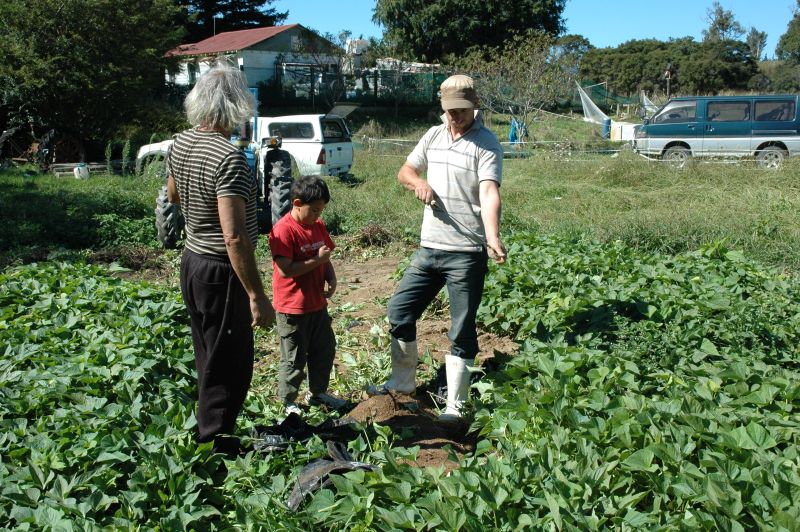
Harvesting samples from a weed control trial in East Coast kumara gardens. Crop&Food Research – Science for Community Change

Identifying instances of resistance and their impact

A Lincoln University team is seeking to predict likely herbicide-resistant weed assemblages worldwide and identify weeds most likely to develop herbicide resistance in new regions. The world-wide mega-database of herbicide resistance will be used to create a matrix of 100 regions and 200 weeds for each major herbicide group. Those relevant to New Zealand will be ranked on their likelihood of occurring in New Zealand. Outputs will be a risk index that indicates a) weeds currently in NZ with a history of herbicide resistance elsewhere in the world pose the greatest risk to our agriculture b) herbicide resistant weeds currently absent from NZ that pose the greatest risk of establishment if unintentionally introduced here and c) weeds worldwide that have a high likelihood of becoming resistant in the future and the risk they pose to NZ.

Grasslands and Massey University researchers will develop superior new ways to rapidly identify resistant plants. This will use genotyping and seed bioassays to create ‘quick tests’ for key weed species. They will also model spread scenarios for resistance genes to determine the greatest risk of resistance i.e. from on-site resistance evolution or from dispersal of resistant weeds. They started with perennial ryegrass before adding other species for screening.

A number of farm surveys have now been completed, and there are significant numbers of resistance being identified and several species and to several active ingredients.

Managing herbicide resistant weeds

We are in the team led by Trevor James looking to develop new non-herbicidal interventions (e.g. robotic weeders, abrasion technologies and smart cultivators) and the use of cover crops (in collaboration with FAR) for both managing existing and avoiding new instances of herbicide resistance.

The small Naio Technologies OZ440 robot cultivating between rows of green beans

Included in this section is ‘rediscovering’ Māori management practices such as traditional strategic resting and natural pathogenic organisms to target the soil weed seed bank). While virtually all our problem weeds are introduced from Europe and the Americas, the holistic approaches typical in Māoridom seem fully relevant to a systems based approach to weed management. A second group in this team is to isolate and evaluate natural pathogenic fungi and bacteria for their ability and efficacy to kill weed seeds.

LandWISE members are well-aware of the risks of herbicide resistance. It has been an aspect of LandWISE projects since the early 2000s when we began promoting strip tillage and no-till systems to maintain soil quality and reduce energy inputs. The extra pressure on herbicide controls when physical cultivation is reduced saw us publish charts of herbicide groups for different crops. Maybe it is time that work was brought up to date!

  • Cyclone Gabrielle Research Symposium
  • Biodiversity Strips Update
  • Carbon Positive: Butternuts
  • Carbon Positive: Butternut Planting to Side Dressing
  • Nitrate Levels on the MicroFarm
  • Cyclone Gabrielle Research Symposium
  • Introducing Carys Luke, our Summer Intern
  • Soil Infiltration Calculator
  • MicroFarm Biodiversity Update
  • Irrigation System Testing
  • Carbon Positive: Butternut Planting
  • NZARM Conference 2025

RECENT POSTS

  • Cyclone Gabrielle Research Symposium
  • Biodiversity Strips Update
  • Carbon Positive: Butternuts
  • Carbon Positive: Butternut Planting to Side Dressing
  • Nitrate Levels on the MicroFarm

CATEGORIES

  • Agritech
  • Asparagus
  • Conference
  • Courses
  • Cover crops
  • Cultivation
  • Events
  • Fresh Vegetables
  • Irrigation
  • Membership
  • Nitrate
  • Nutrition
  • People
  • Permanent crops
  • Pests
  • Process Crops
  • Projects
  • Protected cropping
  • regenerative agriculture
  • Regulations
  • Research
  • soil health
  • Sustainable technology
  • Uncategorized
  • Water resources
  • Weeds
©2023 LandWISE – Promoting sustainable land management

Disclaimer: Any information on the LandWISE website or linked LandWISE resources is of a general nature only. We endeavour to provide accurate and adequate information relating to the subject matters contained in it. It has been prepared and made available to all persons and entities strictly on the basis that LandWISE, its researchers and authors are fully excluded from any liability for damages arising out of any reliance in part or in full upon any of the information for any purpose. No endorsement of named products is intended nor is any criticism of other alternative, but unnamed product.