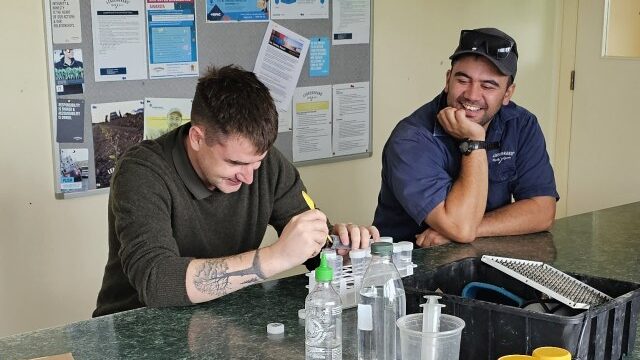

Validation and Practical Implementation of Soil Nitrate Testing using the Nitrachek 404

Introduction
Soil nitrate testing is essential for effective nitrogen management in agriculture, enabling farmers to optimise fertiliser applications while minimising costs and environmental impact. Traditional laboratory analysis, while accurate, can be expensive and time-consuming, limiting the frequency of monitoring that is economically feasible for many farming operations.
The Nitrate Quick Test developed by Hartz at the University of California and calibrated for New Zealand by Norris at Plant & Food Research is a rapid, on-farm method of assessing soil nitrate levels. The information helps growers identify nitrogen requirements and determine fertiliser application rates, and it provides justification for the applications. The standard Quick Test method estimates nitrogen concentration by comparing the colour of a test strip with a colour swatch on the side of the test strip container. That leaves room for error.
LandWISE has conducted well over a thousand Nitrate Quick Test soil assessments over the last five years. We have identified four key sources of error: sample collection, sample preparation, reading the test strip accurately and reliably, and adjusting for soil moisture content. We have used the Nitrachek device (KPG Products Ltd – United Kingdom) for about two years. The system eliminates subjective visual estimation of test strip colours through adoption of electronic colour analysis, potentially reducing operator error and improving consistency.
This project included testing 40 soil samples from four regions (Hawke’s Bay, Manawatu, Pukekohe, and Gisborne), comparing the Nitrachek electronic reader with MQuant test strips against Hill Labs’ mineral nitrogen analysis, while simultaneously assessing practical implementation through extensive grower engagement across diverse farming operations. The project was funded by Te Ahikawariki and supported by the regional growers and agronomists who made their properties and time available. Thank you!
Results
The study demonstrated that the Nitrachek 404 system provides laboratory-equivalent accuracy for soil nitrate testing in New Zealand agricultural systems. Correctly apply calibration factors and adjusting for soil moisture is critical. We made an the Nitrachek online calculator to assist!
Validation Results: The Nitrachek system achieved excellent correlation with laboratory methods (R² = 0.955) when proper protocols were followed, with a simple calibration factor of 1.073 providing direct laboratory equivalence. The systematic 7% difference between methods is easily correctable and falls well within normal soil sampling uncertainty, making it entirely suitable for farm management decisions. Method performance was validated across the 2-30 ppm NO₃-N concentration range, covering most typical pre-planting conditions in New Zealand vegetable production systems.
Critical Success Factors: A number of factors must be correctly implemented for reliable and accurate results. Sample handling with controlled temperature storage and proper protocols improved correlation by 2.4%. Nitrachek equipment calibration proved essential, and test strips required batch calibration. Soil moisture was a major factor and the adoption of the Norris Factor to adjust raw readings using measured soil moisture improved accuracy by as much as 30% compared to soil moisture estimates based on soil texture and wet-moist-dry bands. With these in place, the study conclusively demonstrated that following established protocols delivers laboratory-equivalent results for routine agricultural monitoring.
Implementation Outcomes: Regional workshops successfully demonstrated the technology across all target areas, though grower adoption patterns varied by use case. Users valued precision for nutrient budgeting and regulatory compliance, while some preferred visual estimation for rapid field assessments. The 80-90% cost reduction per sample creates compelling economics, with device payback achieved within 18-34 tests compared to laboratory analysis.
Practical Applications: The validated system is immediately deployable for nitrogen management in vegetable production, offering significant advantages for frequent monitoring, precision agriculture applications, and environmental compliance documentation. Integration opportunities exist with existing farm management systems and precision application technologies.
Bottom Line: The Nitrachek 404 provides a scientifically validated, cost-effective alternative to laboratory analysis for soil nitrate assessment within the tested concentration range. With proper training and protocol adherence, it delivers laboratory-equivalent accuracy while enabling more frequent monitoring and immediate decision-making capability essential for modern agricultural nitrogen management. The technology is ready for sector-wide adoption with clear implementation guidelines and quality assurance frameworks established.
Full Report
Download the Full Report here
Access the Nitrachek online calculator here