
Skip to content
Menu
LandWISE – Promoting sustainable land management
  • Welcome
    • About
    • LandWISE Committee
    • Contact
  • Projects
    • Carbon Positive
      • Carbon Positive Reports
    • Nitrachek: Farmer Friendly Nitrate Testing
    • SLAKES: a cost-effective measure of soil structural stability
    • Soil Repair after Cyclone Gabrielle
    • Vegetable Production Nitrogen Management
    • Best Management of Nitrates in Process Cropping
    • Future Proofing Vegetable Production
    • Herbicide Resistance Management
  • Events
    • Cyclone Gabrielle Research Symposium
      • Historical North Island Flood Events
      • An extraordinary storm: the severity of Cyclone Gabrielle’s weather in Hawke’s Bay
      • The Science Response in the Year of Storms; A Gisborne/Tairawhiti perspective
      • Insights into causes of landslides triggered by Cyclone Gabrielle
      • The effects of Cyclone Gabrielle on fruit tree health in Hawke’s Bay
      • Impact of Cyclone Gabrielle on stonefruit orchards in Hawke’s Bay: a case study
      • Charting the Course following Cyclone Gabrielle
      • Baseline sediment sampling in Tairawhiti and Hawke’s Bay
      • Impacts on cropping businesses
      • Understanding the flooding caused by Cyclone Gabrielle
      • Building Flood Damage from Ex-Tropical Cyclone Gabrielle
      • Food safety and critical incidents: A unified approach for safer produce
      • Silt nutritional status and contamination concerns
      • Lessons from the horticultural sector response to Cyclone Gabrielle
      • Ecological impacts of Cyclone Gabrielle
      • Cyclone Gabrielle and Poplar Windthrow in Northland
      • Seed Size and Establishment Method Determine Crop Recovery Following Cyclone-Induced Silt Deposition
      • Returning to (some) baseline sampling sites to assess cropping soil recovery
      • Recovery of annual cropping ground – Grower learnings
      • Recovery of Annual Cropping over 2 Years
      • Technical and extension learnings from Cyclone Gabrielle
    • Getting to Carbon Positive!
      • Getting to Carbon Positive – Presenters
    • Rebuilding Our Soils
      • Rebuilding Our Soils – Presenters
    • Events Archive
  • Tools
    • Nitrachek Calculator
    • Carbon Calculator
    • Nutrient Budget
    • Irrigation Evaluation – IRRIG8
      • IRRIG8: Centre Pivot
        • IRRIG8-online: Centre Pivot User Guide
      • IRRIG8: Linear Move
      • IRRIG8: Travelling Irrigator
        • IRRIG8-online: Travelling Irrigation User Guide
      • IRRIG8: Multiple sprayline calculator
      • IRRIG8: Solid set irrigation
      • IRRIG8: Pressure and energy
        • Pressure and Energy Calculator: User Guide
    • ANOVA Tool for statistical significance
    • Fertspread Spreader Calibration
    • Fertspread Placement Calibration
    • Soil Infiltration Calculator
      • Disc Permeameter User Guide
      • Disc Permeameter Calculator: Frequently Asked Questions
  • Blog
  • Sign Up
  • Login
  • Members Only
    • Online Learning
  • Account
  • Site Search
LandWISE – Promoting sustainable land management

The Electric Spatula

Posted on November 5, 2023

Killing weeds with pulsed microshocks from a flat plate electrode

This is the third post with details of Dan’s research into electric weeding undertakenas part of the AgResearch lead Herbicide Resistance management project. In this work, he was looking at easy ways to apply very small electric shocks to weeds, without having to carefully place a point-electrode against the plant stem. The electric spatula describes the flat-plate electrode he came up with; it is a out the size and shape of a kitchen spatula or fish-slice and could be used as a hand-weeding unit or part of a robotic system. The research was published in the Journal of Agronomy and is published Open Access, so anyone can download the full paper for free!
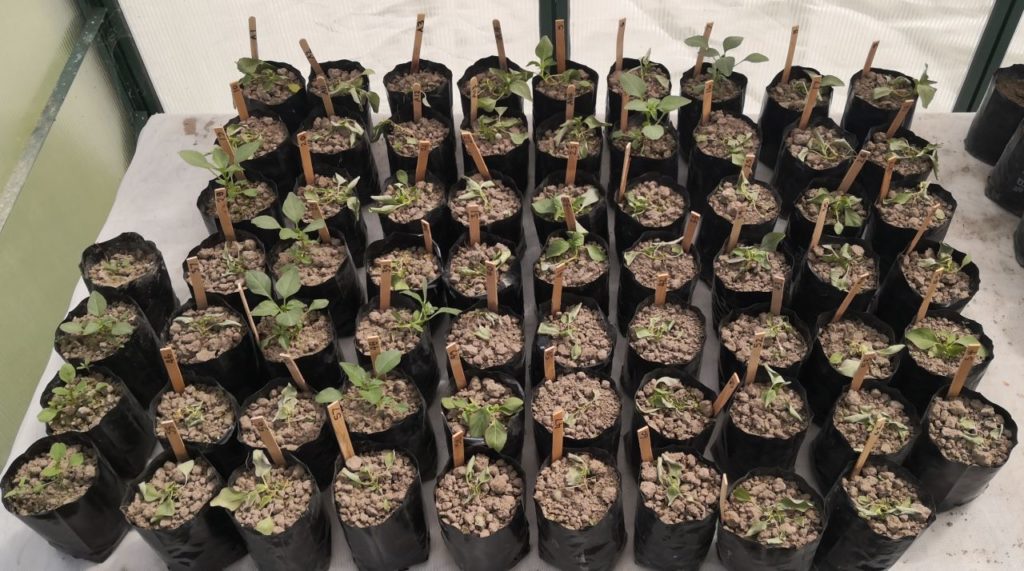
One of the interesting observations is that when plants such as redroot (Amaranthus powellii) are treated with pulsed microshocks, they don’t explode as can be seen with high energy electric weeder systems. In fact, usually nothing happens at all for several days, Dan gets worried “it didn’t work”, and then the plants start to senesce or bleach, before collapsing and dying. The picture above shows healthy plants that were not treated, and other plants in various stages of collapse and death depending on the amount of energy applied.

The paper uses megajoules (MJ) as the measure of energy needed per hectare. As a guide, a litre of diesel contains about 38 MJ of energy, or alternatively, 1 MJ is the amount of energy in about 26mL of diesel.

Abstract

Seeking an easy-to-deploy, energy-efficient, non-herbicide weed control method, we tested a flat-plate electrode to apply pulsed electric microshocks (PMS) to a grass and four broadleaf weed species. The method could be deployed via a hand-held unit or as part of a fully automated system to control escape-weeds in field crops. The effectiveness of treatments and relative energy discharges applying similar electric doses to the plant leaves or to the plant when pressed to the soil by a flat-plate electrode were compared.

The method killed only half of the treated ryegrass (Lolium multiflorum “Winter Star”) plants, well below our target rate, but significantly reduced growth rates and indicated an effective treatment of
< 1.0 MJ ha-1 for treating five plants m-2 is possible.

Wireweed (Polygonum aviculare), redroot (Amaranthus powellii), prostrate amaranth (Amaranthus deflexus), and hairy nightshade (Solanum nitidibaccatum) plants were successfully controlled with the energy required to kill 100% of seedlings varying from 0.1 to 0.9 MJ ha-1, indicating that broadleaf weeds are more susceptible. This easily met our target effectiveness and efficiency goals. The discharged energy increased when the electrode pressed the plant to a dry soil surface rather than to leaves only and increased further when pressed to a wet soil surface.


  • Cyclone Gabrielle Research Symposium
  • Biodiversity Strips Update
  • Carbon Positive: Butternuts
  • Carbon Positive: Butternut Planting to Side Dressing
  • Nitrate Levels on the MicroFarm
  • Cyclone Gabrielle Research Symposium
  • Introducing Carys Luke, our Summer Intern
  • Soil Infiltration Calculator
  • MicroFarm Biodiversity Update
  • Irrigation System Testing
  • Carbon Positive: Butternut Planting
  • NZARM Conference 2025

RECENT POSTS

  • Cyclone Gabrielle Research Symposium
  • Biodiversity Strips Update
  • Carbon Positive: Butternuts
  • Carbon Positive: Butternut Planting to Side Dressing
  • Nitrate Levels on the MicroFarm

CATEGORIES

  • Agritech
  • Asparagus
  • Conference
  • Courses
  • Cover crops
  • Cultivation
  • Events
  • Fresh Vegetables
  • Irrigation
  • Membership
  • Nitrate
  • Nutrition
  • People
  • Permanent crops
  • Pests
  • Process Crops
  • Projects
  • Protected cropping
  • regenerative agriculture
  • Regulations
  • Research
  • soil health
  • Sustainable technology
  • Uncategorized
  • Water resources
  • Weeds
©2023 LandWISE – Promoting sustainable land management

Disclaimer: Any information on the LandWISE website or linked LandWISE resources is of a general nature only. We endeavour to provide accurate and adequate information relating to the subject matters contained in it. It has been prepared and made available to all persons and entities strictly on the basis that LandWISE, its researchers and authors are fully excluded from any liability for damages arising out of any reliance in part or in full upon any of the information for any purpose. No endorsement of named products is intended nor is any criticism of other alternative, but unnamed product.