

Skip to content
Menu
LandWISE – Promoting sustainable land management
  • Welcome
    • About
    • LandWISE Committee and Staff
    • Contact
  • Projects
    • Carbon Positive
      • Carbon Positive Reports
    • Nitrachek: Farmer Friendly Nitrate Testing
    • SLAKES: a cost-effective measure of soil structural stability
    • Soil Repair after Cyclone Gabrielle
    • Vegetable Production Nitrogen Management
    • Best Management of Nitrates in Process Cropping
    • Future Proofing Vegetable Production
    • Herbicide Resistance Management
  • Events
    • Soil Health for Profit
      • Soil Health for Profit Presenters
        • What makes a farm “regenerative”?
        • Soil and Plant Nutrition at Harvest Moon
        • Regenerative agriculture principles in Kiwifruit production
        • Carbon Positive: Applying Regenerative Principles to Intensive Process Vegetable Production 2025-2026
        • Carbon Positive: making sense of carbon data
        • A Career in Cropping ? building soil
        • Cyclone Gabrielle Research Symposium: Lessons for the management of highly productive land
        • Cyclone Recovery: Turning sediment to soil
        • Cascading impacts of Cyclone Gabrielle ? and why soil health is business resilience
        • Lessons Learned from 20 Years of Cover Crop and Soil Health Research and Extension
        • Technologies at Harvest Moon
        • Do all nitrogenamendmentshave the same footprint?
        • Answers Under Foot: Should Soil Health Be Our #1 Sustainability Goal?
        • Going way back: LandWISE?s History of Minimum Tillage
        • Crop Stacking: The best practice of tomorrow
        • Long-term evaluation of tillage systems for maize silage in New Zealand
        • Minimising Tillage at Ludlow Farms
        • Long-Term Maize Establishment andCover Crop Research in the Waikato
        • Minimum tillage discussion panel
    • Cyclone Gabrielle Research Symposium
    • Getting to Carbon Positive!
      • Getting to Carbon Positive – Presenters
    • Rebuilding Our Soils
      • Rebuilding Our Soils – Presenters
    • Events Archive
  • Tools
    • Fertiliser Application Equipment Calibration
      • Fertspread Spreader Calibration
      • Fertspread Placement Calibration
    • Nitrachek Calculator
    • Irrigation Evaluation – IRRIG8
      • IRRIG8: Centre Pivot Calibration
      • IRRIG8: Solid Set Calibration
      • IRRIG8: Sprayline calibration
      • IRRIG8: Centre Pivot Evaluation
      • IRRIG8: Linear Move Calibration
      • IRRIG8: Linear Move Evaluation
      • IRRIG8: Travelling Irrigator Calibration
      • IRRIG8: Travelling Irrigation Evaluation
      • IRRIG8: Drip Micro Calibration
      • IRRIG8: Sprayline Evaluation
      • IRRIG8: Drip Micro Evaluation
      • IRRIG8: Solid set irrigation evaluation
      • IRRIG8: Pressure and energy
        • Pressure and Energy Calculator: User Guide
    • Soil Infiltration Calculator
      • Disc Permeameter User Guide
      • Disc Permeameter Calculator: Frequently Asked Questions
    • Carbon Calculator
    • ANOVA Tool for statistical significance
  • Blog
  • Sign Up
  • Login
  • Members Only
    • Online Learning
  • Account
  • Site Search
LandWISE – Promoting sustainable land management

2026 Winter cover crops emerged

Posted on April 23, 2026

The winter cover crops in the Carbon Positive trial plots are well underway now. The last dull, wet, cold week slowed them down a little, but they still made good progress. The preparation and planting was covered in an earlier post that you can see here>
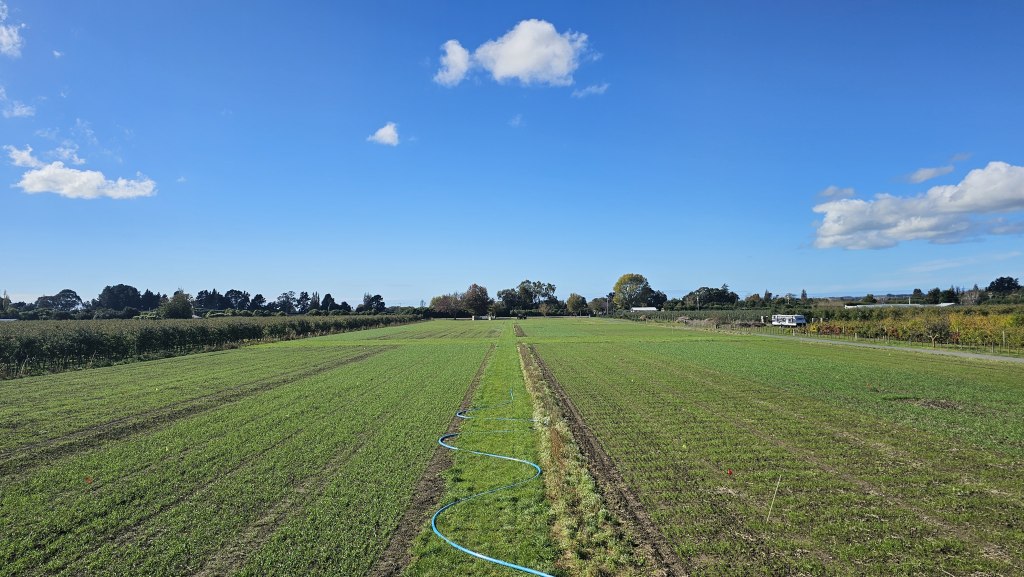
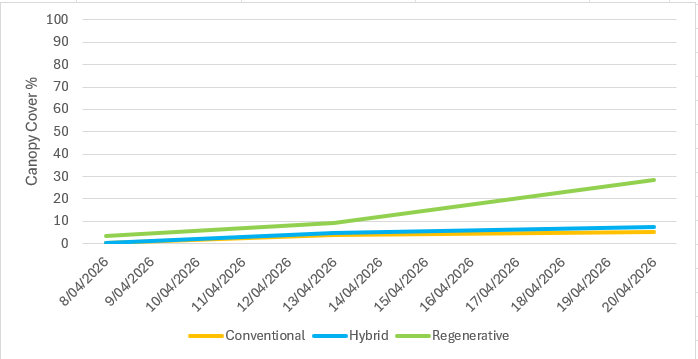
To the left of the central irrigator strip, the Regenerative plot triticale and vetch established fastest and by April 20 had reached 28% ground cover as measured using Canopeo, a brilliant free app that we use for all our weekly assessments regardless of crop (or fallow!). By contract, the ryegrass was slower to get started and on April 20 the Conventional plots averaged 5% ground cover, and the Hybrid plots a little more at about 8% cover as seen in the chart below. As well as getting underway quicker, the triticale and vetch is accelerating away. We had expected the ryegrass to be fastest, as that was what we observed in previous winter cover mixes, but a higher sowing rate of vetch and the triticale seems to be a good option at this stage.
There is some banding in the plots that seems to be an artefact of planting, but we’re not sure why. It lines up exactly on the planter but may relate to the discing and rolling that happened prior.

We continue our weekly monitoring, and assume that by next week, the Regenerative plots will have crossed the magical, but arbitrary, 30% ground cover faction. How long before the ryegrass plots reach that milestone?


Related

  • Electrify Hawke’s Bay EXPO
  • Carbon Positive Update
  • 2026 Winter Cover Crops
  • 2026 – Food Quality Maize
  • Soil Health for Profit – James Hunter
  • Soil Health for Profit – Charlie White
  • Soil Health for Profit – Josh Wing
  • Soil Health for Profit – Pranoy Pal
  • Soil Health for Profit – Olivia Webster
  • Soil Health for Profit – Dan Bloomer
  • Soil Health for Profit – John Evans
  • Soil Health for Profit – Bill Ritchie

RECENT POSTS

  • Electrify Hawke’s Bay EXPO
  • Carbon Positive Update
  • 2026 Winter Cover Crops
  • 2026 – Food Quality Maize
  • Soil Health for Profit – James Hunter

CATEGORIES

  • Agritech
  • Arable crops
  • Asparagus
  • Conference
  • Courses
  • Cover crops
  • Crop protection
  • Cultivation
  • Events
  • Fresh Vegetables
  • Irrigation
  • Membership
  • Nitrate
  • Nutrition
  • People
  • Permanent crops
  • Pests
  • Process Crops
  • Projects
  • Protected cropping
  • regenerative agriculture
  • Regulations
  • Research
  • soil health
  • Sustainable technology
  • Uncategorized
  • Water resources
  • Weeds
©2023 LandWISE – Promoting sustainable land management

Disclaimer: Any information on the LandWISE website or linked LandWISE resources is of a general nature only. We endeavour to provide accurate and adequate information relating to the subject matters contained in it. It has been prepared and made available to all persons and entities strictly on the basis that LandWISE, its researchers and authors are fully excluded from any liability for damages arising out of any reliance in part or in full upon any of the information for any purpose. No endorsement of named products is intended nor is any criticism of other alternative, but unnamed product.