Skip to content
Menu
LandWISE – Promoting sustainable land management
  • Welcome
    • About
    • LandWISE Committee
    • Contact
  • Projects
    • Carbon Positive
      • Carbon Positive Reports
    • Nitrachek: Farmer Friendly Nitrate Testing
    • SLAKES: a cost-effective measure of soil structural stability
    • Soil Repair after Cyclone Gabrielle
    • Vegetable Production Nitrogen Management
    • Best Management of Nitrates in Process Cropping
    • Future Proofing Vegetable Production
    • Herbicide Resistance Management
  • Events
    • Cyclone Gabrielle Research Symposium
      • Historical North Island Flood Events
      • An extraordinary storm: the severity of Cyclone Gabrielle’s weather in Hawke’s Bay
      • The Science Response in the Year of Storms; A Gisborne/Tairawhiti perspective
      • Insights into causes of landslides triggered by Cyclone Gabrielle
      • The effects of Cyclone Gabrielle on fruit tree health in Hawke’s Bay
      • Impact of Cyclone Gabrielle on stonefruit orchards in Hawke’s Bay: a case study
      • Charting the Course following Cyclone Gabrielle
      • Baseline sediment sampling in Tairawhiti and Hawke’s Bay
      • Impacts on cropping businesses
      • Understanding the flooding caused by Cyclone Gabrielle
      • Building Flood Damage from Ex-Tropical Cyclone Gabrielle
      • Food safety and critical incidents: A unified approach for safer produce
      • Silt nutritional status and contamination concerns
      • Lessons from the horticultural sector response to Cyclone Gabrielle
      • Ecological impacts of Cyclone Gabrielle
      • Cyclone Gabrielle and Poplar Windthrow in Northland
      • Seed Size and Establishment Method Determine Crop Recovery Following Cyclone-Induced Silt Deposition
      • Returning to (some) baseline sampling sites to assess cropping soil recovery
      • Recovery of annual cropping ground – Grower learnings
      • Recovery of Annual Cropping over 2 Years
      • Technical and extension learnings from Cyclone Gabrielle
    • Getting to Carbon Positive!
      • Getting to Carbon Positive – Presenters
    • Rebuilding Our Soils
      • Rebuilding Our Soils – Presenters
    • Events Archive
  • Tools
    • Nitrachek Calculator
    • Carbon Calculator
    • Nutrient Budget
    • Irrigation Evaluation – IRRIG8
      • IRRIG8: Centre Pivot
        • IRRIG8-online: Centre Pivot User Guide
      • IRRIG8: Linear Move
      • IRRIG8: Travelling Irrigator
        • IRRIG8-online: Travelling Irrigation User Guide
      • IRRIG8: Multiple sprayline calculator
      • IRRIG8: Solid set irrigation
      • IRRIG8: Pressure and energy
        • Pressure and Energy Calculator: User Guide
    • ANOVA Tool for statistical significance
    • Fertspread Spreader Calibration
    • Fertspread Placement Calibration
    • Soil Infiltration Calculator
      • Disc Permeameter User Guide
      • Disc Permeameter Calculator: Frequently Asked Questions
  • Blog
  • Sign Up
  • Login
  • Members Only
    • Online Learning
  • Account
  • Site Search
LandWISE – Promoting sustainable land management

Carbon Positive Summer Crop 2023-24

Posted on November 5, 2023

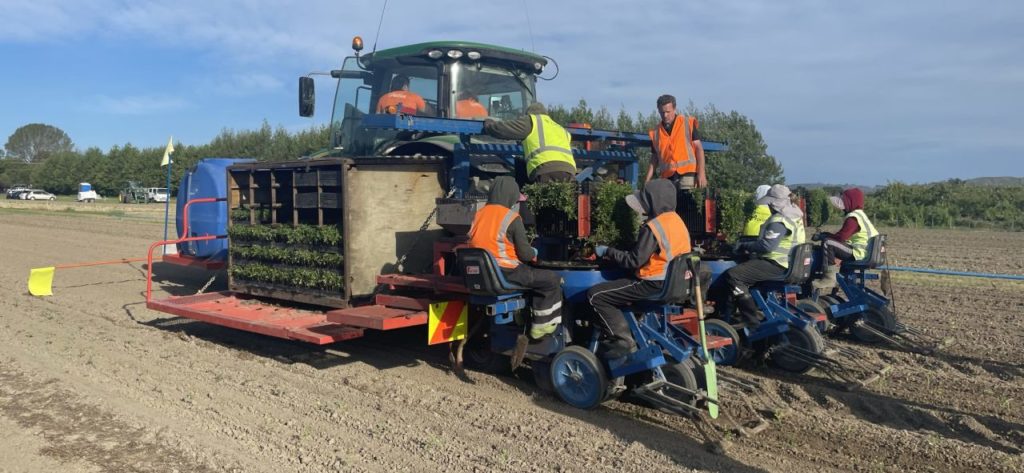
Heinz-Watties’ tomatoes are planted
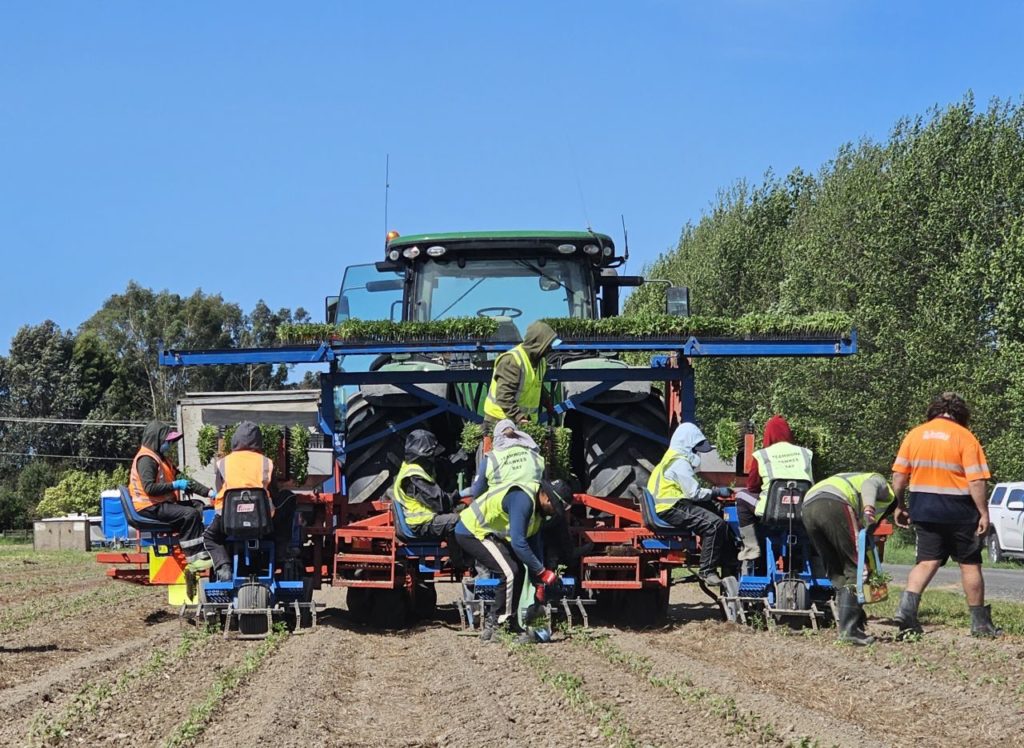
Planting tomato seedlings in the strip-tilled hybrid treatment plots.

Alex had a busy winter and spring, getting the operations programme for the 2023-2024 tomato crop developed in conjunction with Heinz-Watties, McCain Foods, regenerative consultants and advisors, interested local growers, organic vegetable producers, international process tomato growers, technical field representatives and contractors. We particularly note the large inputs of Caleb Burbury and Bruce MacKay of Heinz-Watties, and Phillip Schofield from Reset-Regenerate as the complexities were worked through.

The planning and consultation for this crop was more extensive than for the previous year’s sweetcorn crop, as the inputs for process tomatoes are considerably higher. There have been several iterations of the operational plan and a ‘final’ version, which has already been changed!

Despite predictions of an El Nino summer, soil conditions remained wet through spring, so cultivation activities were delayed. Additional passes with aerators and rotary hoes were required to achieve the soil tilth required to transplant tomatoes.

Just before planting we found that the drying soil under the regenerative treatment was very compacted, and plants were unlikely to establish well. After an in-field operations group meeting, we agreed to incorporate the cover crop and use the Watties conventional planter to transplant seedlings. This was a major deviation away from the operations plan, in which we intended to plant through mulch using the live2give planter. After several trips between Hastings and Palmerston North, a lot of support from Tobi and Robert at live2give, this was most disappointing, but a pragmatic decision.

Why did we need to do this?

In the 12 months since the project started, and indeed for about a year before that, our soil has been very wet. Constant rain and then Cyclone Hale and Cyclone Gabrielle (which left almost a metre of water on our trial site) and yet more rain left the ground saturated. We tried aerating and ripping in autumn but had no success as the plasticine conditions merely caused smearing rather than lifting or shattering. And so here we were, ready for spring planting and finding the soil, which was firm when wet, was now very hard as it dried. In fact, all three treatments had “tight” soil. So, the conventional plots were deep ripped and hoed to create a bed for transplanting. The hybrid plots were hoed, then aerated and hoed again to create enough tilth. And the regenerative plots which had been direct drilled into sweetcorn stubble and mulched for no-till planting were found to need urgent attention. With about 10 t/ha of dry matter on the surface, a lot of physical work was needed to enable rippers and then the planter to work effectively. The residue was incorporated, but at what cost to soil and wallet?

We are grateful to the Watties team, Mike Kettle and Andy Lysaght who prioritised getting a lot of cultivation work done at the MicroFarm, allowing us to plant on time.

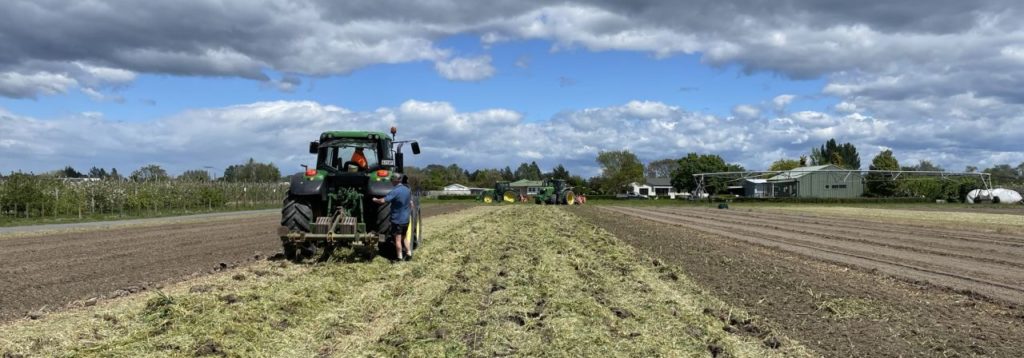
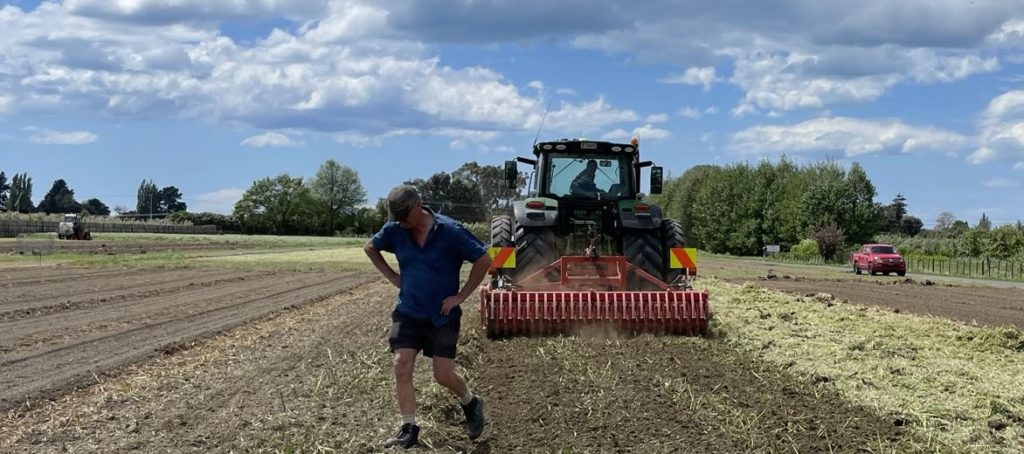
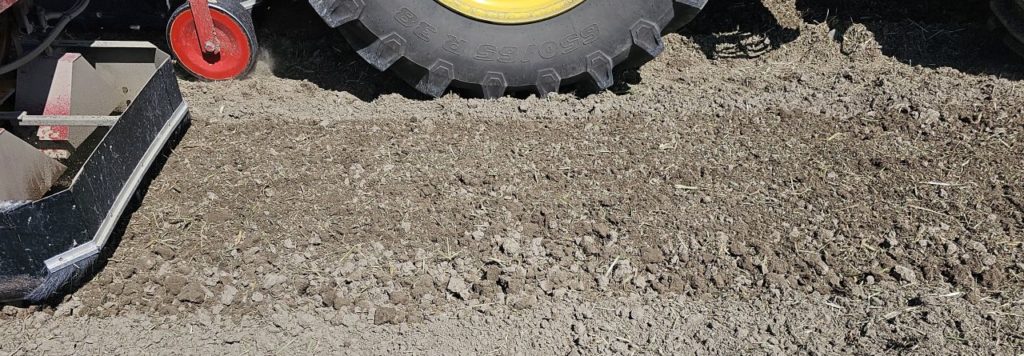
Here’s a pictorial outline of turning our cover crop into a planted tomato field.
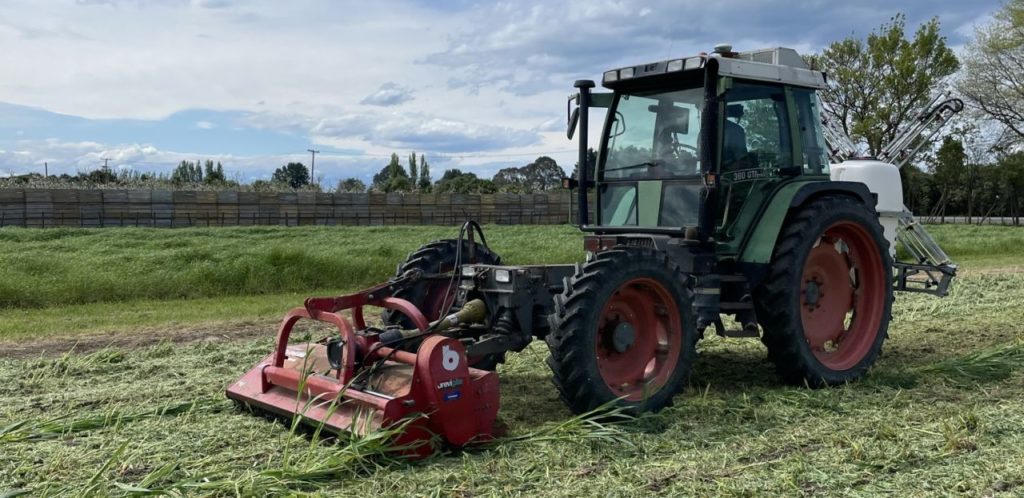
Stage 1: Cover crop mowed then mulched, initially to create material for planting, but then to allow a ripper to work without blocking.
Step 2: Ripping through the mulched cover crop to loosen compacted soil in the regenerative treatment plots.
Step 3: Hoeing and spading to incorporate the oat/vetch/lupin cover crop for transplanting.
Step 4: Adding base fertiliser and herbicide prior to planting.
Step 5: The Heinz-Watties planting team quietly and efficiently getting transplants into the ground.
  • Cyclone Gabrielle Research Symposium
  • Biodiversity Strips Update
  • Carbon Positive: Butternuts
  • Carbon Positive: Butternut Planting to Side Dressing
  • Nitrate Levels on the MicroFarm
  • Cyclone Gabrielle Research Symposium
  • Introducing Carys Luke, our Summer Intern
  • Soil Infiltration Calculator
  • MicroFarm Biodiversity Update
  • Irrigation System Testing
  • Carbon Positive: Butternut Planting
  • NZARM Conference 2025

RECENT POSTS

  • Cyclone Gabrielle Research Symposium
  • Biodiversity Strips Update
  • Carbon Positive: Butternuts
  • Carbon Positive: Butternut Planting to Side Dressing
  • Nitrate Levels on the MicroFarm

CATEGORIES

  • Agritech
  • Asparagus
  • Conference
  • Courses
  • Cover crops
  • Cultivation
  • Events
  • Fresh Vegetables
  • Irrigation
  • Membership
  • Nitrate
  • Nutrition
  • People
  • Permanent crops
  • Pests
  • Process Crops
  • Projects
  • Protected cropping
  • regenerative agriculture
  • Regulations
  • Research
  • soil health
  • Sustainable technology
  • Uncategorized
  • Water resources
  • Weeds
©2023 LandWISE – Promoting sustainable land management

Disclaimer: Any information on the LandWISE website or linked LandWISE resources is of a general nature only. We endeavour to provide accurate and adequate information relating to the subject matters contained in it. It has been prepared and made available to all persons and entities strictly on the basis that LandWISE, its researchers and authors are fully excluded from any liability for damages arising out of any reliance in part or in full upon any of the information for any purpose. No endorsement of named products is intended nor is any criticism of other alternative, but unnamed product.