

Project Purpose
The Te Ahikawariki/VICE project involved growers and soils in four regions: Pukekohe, Gisborne, Hawke’s Bay, and Manawatu/Levin. Results from Slakes assessments were compared with results from the LRMW wet-sieve aggregate stability test and correlated with visual soil assessment (VSA) scores, soil bulk density, and total soil carbon levels.
A key part of the project was to engage with growers to demonstrate and support valid paddock sampling and the proper use of the Slakes app, ensuring the knowledge is retained within each regional community. The intent was for a standardised assessment methodology consistent with Soil Health Institute (SHI) guidelines to be understood and made available for growers if needed. Assuming the Slakes testing methodology proved valid and was found to be easily usable by growers, these sectors would have an improved, cost-effective way to assess soil health using a key indicator. All it would require is a little of a grower’s time and a free smartphone app, and it could be integrated into industry BMP or sustainability guidelines.
Soil Aggregate Stability
Soil aggregate stability is a measurement of aggregates’ ability to resist degradation and maintain structure when being affected by external forces such as rainfall, vehicle traffic, and tillage. It is correlated with soil erosion, water retention, aeration, root growth, soil microorganisms, and soil carbon.
Soil aggregate stability is one of the three key soil health indicator tests recommended by the Soil Health Institute (SHI), alongside soil organic carbon concentration and carbon mineralization potential. The SHI recommends the Slakes method for testing aggregate stability as it is practical and cost-effective.
The Slakes method uses a free app that was developed by the SHI and the University of Sydney, to test aggregate stability. The app is used to take images of sets of three aggregates, initially dry and again after they have been submerged in water for 10 minutes. The Slakes app takes photos, times submersion, and calculates an Aggregate Stability Index, which is the ratio of initial to final soil area.
Slakes Project outline
The project intention was to:
- Compare the Slakes aggregate stability index and Manaaki Whenua – Landcare Research wet sieving aggregate stability results
- Correlate the results to a visual soil assessment (VSA) score, bulk density, and total carbon
- Engage with growers while demonstrating valid paddock sampling and how to use the Slakes app

Slakes Method
The Slakes procedure published by the SHI recommends extracting clods of soil from the top 5 cm of the profile and extracting “pea sized” aggregates. A number of clods can be taken across an area to obtain a paddock average, similar to any other soil test sampling. This project included comparing Slakes with other testing methods, including the LRMW mean weight diameter and VSA, so Slakes peds were collected from the upper 20 cm of soil.
The samples were broken up by hand along the soil’s natural fractures, and 30 aggregates of approximately 5 mm diameter were collected and weighed. The selected aggregates were dried in a microwave for 2 minutes, then reweighed. The samples continued to be dried for one-minute intervals until there was no significant change in weight.
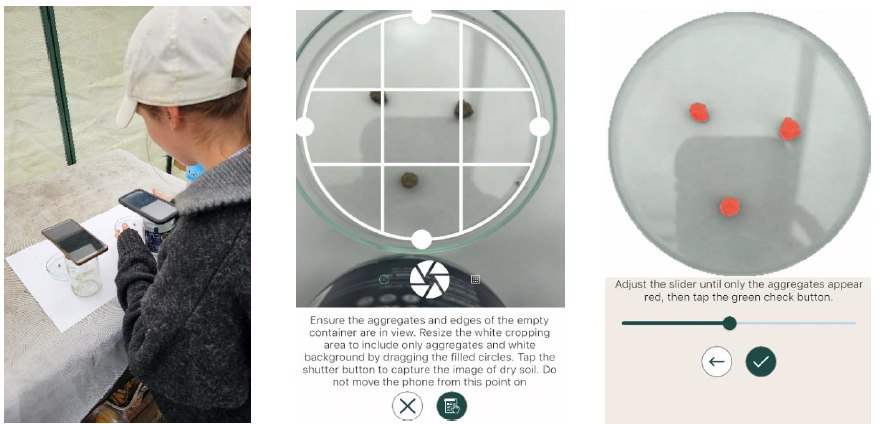
Three dry aggregates were placed evenly in a white dish, and a phone was set up 10 cm above the dish. Then the dish was filled with water, the aggregates returned to it and another photo was taken. Ten minutes later the Slakes app automatically took another photo and calculated the mount of aggregate dispersion to give the Slakes Aggregate Stability Index.
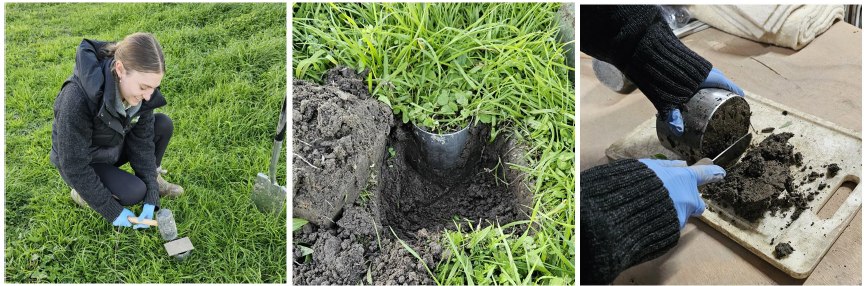
A 7.5 cm deep x 9.8 cm diameter bulk density ring was pressed into the soil beside the VSA hole to collect a sample of known volume. The sample was oven dried for 72 hours at 100 degrees Celsius. The dry soil weight and volume of the bulk density ring were used to calculate the soil’s bulk density.
Results
Most samples collected throughout this project were taken from an uncropped and a cropped area within the same paddock. The Slakes aggregate stability index and the Manaaki Whenua Landcare Research wet sieving aggregate stability tests gave well correlated results. As expected, there was a clear trend in both methods for the uncropped areas to have higher aggregate stability. See example images below.
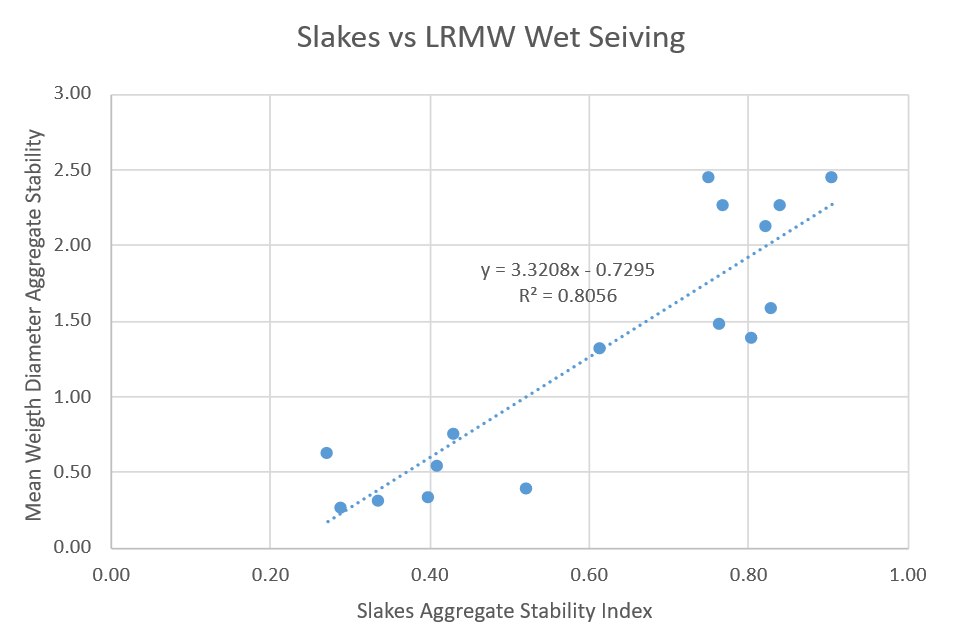
There was a strong relationship (R2 = 0.81) between the Slakes Index and the LRMW MWD results, with uncropped areas having higher aggregate stability than cropped areas. Based on published interpretations of wet-sieve aggregate results, and the strong correlation we found, we suggest a Slakes Risk Index, where a score > 0.8 indicates strong aggregate stability and high health. A Slakes index between 0.80 and 0.65 indicates structure is somewhat degraded, a value below 0.65 indicates cause for concern. A Slakes index < 0.55 provides a lower boundary and should be seen as indicating significant degradation and increased risk of adverse agronomic factors associated with poor aeration, drainage, and susceptibility to compaction. This relationship appears to be valid across the sites tested.

When comparing the VSA and aggregate stability results, most of the cropped paddocks had good VSA structure scores but weak aggregate stability. This suggests that the tilth created by cultivation looks good, but it lacks the strength of true aggregates that are the basis for good soil structure.

There was a moderately strong relationship between the Slakes aggregate stability index and the total carbon percentage in the soil (R2 = 0.69), with the uncropped areas (blue dots) having higher total carbon and aggregate stability than cropped areas (brown dots).

Conclusion
Aggregate stability is one of three soil health indicators recommended by the Soil Health Institute. It measures the ability of soil aggregates or “peds” to resist degradation and maintain structure when being affected by external forces. Aggregate stability is essential as it is associated with moisture retention, root growth, soil erosion, water infiltration rates, aeration, soil microorganisms, and carbon sequestration.
This project included working with growers and agronomists in four regions: Pukekohe, Gisborne, Hawke’s Bay, and Manawatu/Levin. We also shared the method with many others through a variety of events and found a high level of interest.
Throughout the Slakes project, we received positive feedback from growers about the Slakes app, as it provides a quick, simple, and affordable way to gauge the soil’s aggregate stability without needing to send samples away to a lab. They recognise the test is low cost, but some would like the option to send it to a laboratory to save time.
However, some growers asked how they can use it to aid their management. Most are keen to know if there is an aggregate stability index threshold that indicates when poor stability will impact productivity. The Slakes Risk Index we propose provides an interim guide, but further research is recommended.
The VSA structure scores in cropped areas were moderate to good, whereas the aggregate stability results from Slakes and LRMW indicated stability was low and was of concern. The difference is likely due to cultivation in cropped areas creating tilth rather than structure. We suggest using the Slakes method as a useful addition when doing a VSA on cropped soils, as it will provide a better representation of soil structural strength.
This Project has confirmed the utility of the Slakes method as an indicator of soil health status. It showed the method correlated well with other indicators, such as the MWD method and was better than the VSA method at identifying weak soil structure in cropped areas. The relationships with soil carbon concentration and bulk density are consistent with expectations.
Many thanks to Te Ahikawariki, the Vegetable Industry Centre of Excellence, for funding the Slakes research project. And thanks also to the farmers, growers and consultants who spent time trying out the Slakes method with us and giving us their considered feedback.
Download
Download the Full Project Report here