


Skip to content
Menu
LandWISE – Promoting sustainable land management
  • Welcome
    • About
    • LandWISE Committee
    • Contact
  • Projects
    • Carbon Positive
      • Carbon Positive Reports
    • Nitrachek: Farmer Friendly Nitrate Testing
    • SLAKES: a cost-effective measure of soil structural stability
    • Soil Repair after Cyclone Gabrielle
    • Vegetable Production Nitrogen Management
    • Best Management of Nitrates in Process Cropping
    • Future Proofing Vegetable Production
    • Herbicide Resistance Management
  • Events
    • Cyclone Gabrielle Research Symposium
      • Historical North Island Flood Events
      • An extraordinary storm: the severity of Cyclone Gabrielle’s weather in Hawke’s Bay
      • The Science Response in the Year of Storms; A Gisborne/Tairawhiti perspective
      • Insights into causes of landslides triggered by Cyclone Gabrielle
      • The effects of Cyclone Gabrielle on fruit tree health in Hawke’s Bay
      • Impact of Cyclone Gabrielle on stonefruit orchards in Hawke’s Bay: a case study
      • Charting the Course following Cyclone Gabrielle
      • Baseline sediment sampling in Tairawhiti and Hawke’s Bay
      • Impacts on cropping businesses
      • Understanding the flooding caused by Cyclone Gabrielle
      • Building Flood Damage from Ex-Tropical Cyclone Gabrielle
      • Food safety and critical incidents: A unified approach for safer produce
      • Silt nutritional status and contamination concerns
      • Lessons from the horticultural sector response to Cyclone Gabrielle
      • Ecological impacts of Cyclone Gabrielle
      • Cyclone Gabrielle and Poplar Windthrow in Northland
      • Seed Size and Establishment Method Determine Crop Recovery Following Cyclone-Induced Silt Deposition
      • Returning to (some) baseline sampling sites to assess cropping soil recovery
      • Recovery of annual cropping ground – Grower learnings
      • Recovery of Annual Cropping over 2 Years
      • Technical and extension learnings from Cyclone Gabrielle
    • Getting to Carbon Positive!
      • Getting to Carbon Positive – Presenters
    • Rebuilding Our Soils
      • Rebuilding Our Soils – Presenters
    • Events Archive
  • Tools
    • Nitrachek Calculator
    • Carbon Calculator
    • Nutrient Budget
    • Irrigation Evaluation – IRRIG8
      • IRRIG8: Centre Pivot
        • IRRIG8-online: Centre Pivot User Guide
      • IRRIG8: Linear Move
      • IRRIG8: Travelling Irrigator
        • IRRIG8-online: Travelling Irrigation User Guide
      • IRRIG8: Multiple sprayline calculator
      • IRRIG8: Solid set irrigation
      • IRRIG8: Pressure and energy
        • Pressure and Energy Calculator: User Guide
    • ANOVA Tool for statistical significance
    • Fertspread Spreader Calibration
    • Fertspread Placement Calibration
    • Soil Infiltration Calculator
      • Disc Permeameter User Guide
      • Disc Permeameter Calculator: Frequently Asked Questions
  • Blog
  • Sign Up
  • Login
  • Members Only
    • Online Learning
  • Account
  • Site Search
LandWISE – Promoting sustainable land management

Winter cover crop update – September

Posted on September 16, 2025

After a successful bean crop in the 2024-2025 season, the three systems were planted in cover crops for the winter. The Conventional was planted with ryegrass, the Hybrid with ryegrass, Balansa clover and crimson clover, and the Regenerative was the same as the Hybrid but with the addition of vetch.

The Canopeo phone app has been used weekly to monitor the canopy development of the cover crops. All three treatments achieved impressive canopy coverage, reaching over 90% canopy cover after just eight weeks. This rapid establishment is attributed to the ryegrass component, which typically establishes ground cover faster than other cover crop species used previously in the Carbon Positive trial.
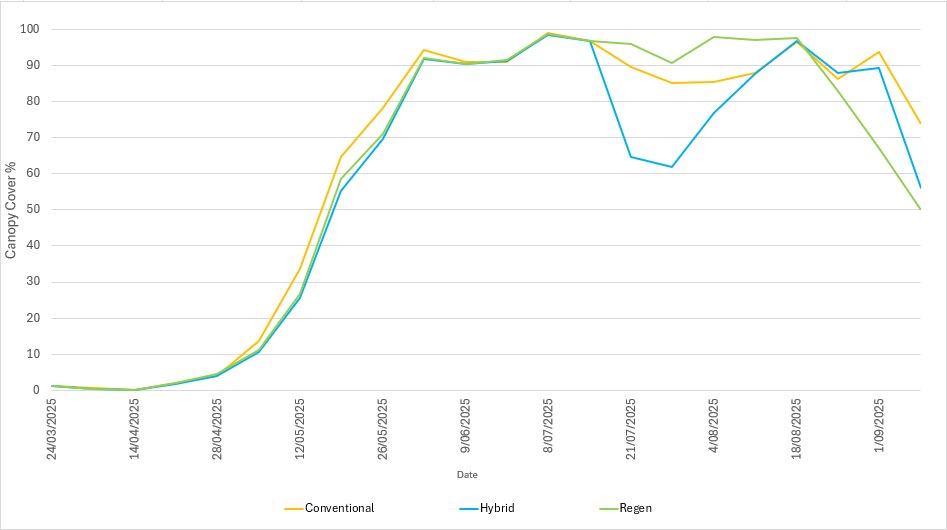
Sheep were brought on to the Conventional plots in early July, after which they had a gradual reduction in canopy cover due to ongoing grazing, reaching its lowest point at 85% canopy cover.

The Hybrid system presented a unique challenge as it developed a significant nettle problem. This is probably an artefact of the site, rather than being caused by the Hybrid management strategy. To manage the nettles, the Hybrid was mowed in mid-July before the nettle set seed. Mowing reduced the Hybrid’s canopy cover to 65%, but the resilience of the cover crop mix was demonstrated as it quickly regrew to full canopy cover. Sheep were introduced in mid-August to reduce biomass before strip spraying.

The Regenerative treatment maintained steady canopy cover (90-100%) until sheep were introduced in mid-August to reduce biomass in preparation for strip spraying. The small fluctuations in the data are due strong shadows on bright days impacting the green percentage calculation in the app.

Cover crop biomass measurements were taken before grazing. The Conventional system produced an average of 3,987 kg/ha of dry matter from April to mid-July, compared to the Regenerative system, which produced an average of 5169 kg of dry matter per hectare from April to mid-August.

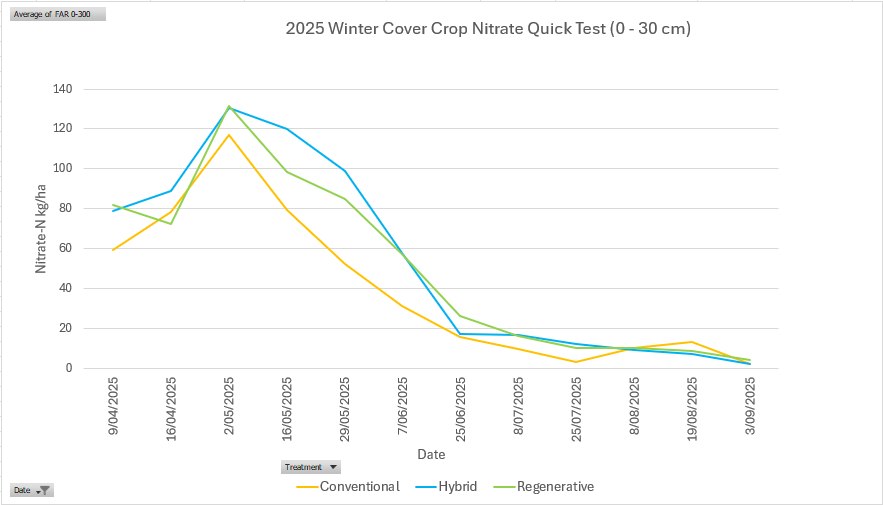
Fortnightly nitrate quick tests throughout the cover crop have provided insights into nitrogen dynamics within the different systems. Nitrate-N levels peaked approximately one month after cover crop establishment, with the Hybrid and Regenerative treatments showing higher levels than the Conventional treatment. [The Conventional Bean crop had received significantly more N fertiliser but yielded lower than the other treatments.] All treatments have shown steady decreases in nitrate-N. We haven’t seen a significant increase in nitrate-N from sheep grazing in any of the three treatments, although a slight lift in the Conventional plots may show some effect.
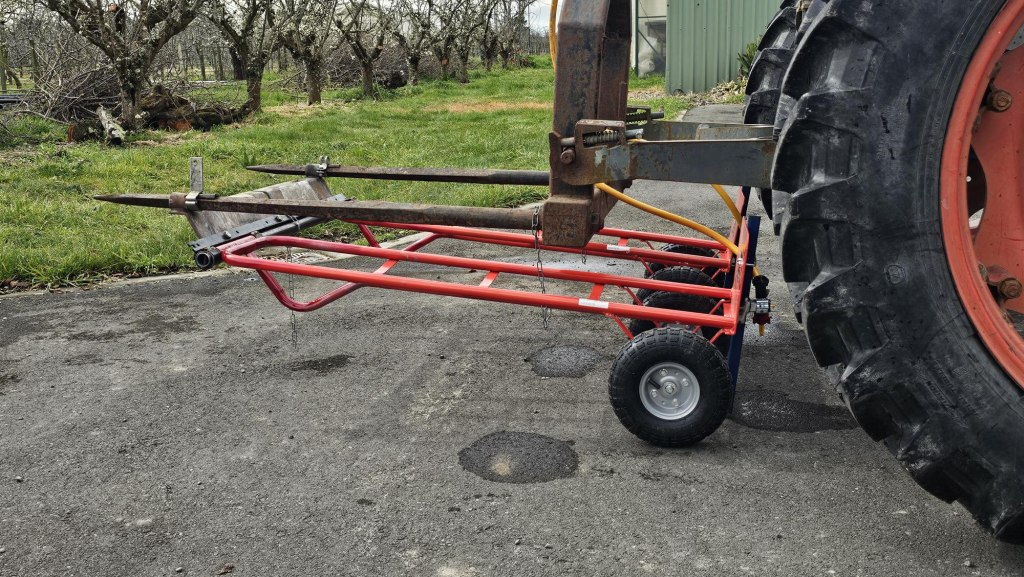
The Hybrid and Regenerative plots were strip sprayed on 15 September using our prototype twin-row sprayer. We wait in anticipation to see the results!
  • Cyclone Gabrielle Research Symposium
  • Biodiversity Strips Update
  • Carbon Positive: Butternuts
  • Carbon Positive: Butternut Planting to Side Dressing
  • Nitrate Levels on the MicroFarm
  • Cyclone Gabrielle Research Symposium
  • Introducing Carys Luke, our Summer Intern
  • Soil Infiltration Calculator
  • MicroFarm Biodiversity Update
  • Irrigation System Testing
  • Carbon Positive: Butternut Planting
  • NZARM Conference 2025

RECENT POSTS

  • Cyclone Gabrielle Research Symposium
  • Biodiversity Strips Update
  • Carbon Positive: Butternuts
  • Carbon Positive: Butternut Planting to Side Dressing
  • Nitrate Levels on the MicroFarm

CATEGORIES

  • Agritech
  • Asparagus
  • Conference
  • Courses
  • Cover crops
  • Cultivation
  • Events
  • Fresh Vegetables
  • Irrigation
  • Membership
  • Nitrate
  • Nutrition
  • People
  • Permanent crops
  • Pests
  • Process Crops
  • Projects
  • Protected cropping
  • regenerative agriculture
  • Regulations
  • Research
  • soil health
  • Sustainable technology
  • Uncategorized
  • Water resources
  • Weeds
©2023 LandWISE – Promoting sustainable land management

Disclaimer: Any information on the LandWISE website or linked LandWISE resources is of a general nature only. We endeavour to provide accurate and adequate information relating to the subject matters contained in it. It has been prepared and made available to all persons and entities strictly on the basis that LandWISE, its researchers and authors are fully excluded from any liability for damages arising out of any reliance in part or in full upon any of the information for any purpose. No endorsement of named products is intended nor is any criticism of other alternative, but unnamed product.