
Skip to content
Menu
LandWISE – Promoting sustainable land management
  • Welcome
    • About
    • LandWISE Committee
    • Contact
  • Projects
    • Carbon Positive
      • Carbon Positive Reports
    • Nitrachek: Farmer Friendly Nitrate Testing
    • SLAKES: a cost-effective measure of soil structural stability
    • Soil Repair after Cyclone Gabrielle
    • Vegetable Production Nitrogen Management
    • Best Management of Nitrates in Process Cropping
    • Future Proofing Vegetable Production
    • Herbicide Resistance Management
  • Events
    • Cyclone Gabrielle Research Symposium
      • Historical North Island Flood Events
      • An extraordinary storm: the severity of Cyclone Gabrielle’s weather in Hawke’s Bay
      • The Science Response in the Year of Storms; A Gisborne/Tairawhiti perspective
      • Insights into causes of landslides triggered by Cyclone Gabrielle
      • The effects of Cyclone Gabrielle on fruit tree health in Hawke’s Bay
      • Impact of Cyclone Gabrielle on stonefruit orchards in Hawke’s Bay: a case study
      • Charting the Course following Cyclone Gabrielle
      • Baseline sediment sampling in Tairawhiti and Hawke’s Bay
      • Impacts on cropping businesses
      • Understanding the flooding caused by Cyclone Gabrielle
      • Building Flood Damage from Ex-Tropical Cyclone Gabrielle
      • Food safety and critical incidents: A unified approach for safer produce
      • Silt nutritional status and contamination concerns
      • Lessons from the horticultural sector response to Cyclone Gabrielle
      • Ecological impacts of Cyclone Gabrielle
      • Cyclone Gabrielle and Poplar Windthrow in Northland
      • Seed Size and Establishment Method Determine Crop Recovery Following Cyclone-Induced Silt Deposition
      • Returning to (some) baseline sampling sites to assess cropping soil recovery
      • Recovery of annual cropping ground – Grower learnings
      • Recovery of Annual Cropping over 2 Years
      • Technical and extension learnings from Cyclone Gabrielle
    • Getting to Carbon Positive!
      • Getting to Carbon Positive – Presenters
    • Rebuilding Our Soils
      • Rebuilding Our Soils – Presenters
    • Events Archive
  • Tools
    • Nitrachek Calculator
    • Carbon Calculator
    • Nutrient Budget
    • Irrigation Evaluation – IRRIG8
      • IRRIG8: Centre Pivot
        • IRRIG8-online: Centre Pivot User Guide
      • IRRIG8: Linear Move
      • IRRIG8: Travelling Irrigator
        • IRRIG8-online: Travelling Irrigation User Guide
      • IRRIG8: Multiple sprayline calculator
      • IRRIG8: Solid set irrigation
      • IRRIG8: Pressure and energy
        • Pressure and Energy Calculator: User Guide
    • ANOVA Tool for statistical significance
    • Fertspread Spreader Calibration
    • Fertspread Placement Calibration
    • Soil Infiltration Calculator
      • Disc Permeameter User Guide
      • Disc Permeameter Calculator: Frequently Asked Questions
  • Blog
  • Sign Up
  • Login
  • Members Only
    • Online Learning
  • Account
  • Site Search
LandWISE – Promoting sustainable land management

Carbon Accounting in Carbon Positive

Posted on October 6, 2025

One way to track greenhouse gas emissions is through carbon accounting. Carbon accounting quantifies carbon dioxide, methane, and nitrous oxide emissions. We have been tracking the relative emissions from each of the three different management systems applied in our Carbon Positive trial.

There are three scopes within carbon accounting: Scope 1, Scope 2 and Scope 3. Scope 1 is direct GHG emissions from sources controlled or owned by a business.  Scope 2 is indirect GHG emissions from electricity purchased by a business. Scope 3, which is broken down into 15 categories, is all other indirect GHG emissions not controlled or owned by a business.
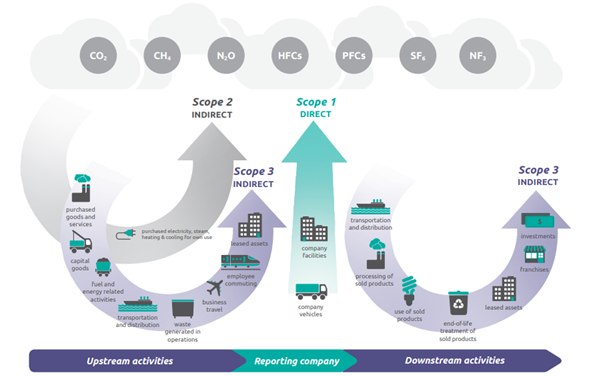
Overview of carbon accounting scopes within a business. Source: Greenhouse Gas Protocol, (2013)

Carbon accounting calculator

We developed a carbon accounting calculator that quantifies the emissions from the different management systems. We are considering making it into a webtool for others to use.

The Scope 1 emissions we considered were fertiliser use, fuel use, and livestock. The Scope 2 emission was from the power used to run the Irrigator. Scope 3 emissions were from the manufacturing and transportation of fertilisers and agrichemicals.

We set the farm gate as our boundary for crops produced, so we have not calculated transport to the factory (the same for all treatments), food processing, sales or home cooking etc. We have included those factors that make most impact and that are within our control. This parallels the Gross Margin accounting we use to assess profitability of the different treatments in our trial.

Emission factors were used to determine the CO2 equivalent (CO2-e) for each operation within the Carbon Positive trial. An emission factor is a coefficient that converts an activity to a greenhouse gas emission. For example, 1 kilogram of non-urea nitrogen has an emission factor of 4.84 kg CO2-e; therefore, you multiply the amount of fertiliser used by the emission factor to determine total emissions.

  • The emission factors for fertiliser, fuel use, livestock, and power were all sourced from the Ministry for the Environment: Te ine tukunga: He tohutohu pakihi Measuring emissions: A guide for organisations.
  • The fertiliser manufacturing emission factors were sourced from Wells 2001: Total energy indicators of agricultural sustainability: Dairy farming case study.
  • The fertiliser transportation emission factor is an average of different fertilisers being transported to New Zealand, sourced from Ledgard & Falconer 2019: Update of the carbon footprint of fertilisers used in New Zealand.
  • The emission factors for agrichemicals manufacturing and transportation were sourced from Audsley et al. (2009): Estimation of the greenhouse gas emissions from agricultural pesticide manufacture and use, with original data from Green (1987). Emission factors for the active ingredients were used if available; otherwise, the average value was used for the agrichemical type: Herbicide, Fungicide, or Insecticide.

Carbon accounting calculator results

Over 2022-2025, the first 3 years of the Carbon Positive trial, the Conventional treatment had the highest emissions (5,906 kg CO2-e). The Hybrid treatment (4,401kg CO2-e) was next, and the Regenerative treatment (3,575 kg CO2-e) was lowest. Nitrogen fertiliser followed by fuel were the highest emission sources in all treatments.
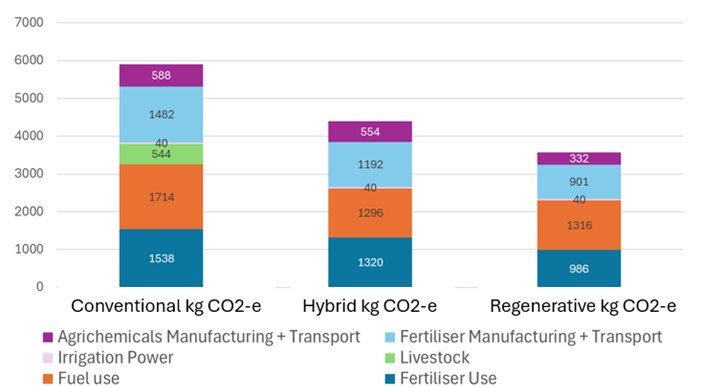
Greenhouse gas emissions from 2022-2025, the first 3 years of the Carbon Positive trial, by treatment.

In the first three years, only the conventional plots had sheep grazed on them. The other plots were left in ungrazed cover crops. Over later winter 2025, we did have sheep grazing on all three treatments and they will show up in our next update. Note from the chart above, that sheep had about the same emissions as our agrichemicals.

  • Cyclone Gabrielle Research Symposium
  • Biodiversity Strips Update
  • Carbon Positive: Butternuts
  • Carbon Positive: Butternut Planting to Side Dressing
  • Nitrate Levels on the MicroFarm
  • Cyclone Gabrielle Research Symposium
  • Introducing Carys Luke, our Summer Intern
  • Soil Infiltration Calculator
  • MicroFarm Biodiversity Update
  • Irrigation System Testing
  • Carbon Positive: Butternut Planting
  • NZARM Conference 2025

RECENT POSTS

  • Cyclone Gabrielle Research Symposium
  • Biodiversity Strips Update
  • Carbon Positive: Butternuts
  • Carbon Positive: Butternut Planting to Side Dressing
  • Nitrate Levels on the MicroFarm

CATEGORIES

  • Agritech
  • Asparagus
  • Conference
  • Courses
  • Cover crops
  • Cultivation
  • Events
  • Fresh Vegetables
  • Irrigation
  • Membership
  • Nitrate
  • Nutrition
  • People
  • Permanent crops
  • Pests
  • Process Crops
  • Projects
  • Protected cropping
  • regenerative agriculture
  • Regulations
  • Research
  • soil health
  • Sustainable technology
  • Uncategorized
  • Water resources
  • Weeds
©2023 LandWISE – Promoting sustainable land management

Disclaimer: Any information on the LandWISE website or linked LandWISE resources is of a general nature only. We endeavour to provide accurate and adequate information relating to the subject matters contained in it. It has been prepared and made available to all persons and entities strictly on the basis that LandWISE, its researchers and authors are fully excluded from any liability for damages arising out of any reliance in part or in full upon any of the information for any purpose. No endorsement of named products is intended nor is any criticism of other alternative, but unnamed product.