
Throughout the Carbon Positive Trial, Soil Nitrate levels down to 30cm have been monitored fortnightly.
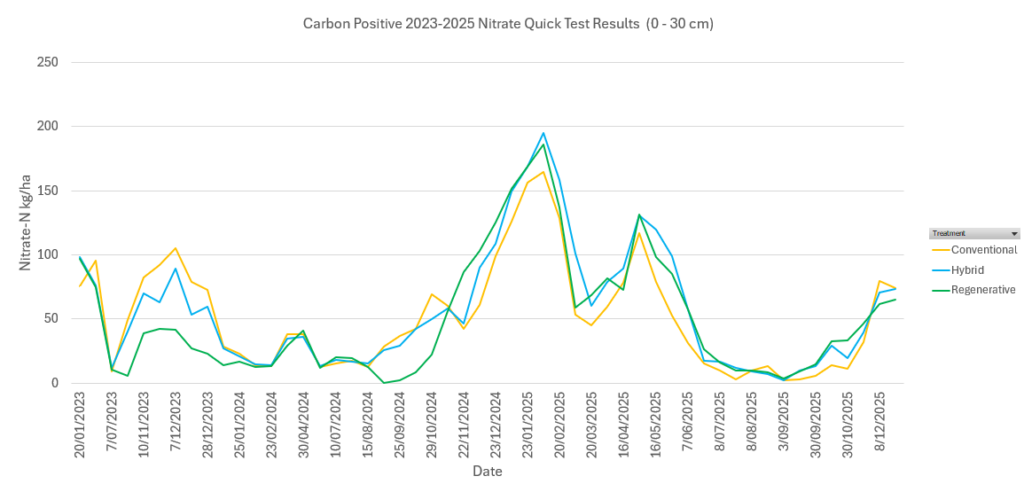
During the tomato crop (26/10/2023 – 6/3/2024), the Regenerative treatment had significantly lower nitrate levels than the Conventional and Hybrid treatments, despite all three receiving similar amounts of nitrogen. This lower nitrate level was likely due to the breakdown of the cover crop. Approximately 12 t/ha of cover crop, mainly oats, was incorporated into the soil two days before planting, which would have tied up nitrogen.
Since then, different amounts of nitrogen have been applied across treatments, and there has been no significant difference in soil nitrate levels, except during the period when the Conventional and Hybrid treatments were in peas, while the Regenerative treatment remained in cover crop.
Amount of Nitrogen applied during each crop, by treatment.
| Treatment | Tomato Applied N kg/ha | Bean Applied N kg/ha | Butternut Applied N kg/ha |
| Conventional | 89.4 | 60.8 | 76 |
| Hybrid | 83.6 | 47.3 | 66 |
| Regen | 88.5 | 28.9 | 18 |
Butternuts
Our pre-season soil tests showed that there was 110 kg of potentially available nitrogen in the Conventional, 93. 3 in the Hybrid and 97.3 in the Regenerative treatment.
Two days before the butternuts were planted, there were 32 kg Nitrate-N/ha in the Conventional, 39 in the Hybrid, and 46 in the Regenerative treatment.
At planting, the Conventional and Hybrid treatments received 300 kg of Complex, whereas the Regenerative treatment received 150 kg of Complex. This increased the kg of Nitrate-N in the Conventional to 80, the Hybrid to 71, and the Regenerative to 63.
At side dressing, the Conventional treatment got 150 kg/ha of CAN. The Hybrid got 113 kg/ha of CAN and a foliar application of seaweed. The Regenerative treatment got a foliar application of seaweed, Megafol, and fulvic acid.
When testing for nitrate after side dressing, we avoided the area where the fertiliser was applied. The nitrate test showed similar results to last time. There is 74 Kg of Nitrate-N in the Conventional, 73 in the Hybrid and 65 in the Regenerative treatment. We can assume the conventional is 18 kg higher and the Hybrid is 13.6 kg higher, as this is how much nitrogen was applied at side dressing.
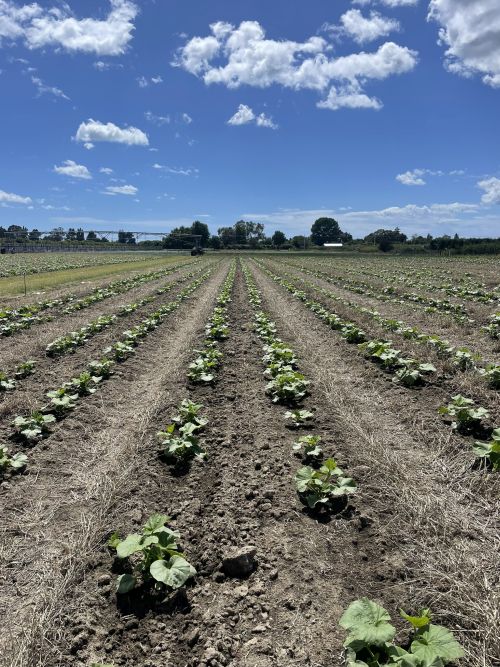
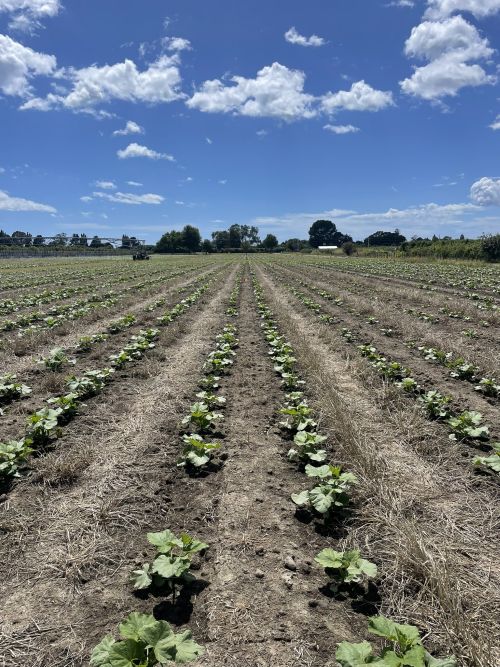
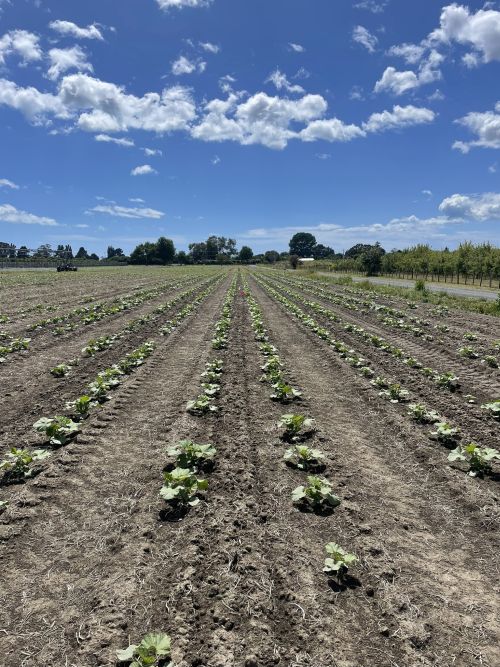
Our aim is to push the limits of regenerative cropping to understand how much nitrogen input can be reduced. Based on potentially available nitrogen and fortnightly soil nitrate results, the Operations Advisory Group decided not to apply granular fertiliser to the Regenerative treatment at side-dressing.
A similar approach was taken last season in beans, where no granular fertiliser was applied at side-dressing and a foliar approach was used instead. Soil nitrate levels remained similar across all treatments, and the Regenerative treatment produced the highest bean yield.
We will continue to monitor nitrate levels fortnightly, and we will do leaf testing during fruit set.