Skip to content
Menu
LandWISE – Promoting sustainable land management
  • Welcome
    • About
    • LandWISE Committee and Staff
    • Contact
  • Projects
    • Carbon Positive
      • Carbon Positive Reports
    • Nitrachek: Farmer Friendly Nitrate Testing
    • SLAKES: a cost-effective measure of soil structural stability
    • Soil Repair after Cyclone Gabrielle
    • Vegetable Production Nitrogen Management
    • Best Management of Nitrates in Process Cropping
    • Future Proofing Vegetable Production
    • Herbicide Resistance Management
  • Events
    • Soil Health for Profit
      • Soil Health for Profit Presenters
    • Cyclone Gabrielle Research Symposium
      • Historical North Island Flood Events
      • An extraordinary storm: the severity of Cyclone Gabrielle’s weather in Hawke’s Bay
      • The Science Response in the Year of Storms; A Gisborne/Tairawhiti perspective
      • Insights into causes of landslides triggered by Cyclone Gabrielle
      • The effects of Cyclone Gabrielle on fruit tree health in Hawke’s Bay
      • Impact of Cyclone Gabrielle on stonefruit orchards in Hawke’s Bay: a case study
      • Charting the Course following Cyclone Gabrielle
      • Baseline sediment sampling in Tairawhiti and Hawke’s Bay
      • Impacts on cropping businesses
      • Understanding the flooding caused by Cyclone Gabrielle
      • Building Flood Damage from Ex-Tropical Cyclone Gabrielle
      • Food safety and critical incidents: A unified approach for safer produce
      • Silt nutritional status and contamination concerns
      • Lessons from the horticultural sector response to Cyclone Gabrielle
      • Ecological impacts of Cyclone Gabrielle
      • Cyclone Gabrielle and Poplar Windthrow in Northland
      • Seed Size and Establishment Method Determine Crop Recovery Following Cyclone-Induced Silt Deposition
      • Returning to (some) baseline sampling sites to assess cropping soil recovery
      • Recovery of annual cropping ground – Grower learnings
      • Recovery of Annual Cropping over 2 Years
      • Technical and extension learnings from Cyclone Gabrielle
    • Getting to Carbon Positive!
      • Getting to Carbon Positive – Presenters
    • Rebuilding Our Soils
      • Rebuilding Our Soils – Presenters
    • Events Archive
  • Tools
    • Fertiliser Application Equipment Calibration
      • Fertspread Spreader Calibration
      • Fertspread Placement Calibration
    • Nitrachek Calculator
    • Irrigation Evaluation – IRRIG8
      • IRRIG8: Centre Pivot
        • IRRIG8-online: Centre Pivot User Guide
      • IRRIG8: Linear Move
      • IRRIG8: Travelling Irrigator
        • IRRIG8-online: Travelling Irrigation User Guide
      • IRRIG8: Multiple sprayline calculator
      • IRRIG8: Solid set irrigation
      • IRRIG8: Pressure and energy
        • Pressure and Energy Calculator: User Guide
    • Soil Infiltration Calculator
      • Disc Permeameter User Guide
      • Disc Permeameter Calculator: Frequently Asked Questions
    • Carbon Calculator
    • ANOVA Tool for statistical significance
  • Blog
  • Sign Up
  • Login
  • Members Only
    • Online Learning
  • Account
  • Site Search
LandWISE – Promoting sustainable land management

Irrigation Performance Assessment

Posted on April 24, 2026

Irrigation NZ Training Course at the MicroFarm
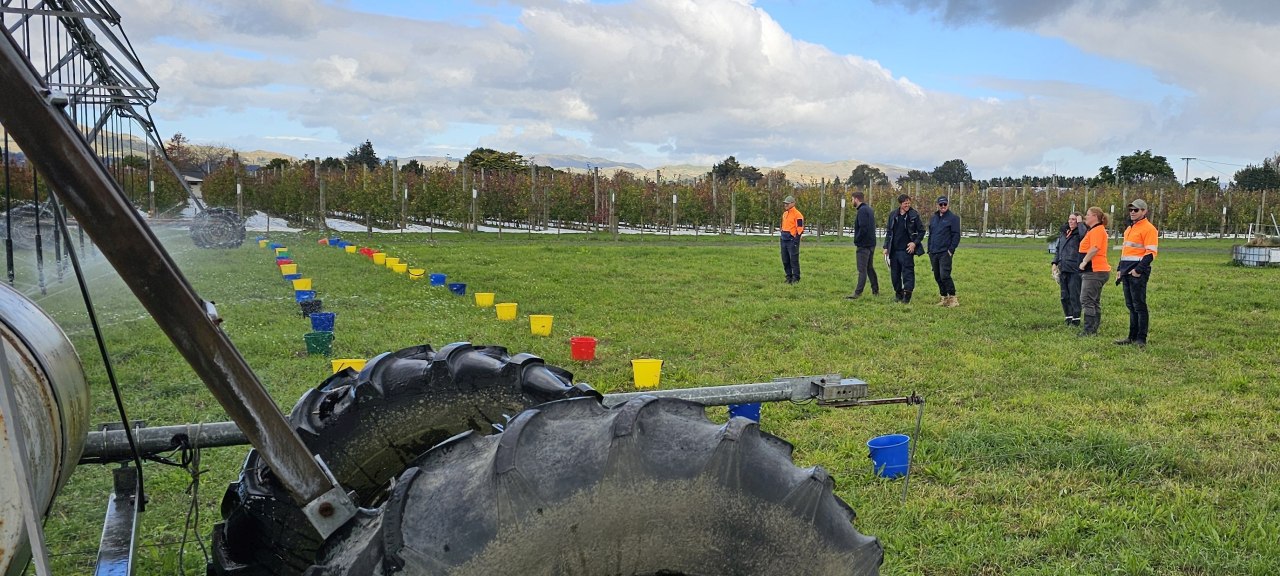
We were delighted to host Vicky Bloomer from Drop Consulting to present the Irrigation New Zealand Performance Assessor training course at the Centre for Land and Water this week. And what a wet week it was, so we thank them for breaking the drought in this part of the country.

The course participants were out and about visiting Drumpeel Farms to assess a centre pivot, our neighbours YummyFruit to assess drip/micro system and an Oderings nursery to look at a solid set system. At the LandWISE MicroFarm, they assessed the linear move irrigator. LandWISE Project manager Olivia Webster is one of the course participants

The performance assessment course is based on the Irrigation New Zealand Piped Irrigation System Performance Assessment Code of Practice, initially developed by Dan Bloomer at Page Bloomer Associates. The concept of irrigation performance assessment was strongly promoted by Hugh Ritchie following his Nuffield scholar experiences in the USA and he was a key player in obtaining funding support to write the New Zealand codes in the first place.

The MicroFarm Linear

The LandWISE linear machine was donated by Hugh and Sharon Ritchie. It was converted to a low energy precision application system (LEPA) by WaterForce who have been excellent with anything water related we need. The machine began life as a 460m multi-span linear at Drumpeel, and when it was due for replacement, Hugh collected the best bits and rebuilt it to fit the LandWISE MicroFarm. In its early days, it was repeatedly measured as a test case while the Code of Practice was developed! It was also used in other SFF projects assessing impacts of application intensity of soil surface redistribution and consequent soil moisture uniformity.
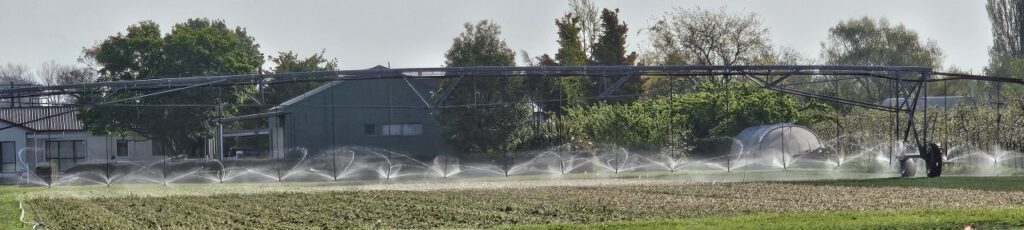
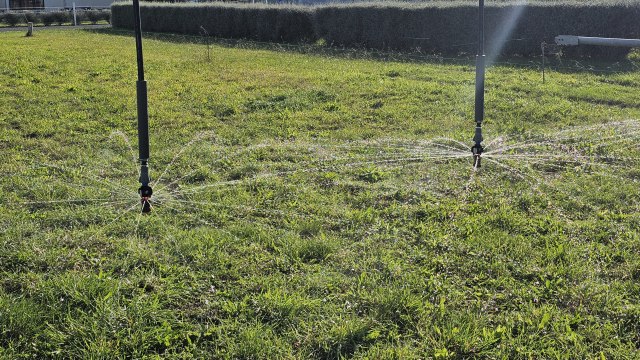
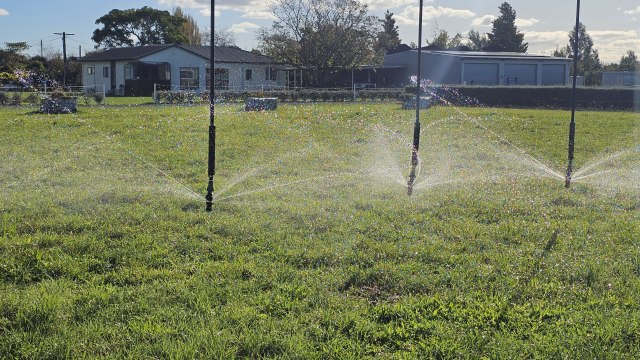
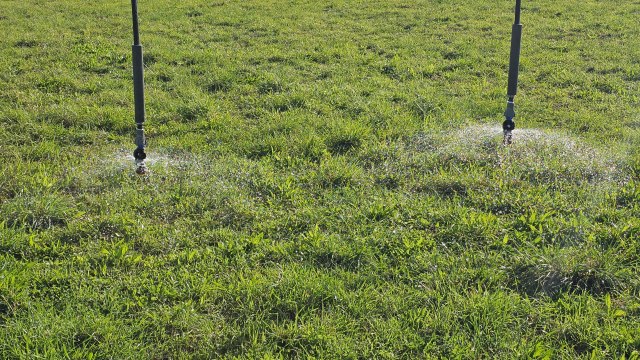
Quinn Elstone at WaterForce deigned the LEPA system specifically for the MicroFarm layout, centring the outlets above each 2m bed. We run two parallel header pipes along the linear span, and we can split the sprinklers between them. We can use the sprinklers as rotators doing a wide overlapping ~12m spread to maximise uniformity and minimise application intensity. Or we can run them as sprays with a 5m spread, keeping application tighter to our 12m plots. A third option is changing the nozzles to tighter 2m splash plates that water each bed individually. Or we can turn individual nozzles off.
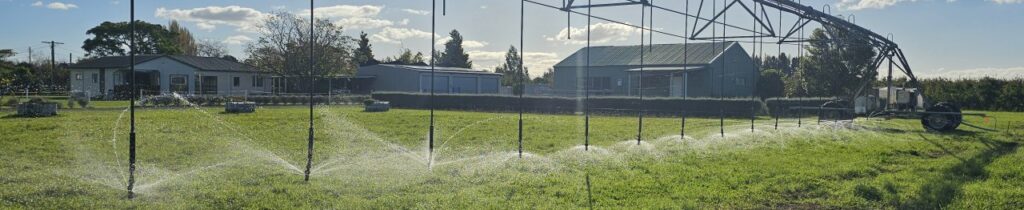
Images of irrigator showing 12m spread rotators on left, 2m splash plates in centre and 5m sprays at right
Why LEPA?

It gives us tremendous flexibility.

In the LEPA system the nozzles are very close to the ground, so we see very little effect in windier conditions. And because we generally run the irrigation during the day to take advantage of our solar electricity system for pumping, there is often a bit more breeze than at night. We haven’t converted the machine from diesel yet – that is on a long list!

We can tailor irrigation to treatments.

In our Carbon Positive trial, we’re running 6 beds per treatment plot, and sometimes we want to do different things to different treatments. When the nozzles are running as sprays, there is very little overpal of treatments.

The WaterForce LEPA system lets us turn one treatment plot off and irrigate the other two, or irrigate only one plot. We can run nutrient solution in one header and fresh water in the other and fertigate some plots and not others, even though we have three different treatments under the irrigator at any time. For us, the Drumpeel/WaterForce machine has been life changing because without flexible high-quality irrigation, our trial work is severely impacted.

We are tremendously grateful to the Ritchies for the generous donation, and to WaterForce for their supply and installation of the components. It is this kind of community support that characterises LandWISE and has allowed it to be a success.


Related

  • Irrigation Performance Assessment
  • Soil Health for Profit – James Hunter
  • Soil Health for Profit – Charlie White
  • Soil Health for Profit – Josh Wing
  • 2026 Winter cover crops emerged
  • Soil Health for Profit – Pranoy Pal
  • Soil Health for Profit
  • Winter Cover Crops
  • Butternut Harvest Data
  • A Lighter Touch Biodiversity Field Walk
  • Butternut Harvest
  • Measuring Soil Infiltration

RECENT POSTS

  • Irrigation Performance Assessment
  • Soil Health for Profit – James Hunter
  • Soil Health for Profit – Charlie White
  • Soil Health for Profit – Josh Wing
  • 2026 Winter cover crops emerged

CATEGORIES

  • Agritech
  • Asparagus
  • Conference
  • Courses
  • Cover crops
  • Cultivation
  • Events
  • Fresh Vegetables
  • Irrigation
  • Membership
  • Nitrate
  • Nutrition
  • People
  • Permanent crops
  • Pests
  • Process Crops
  • Projects
  • Protected cropping
  • regenerative agriculture
  • Regulations
  • Research
  • soil health
  • Sustainable technology
  • Uncategorized
  • Water resources
  • Weeds
©2023 LandWISE – Promoting sustainable land management

Disclaimer: Any information on the LandWISE website or linked LandWISE resources is of a general nature only. We endeavour to provide accurate and adequate information relating to the subject matters contained in it. It has been prepared and made available to all persons and entities strictly on the basis that LandWISE, its researchers and authors are fully excluded from any liability for damages arising out of any reliance in part or in full upon any of the information for any purpose. No endorsement of named products is intended nor is any criticism of other alternative, but unnamed product.