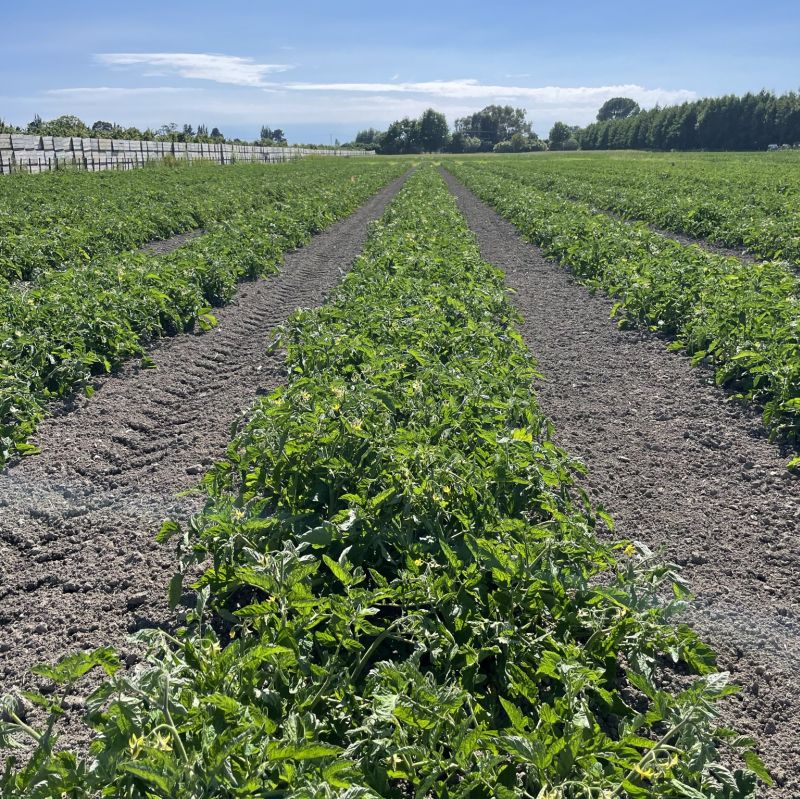
Our tomatoes have now been planted for eight weeks and we have seen a lot of growth since the November newsletter. Since our last update, the Watties operations team have mechanically weeded the interrow and Andy Lysaght has mechanically weeded in between the tomatoes. We have applied several sprays, side dressed, and irrigated. It is the first time the irrigator has been turned on in two years!!

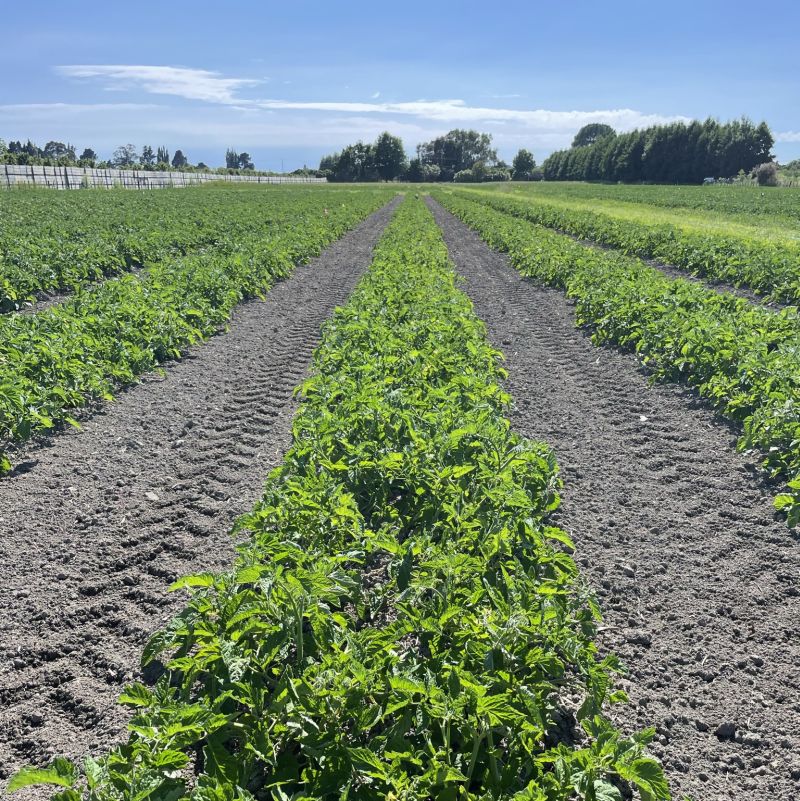
Compare these images with last month’s post here>
Operations
Summary
The below table provides an overview of the three treatments and the main management decisions to date.
| Management | Conventional | Hybrid | Regen |
| Spray 28/11/2023 | Kocide Opti (Fg) Ridomil Gold MZ (Fg) YaraVita Bud Builder (FN) | Kocide Opti (Fg) Ridomil Gold MZ (Fg) YaraVita Bud Builder (FN) | Phoscheck (Fg) Aureo Gold (BB) YaraVita Bud Builder (FN) |
| Spray 7/12/2023 | Kocide Opti (Fg) Ridomil Gold MZ (Fg) Benevia (I) | Kocide Opti (Fg) Ridomil Gold MZ (Fg) Benevia (I) | Aureo Gold (BB) Ridomil Gold MZ (Fg) Benevia (I) |
| Side dressing 15/12/2023 | 400kg/ha YaraMila Complex (GN) 48N, 20P, 60K, 32S, 6.4Mg | 300kg/ha YaraMila Complex (GN) 36N, 15P, 45K, 24S, 4.8Mg | 200kg/ha YaraLiva Nitrabor (GN) 3kg/ha Granular Humates (BStim) 30.8N, 36.6Ca |
| Pre emerge herbicide 15/12/2023 | Boxer Gold (H) Magneto (H) | Boxer Gold (H) Magneto (H) | Nil |
| Foliar application 15/12/2023 | Nil | Levity Lono (FN) Biostart Foliacin (BStim) | Levity Lono (FN) Biostart Foliacin (BStim) |
| Irrigation 16-17 Dec | 15mm | 15mm | 15mm |
| Irrigation 19-20 Dec | 15mm | 15mm | 15mm |
BB= Bio bactericide, I= Insecticide, H= Herbicide
Weed control
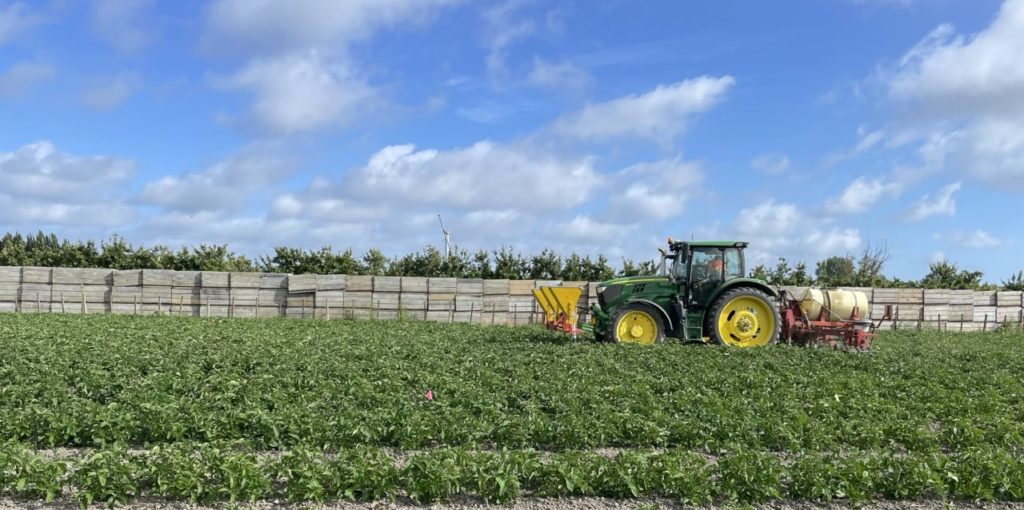
Due to continued wet weather we missed the window for our second Sencor (herbicide) application. Watties mechanically weeded with their Rototiller on the 1st of December, which supressed weed growth in the interrow ahead of side dressing. Andy Lysaght then weeded between the double row of tomatoes with one of his mechanical weeders. This was completed across all treatments.
The Badalini (multi-row rototiller) came through at side dressing, completing a shallow cultivation in the interrow and incorporated a pre-emerge herbicide to supress weeds. The operations team decided we would exclude the pre-emerge herbicide from the regen treatment, with the view that we can mechanically weed again if weeds do get out of control.
Disease management
The weather has generally been cooler and overcast through the early part of the season, perfect conditions for late blight and bacterial speck in tomatoes. Our the spray programmes for the Conventional and Hybrid treatments have been the same and have included regular applications of Kocide Opti (copper) to protect against disease. These treatments have also had two Ridomil Gold MZ applications (protectant fungicide for blight). We are trying to exclude copper applications from the Regen treatment, replacing the coppers with Aureo Gold, a bio-bactericide to control disease (mostly used in kiwifruit). Only one Ridomil application has been applied to the Regen treatment as the canopy was smaller early on and had better air movement around the plants.
Insect pest management
All treatments have had one application of Benevia insecticide. A second application is planned for the Conventional and Hybrid treatments later this week. This is mainly to protect plants against Tomato Potato Psyllid (TPP), however also controls aphids and thrips. Some Biological Control Agents (BCAs) have been released in the trial area to help control insect pests (more detail on this in subsequent post).
Nutrient management
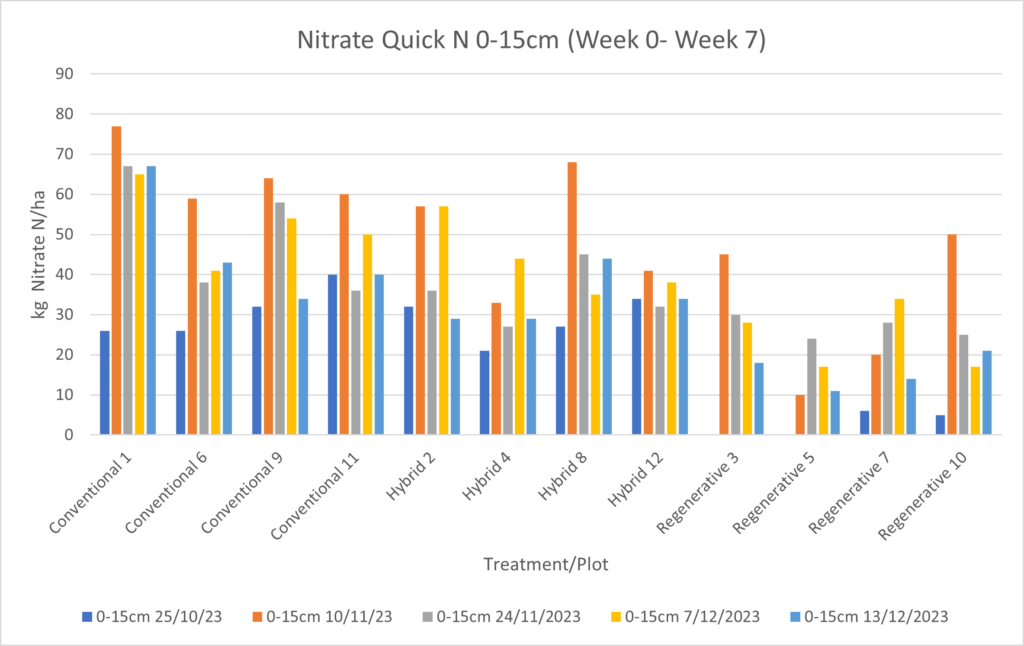
Fertiliser decisions are made by the operations group, along with Mark Redshaw from Yara. A high rate of YaraMila Complex (full N, P, K, S, Mg, B, Fe, Mn, Zn) was applied to the Conventional treatment, with a slightly lower rate of Complex applied to the Hybrid treatment. As the background fertility of the plots is in theory high enough to support a crop of tomatoes, it was decided that the Regen treatment would have an application of nitrogen only, so had YaraLiva Nitrabor applied (N, Ca, B). We have been monitoring Nitrate-N levels using the Nitrate Quick Test every two weeks. Results for the top 15cm is displayed below.
Side-dressing
Fertiliser was applied in bands at side dressing through the Badalini (single pass with herbicide application), and worked into the interrow, close to the rows of tomatoes. The Hybrid treatment interrow surface was particularly hard and had two passes with the rototiller to break up the surface.
Foliar nutrition
All treatments had foliar nutrition with YaraVita Bud Builder applied in early November. Regular foliar applications to both the Hybrid and the Regen treatments are planned and bio-stimulants in the mix have been advised. Caution is being when these products are included with other sprays to minimise the risk of burn. In some cases, crop protection and foliar nutrition products are being applied separately.
Irrigation
Management
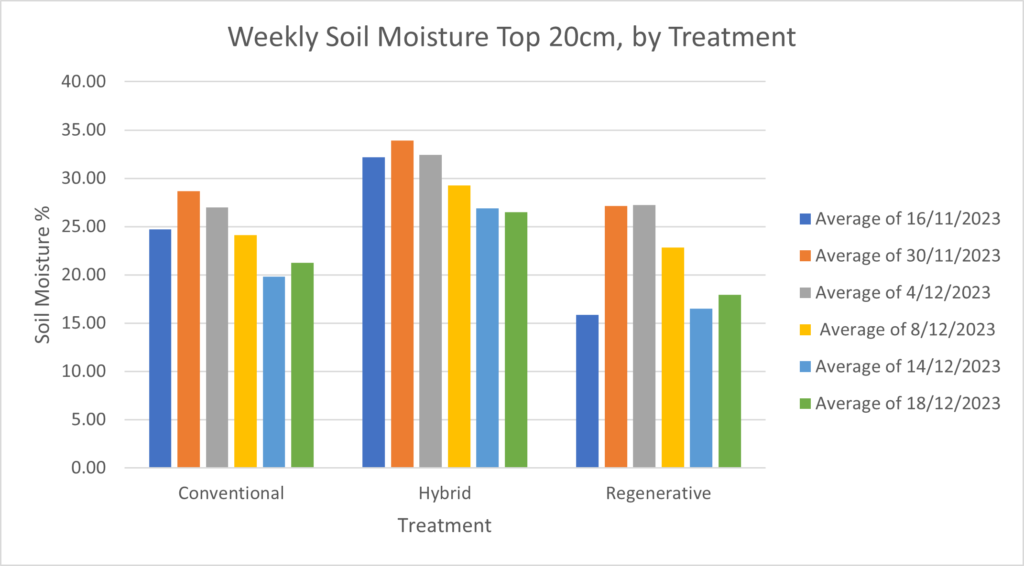
Irrigation has started with a 15mm application on 16 December that, after the heat and evapotranspiration over the weekend, barely changed soil moisture in the top 200mm where most of our root activity is currently. A second 15mm application was made immediately after the first, and a third is due.
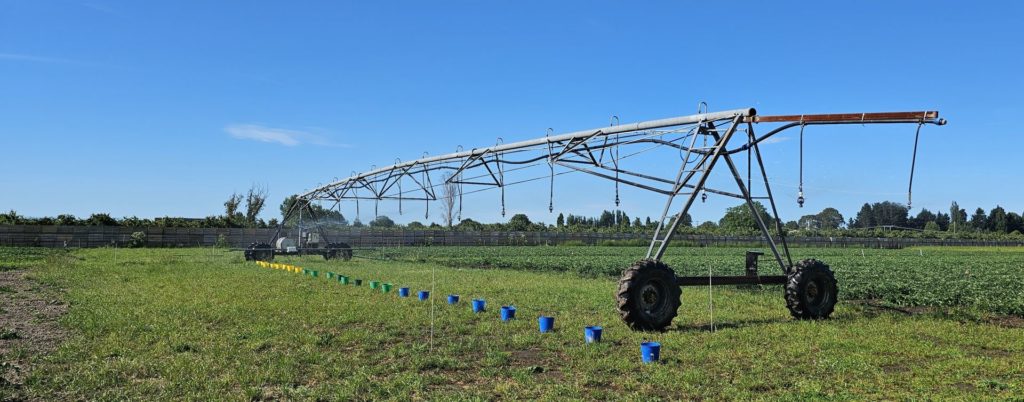
Bucket test
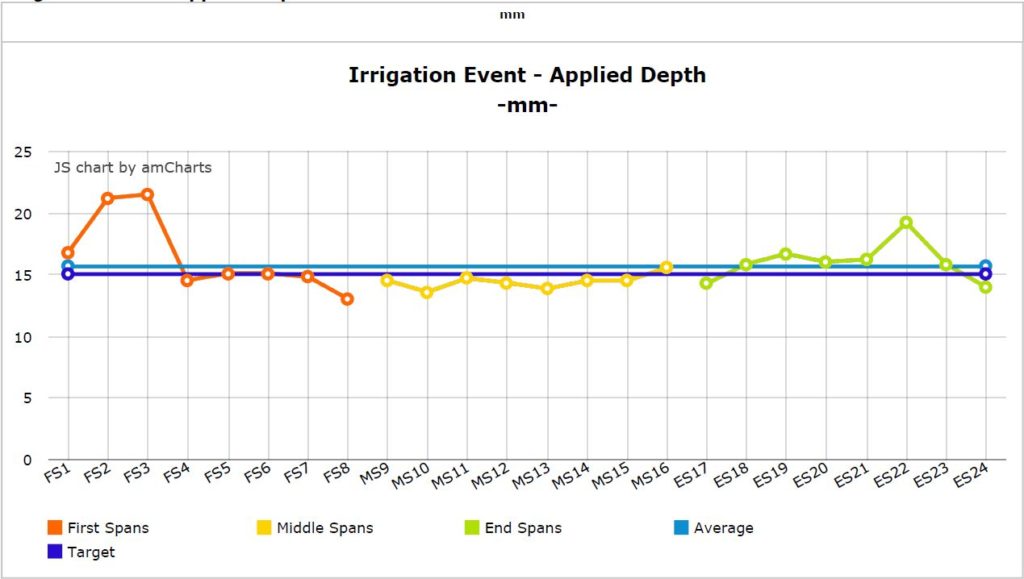
We did an IRRIG8 bucket test and found a DU = 0.88 which is good.
We will make minor changes to the sprinklers on each end and expect an improvement as a result. At the inlet end, a 180 sprinkler is over-applying (orange line) and at the far end a sprinkler is underapplying.
Now is a great time to check irrigation using the bucket test – it is easy to do, it doesn’t take long, and it costs very little. Have a look at the guidance in our Irrigation Management online learning resource. You will need to login – it is free although we welcome paying members to help run the organisation!
“Carbon Positive” is a project running in partnership with the Hawke’s Bay Future Farming Trust. It is funded by the Ministry for Primary Industries, Hawke’s Bay Regional Council, Kraft Heinz Watties, McCain Foods, and BASF Crop Protection with in-kind support from many others.