Skip to content
Menu
LandWISE – Promoting sustainable land management
  • Welcome
    • About
    • LandWISE Committee
    • Contact
  • Projects
    • Carbon Positive
      • Carbon Positive Reports
    • Nitrachek: Farmer Friendly Nitrate Testing
    • SLAKES: a cost-effective measure of soil structural stability
    • Soil Repair after Cyclone Gabrielle
    • Vegetable Production Nitrogen Management
    • Best Management of Nitrates in Process Cropping
    • Future Proofing Vegetable Production
    • Herbicide Resistance Management
  • Events
    • Cyclone Gabrielle Research Symposium
      • Historical North Island Flood Events
      • An extraordinary storm: the severity of Cyclone Gabrielle’s weather in Hawke’s Bay
      • The Science Response in the Year of Storms; A Gisborne/Tairawhiti perspective
      • Insights into causes of landslides triggered by Cyclone Gabrielle
      • The effects of Cyclone Gabrielle on fruit tree health in Hawke’s Bay
      • Impact of Cyclone Gabrielle on stonefruit orchards in Hawke’s Bay: a case study
      • Charting the Course following Cyclone Gabrielle
      • Baseline sediment sampling in Tairawhiti and Hawke’s Bay
      • Impacts on cropping businesses
      • Understanding the flooding caused by Cyclone Gabrielle
      • Building Flood Damage from Ex-Tropical Cyclone Gabrielle
      • Food safety and critical incidents: A unified approach for safer produce
      • Silt nutritional status and contamination concerns
      • Lessons from the horticultural sector response to Cyclone Gabrielle
      • Ecological impacts of Cyclone Gabrielle
      • Cyclone Gabrielle and Poplar Windthrow in Northland
      • Seed Size and Establishment Method Determine Crop Recovery Following Cyclone-Induced Silt Deposition
      • Returning to (some) baseline sampling sites to assess cropping soil recovery
      • Recovery of annual cropping ground – Grower learnings
      • Recovery of Annual Cropping over 2 Years
      • Technical and extension learnings from Cyclone Gabrielle
    • Getting to Carbon Positive!
      • Getting to Carbon Positive – Presenters
    • Rebuilding Our Soils
      • Rebuilding Our Soils – Presenters
    • Events Archive
  • Tools
    • Nitrachek Calculator
    • Carbon Calculator
    • Nutrient Budget
    • Irrigation Evaluation – IRRIG8
      • IRRIG8: Centre Pivot
        • IRRIG8-online: Centre Pivot User Guide
      • IRRIG8: Linear Move
      • IRRIG8: Travelling Irrigator
        • IRRIG8-online: Travelling Irrigation User Guide
      • IRRIG8: Multiple sprayline calculator
      • IRRIG8: Solid set irrigation
      • IRRIG8: Pressure and energy
        • Pressure and Energy Calculator: User Guide
    • ANOVA Tool for statistical significance
    • Fertspread Spreader Calibration
    • Fertspread Placement Calibration
    • Soil Infiltration Calculator
      • Disc Permeameter User Guide
      • Disc Permeameter Calculator: Frequently Asked Questions
  • Blog
  • Sign Up
  • Login
  • Members Only
    • Online Learning
  • Account
  • Site Search
LandWISE – Promoting sustainable land management

Carbon Positive

Posted on July 1, 2024

June update

Most of June has involved watching cover crops grow! but we also completed a series of soil measurements including visual soil assessments (VSAs) and worm counts, and we have sampled for labile soil carbon.

To monitor the cover crops’ development, we have made weekly ground cover measurements since germination using the smartphone Canopeo app. Canopeo allows us to track growth many times without disturbing the crop in our key measurement plots.
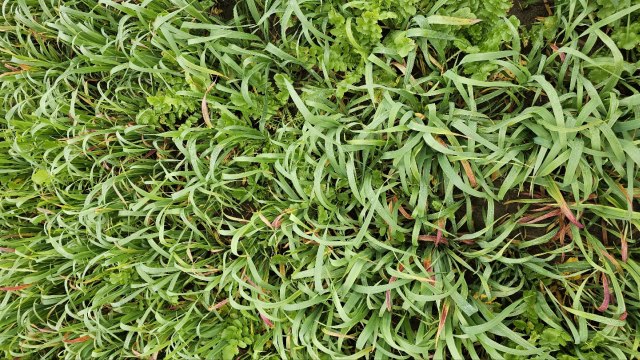

Original RGB photo of an area of cover crop showing oats and radish, small vetch is hard to see. Most of the sunflowers were hit by frosts.
Image after Canopeo processing converts foliage (green) to white and soil (black or brown) to black. The percentage that is white is calculated.

We saw that the annual ryegrass in the conventional treatment plots reached a high ground cover percentage faster than the mixed oats, radish, vetch, sunflower mix in the hybrid and regenerative plots which are relatively sparsely planted. By the end of June, there was less difference, and the cover crops are much taller than the ryegrass. We intend grazing the ryegrass with lambs once the soil dries out some! The mixed covers will not be grazed. We will make harvest cuts and determine the actual dry biomass in all the plots before we terminate the cover crops.
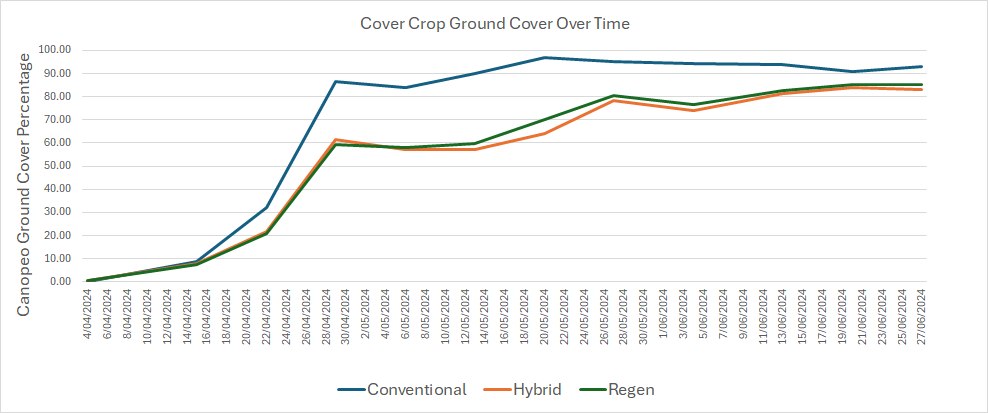
A graph of the ground cover percentage of three cover crops showing conventional (annual ryegrass) plots gained ground cover faster but by the end of June, all are similar.

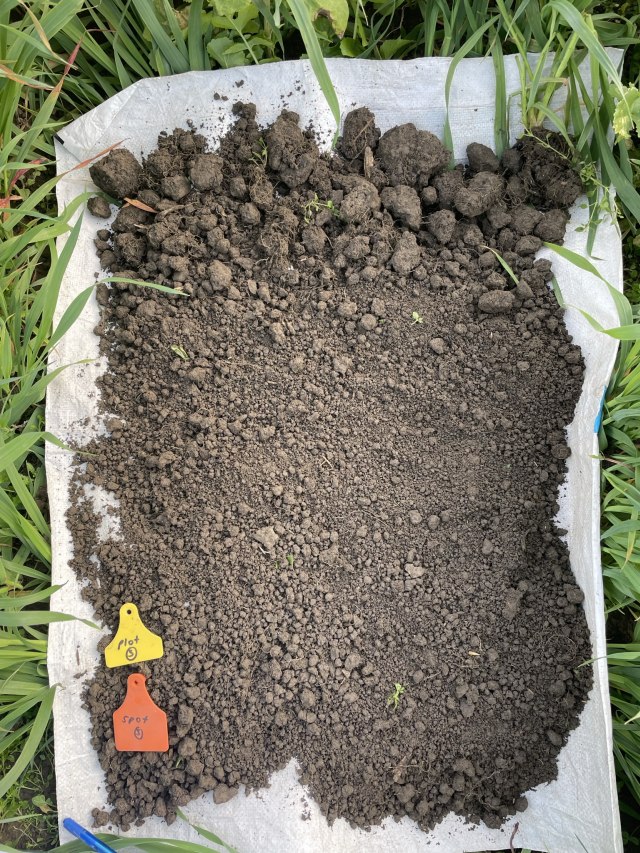
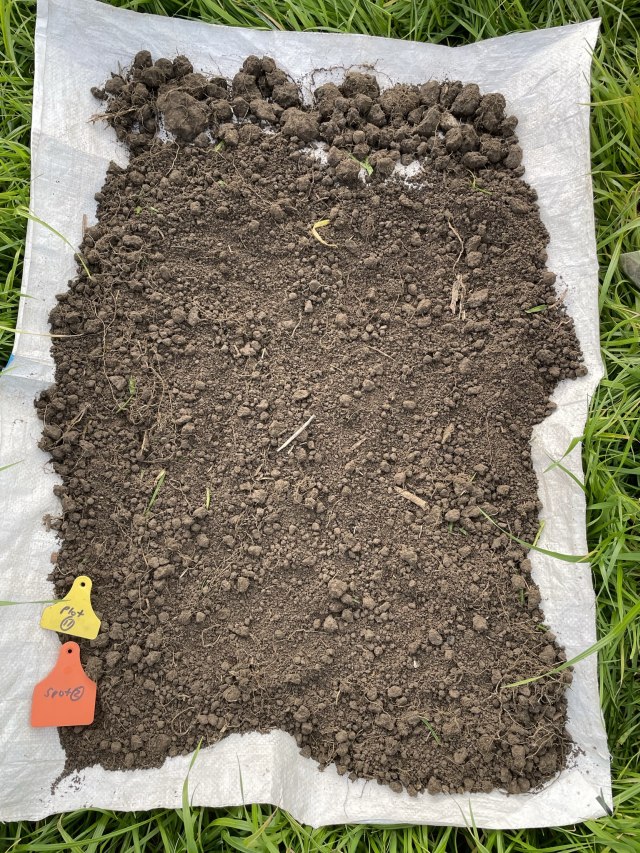
We think we are starting to see changes in the VSA tests, generally in a positive direction. Three examples are shown below. But remember, one image from a test at one time of year is not enough to give statistically relevant answers!! What we do see is that annual ryegrass can give good nutty structure quite quickly. Given the different cultivation that the treatments were given before tomatoes, we are not too surprised to see some differences. The hybrid plots suffered from a rotary hoe while the soil was still wet, and the subsequent pan development remains noticeable. The soil moisture was ideal for VSA when we did these in early June, and that will have helped increase scores relative to those we did in wet soil in previous seasons.
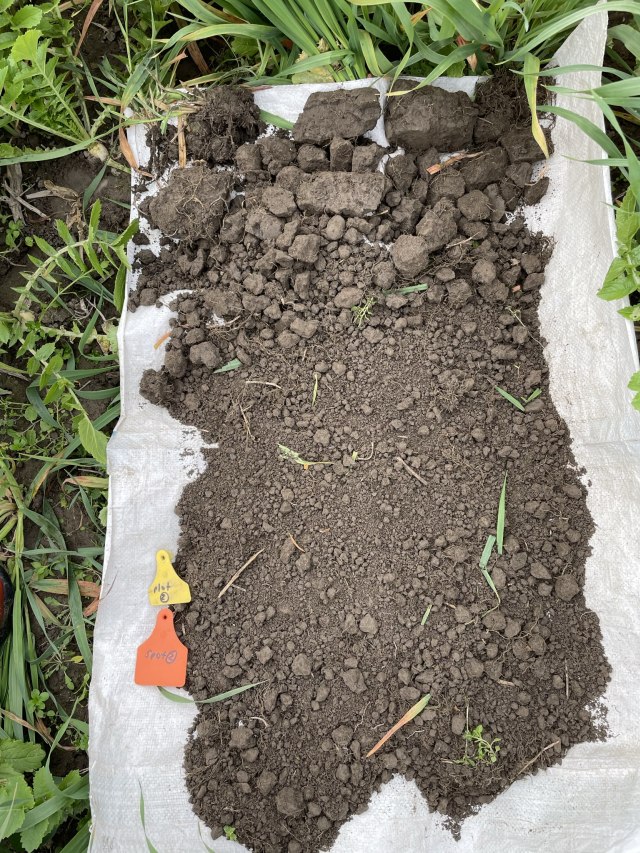
Conventional VSA
Hybrid VSA
Regen VSA

Carbon in the soil takes many forms, including mineral/inorganic calcium carbonate, the main component of limestone. The organic carbon components are often thought of as fitting into one of two pools: the “stable” and “labile” fractions. The stable fraction, which may be protected by clay minerals or soil aggregates, or be chemically persistent, takes years to centuries to decompose and to build up so annual changes are very small. Labile carbon breaks down in days or years and is the portion of soil organic carbon that consists of soil microbial biomass carbon, dissolved organic matter, and easily oxidative organic matter. Because it can be readily decomposed by soil organisms, it is the fraction of soil organic carbon with the most rapid turnover times, and its oxidation drives the movement of CO2 between soils and atmosphere. It is an active source of nutrition and an indicator of change in the soil.

We are sampling all carbon at the beginning, middle and end of the Carbon Positive project. We are sampling for labile carbon a couple of times each year, basically in spring and autumn. We have been taking labile samples to 60cm depth, split into 0-15, 15-30, and 30-60cm bands. These are the very active root zone in the cultivated depth and the area below it, which still has significant root and micro-organism activity. As well as Hill Laboratories’ measurement of labile carbon percentage using the Hot Water Extractable Carbon method, we are determining the actual soil bulk density so we can accurately assess the tonnes of labile carbon per hectare. Hill Labs has a very informative technical note on soil carbon tests.
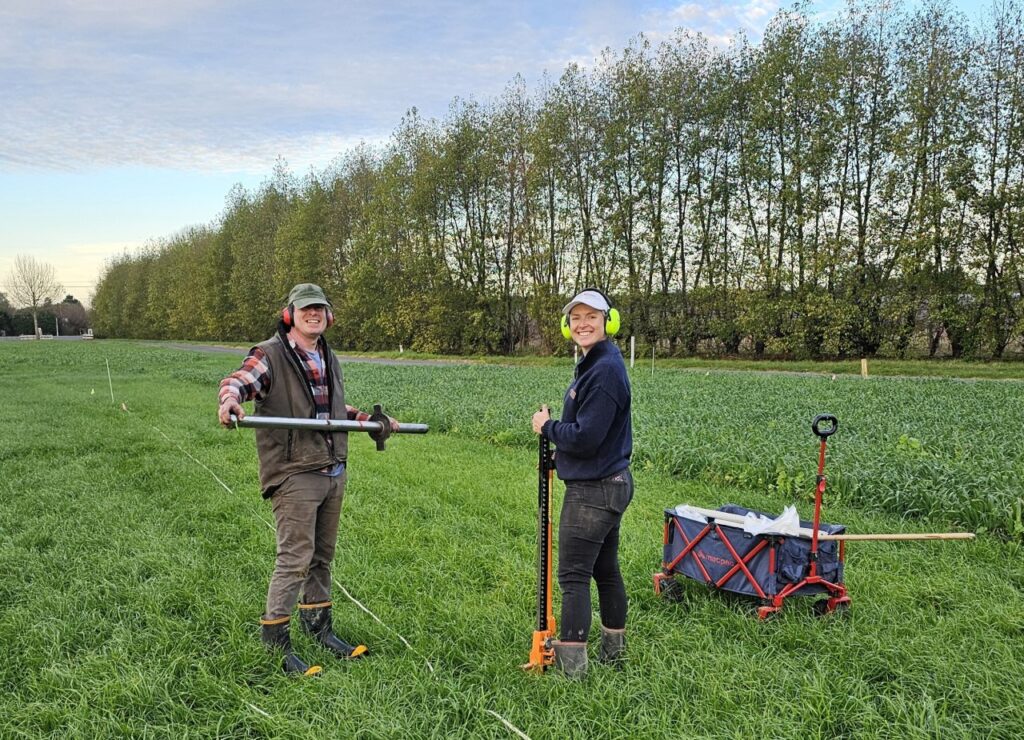
Soil sampling to 60cm to assess labile carbon levels. Thanks Hayden from Tipu Services for lending a hand!

We also completed the Milestone 7 report which gives a lot of information about the development and outcomes of the process tomato crops we grew with Heinz-Watties last summer. Now we are reviewing our plans for the coming season and making sure things are ready.

  • Cyclone Gabrielle Research Symposium
  • Biodiversity Strips Update
  • Carbon Positive: Butternuts
  • Carbon Positive: Butternut Planting to Side Dressing
  • Nitrate Levels on the MicroFarm
  • Cyclone Gabrielle Research Symposium
  • Introducing Carys Luke, our Summer Intern
  • Soil Infiltration Calculator
  • MicroFarm Biodiversity Update
  • Irrigation System Testing
  • Carbon Positive: Butternut Planting
  • NZARM Conference 2025

RECENT POSTS

  • Cyclone Gabrielle Research Symposium
  • Biodiversity Strips Update
  • Carbon Positive: Butternuts
  • Carbon Positive: Butternut Planting to Side Dressing
  • Nitrate Levels on the MicroFarm

CATEGORIES

  • Agritech
  • Asparagus
  • Conference
  • Courses
  • Cover crops
  • Cultivation
  • Events
  • Fresh Vegetables
  • Irrigation
  • Membership
  • Nitrate
  • Nutrition
  • People
  • Permanent crops
  • Pests
  • Process Crops
  • Projects
  • Protected cropping
  • regenerative agriculture
  • Regulations
  • Research
  • soil health
  • Sustainable technology
  • Uncategorized
  • Water resources
  • Weeds
©2023 LandWISE – Promoting sustainable land management

Disclaimer: Any information on the LandWISE website or linked LandWISE resources is of a general nature only. We endeavour to provide accurate and adequate information relating to the subject matters contained in it. It has been prepared and made available to all persons and entities strictly on the basis that LandWISE, its researchers and authors are fully excluded from any liability for damages arising out of any reliance in part or in full upon any of the information for any purpose. No endorsement of named products is intended nor is any criticism of other alternative, but unnamed product.