
Skip to content
Menu
LandWISE – Promoting sustainable land management
  • Welcome
    • About
    • LandWISE Committee
    • Contact
  • Projects
    • Carbon Positive
      • Carbon Positive Reports
    • Nitrachek: Farmer Friendly Nitrate Testing
    • SLAKES: a cost-effective measure of soil structural stability
    • Soil Repair after Cyclone Gabrielle
    • Vegetable Production Nitrogen Management
    • Best Management of Nitrates in Process Cropping
    • Future Proofing Vegetable Production
    • Herbicide Resistance Management
  • Events
    • Cyclone Gabrielle Research Symposium
      • Historical North Island Flood Events
      • An extraordinary storm: the severity of Cyclone Gabrielle’s weather in Hawke’s Bay
      • The Science Response in the Year of Storms; A Gisborne/Tairawhiti perspective
      • Insights into causes of landslides triggered by Cyclone Gabrielle
      • The effects of Cyclone Gabrielle on fruit tree health in Hawke’s Bay
      • Impact of Cyclone Gabrielle on stonefruit orchards in Hawke’s Bay: a case study
      • Charting the Course following Cyclone Gabrielle
      • Baseline sediment sampling in Tairawhiti and Hawke’s Bay
      • Impacts on cropping businesses
      • Understanding the flooding caused by Cyclone Gabrielle
      • Building Flood Damage from Ex-Tropical Cyclone Gabrielle
      • Food safety and critical incidents: A unified approach for safer produce
      • Silt nutritional status and contamination concerns
      • Lessons from the horticultural sector response to Cyclone Gabrielle
      • Ecological impacts of Cyclone Gabrielle
      • Cyclone Gabrielle and Poplar Windthrow in Northland
      • Seed Size and Establishment Method Determine Crop Recovery Following Cyclone-Induced Silt Deposition
      • Returning to (some) baseline sampling sites to assess cropping soil recovery
      • Recovery of annual cropping ground – Grower learnings
      • Recovery of Annual Cropping over 2 Years
      • Technical and extension learnings from Cyclone Gabrielle
    • Getting to Carbon Positive!
      • Getting to Carbon Positive – Presenters
    • Rebuilding Our Soils
      • Rebuilding Our Soils – Presenters
    • Events Archive
  • Tools
    • Nitrachek Calculator
    • Carbon Calculator
    • Nutrient Budget
    • Irrigation Evaluation – IRRIG8
      • IRRIG8: Centre Pivot
        • IRRIG8-online: Centre Pivot User Guide
      • IRRIG8: Linear Move
      • IRRIG8: Travelling Irrigator
        • IRRIG8-online: Travelling Irrigation User Guide
      • IRRIG8: Multiple sprayline calculator
      • IRRIG8: Solid set irrigation
      • IRRIG8: Pressure and energy
        • Pressure and Energy Calculator: User Guide
    • ANOVA Tool for statistical significance
    • Fertspread Spreader Calibration
    • Fertspread Placement Calibration
    • Soil Infiltration Calculator
      • Disc Permeameter User Guide
      • Disc Permeameter Calculator: Frequently Asked Questions
  • Blog
  • Sign Up
  • Login
  • Members Only
    • Online Learning
  • Account
  • Site Search
LandWISE – Promoting sustainable land management

Carbon Positive

Regenerating soil carbon in soils used for intensive field cropping

Ready to go

In partnership with the Hawke’s Bay Future Farming Trust, LandWISE set out on a new journey, a six-year project to assess the economic and environmental impacts of adopting regenerative farming within a typical New Zealand cropping system, in particular studying the effects in degraded soils. One of a suite of MPI funded regenerative farming projects, ours is the only one focused on process cropping. The project was officially launched by the Minister for Agriculture, Damien O’Connor in February 2023.

Carbon Positive is made possible by huge support from the Ministry for Primary Industries, Hawke’s Bay Future Farming Charitable Trust, Heinz-Wattie’s NZ, McCain Foods, Process Vegetables NZ, and Hill Laboratories. We received early sponsorship from Hawke’s Bay Regional Council, BASF Crop Protection and Hawke’s Bay Vegetable Growers Group. Costs are underwritten by Page Bloomer Associates.

With the support of McCain Foods and Heinz-Wattie’s, we are growing a range of crops including beetroot, green beans, peas, sweetcorn and tomatoes. Cover crops will be an important feature, with a standard winter ryegrass and various single or multi-species cover crops.

Do we know the outcome?

No, that’s exactly why we are doing the research!

To run the trial, we have split the LandWISE MicroFarm into replicate plots, putting three different management systems against one another. We call the systems “conventional”, “regenerative” and “hybrid”. Each treatment has four replicates randomly allocated across the MicroFarm. This gives a sound basis for statistical analyses. Each plot is 12 m wide and 90 m long, designed to allow standard farm / contracting equipment to operate.
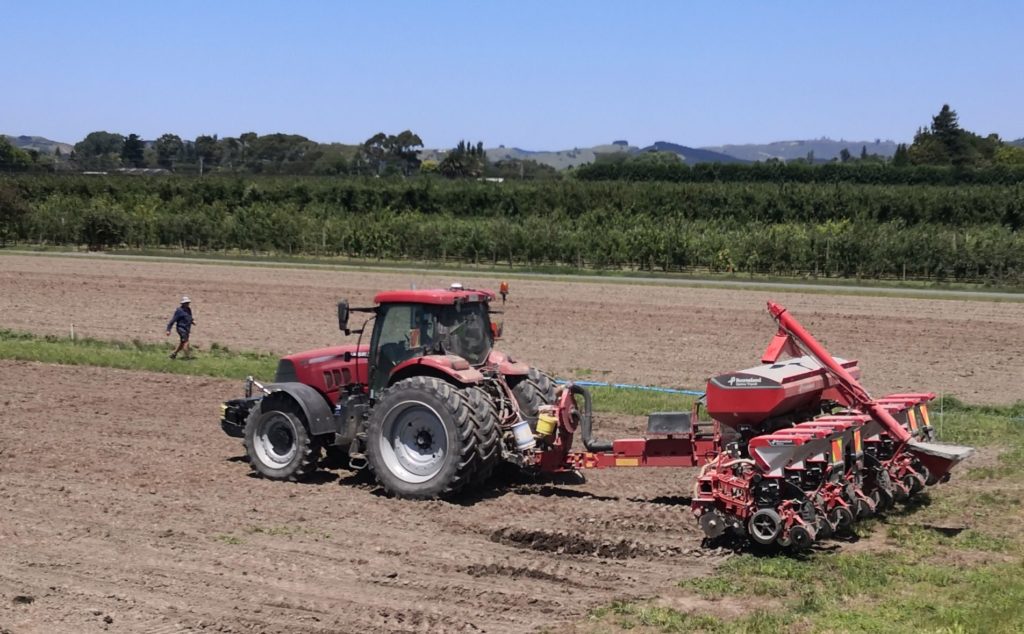
Nicolle Contracting planting sweetcorn for McCain Foods at the MicroFarm Carbon Positive trial

What is “regenerative cropping”?

There are many definitions or explanations of regenerative farming. Some say they are a bit woolly but that’s part of the point. Rather than strictly defining what can and cannot be done, regenerative cropping works to best meet a set of core principles focused on management to rebuild soil health.
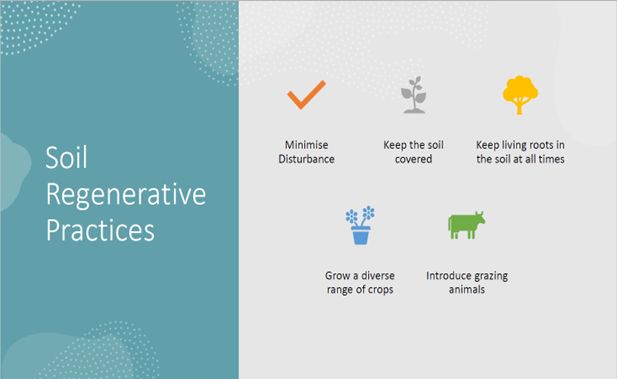
Core Soil Regenerative Practice Principles

What is “conventional practice”?

We are applying a management policy akin to that used by the majority of farmers for the last few decades. Based on best practice, we run nutrient budgets and apply fertiliser accordingly, we use best practice agrichemical management to control pests, weeds and diseases, and we apply a full cultivation regime.

What is the “hybrid” system?

Our hybrid system is a bit of the other two, cherry picking if you like. It might be a set of practices using minimal cultivation, keeping other chemical inputs at the low-normal end, and using a cover crop over winter.

Most importantly, each system will be actively managed. If something needs to be done, we’ll try to do it. We don’t intend being stuck in a rigid box when the soil, weather, crop or pest and disease situation can change so much. So, we have pragmatic farmers, contractors and industry providers advising our team.

Mātauranga Māori is woven throughout the project. We are pleased to have the support of our neighbouring marae advising us, and we look forward to sharing knowledge between us to enrich us all.

The project has a separate Project Steering Group, a Technical Advisory Group and a less formalised Operations Advisory Group helping the LandWISE team implement treatments and monitor results.

See here for reports.

The Project Steering Group members are:

  • Richard Pentreath – Chair (Hawke’s Bay Future Farming Trust)
  • John Evans (LandWISE/Process Vegetables NZ)
  • Pohatu Paku – Mātauranga Māori (Ruahapia Marae)
  • Scott Lawson (HB Vegetable Growers Association)
  • Bruce McKay (Heinz-Wattie’s)
  • Allan Machakairie (McCain Foods)
  • Ceris James – MPI Investment Advisor

The Technical Advisory Group core membership is:

  • Dan Bloomer – TAG Leader
  • Paul Mudge – soil carbon (Landcare Research)
  • Gwen Grelet– regenerative systems (Landcare Research)
  • Nicole Schon – worms and soil health (AgResearch)
  • Kathleen Kozyniak – Air and Land Science (HBRC)
  • Nick Roskruge – Mātauranga Māori
  • Bruce Searle – crop agronomy (Plant & Food)
  • Paul Smith – Carbon Farming consultant
  • Gerald Rhys – MPI Science Manager

The Operations Advisory Group includes:

  • Olivia Webster – OAG Leader
  • Bruce MacKay (Heinz-Watties)
  • Mike Flynn (McCain Foods)
  • Ben Prebble (McCain Foods)
  • Lizzy Wicken (Kraft Heinz Watties)
  • Phil Schofield – consultant
  • Rob Nicole – crop protection advisor
  • Simon White – farmer
  • Gareth Holder – farmer
  • Mike Kettle – contractor
  • Members of the PSG and TAG
  • Others
  • If you are interested, please contact Olivia.

  • Cyclone Gabrielle Research Symposium
  • Biodiversity Strips Update
  • Carbon Positive: Butternuts
  • Carbon Positive: Butternut Planting to Side Dressing
  • Nitrate Levels on the MicroFarm
  • Cyclone Gabrielle Research Symposium
  • Introducing Carys Luke, our Summer Intern
  • Soil Infiltration Calculator
  • MicroFarm Biodiversity Update
  • Irrigation System Testing
  • Carbon Positive: Butternut Planting
  • NZARM Conference 2025

RECENT POSTS

  • Cyclone Gabrielle Research Symposium
  • Biodiversity Strips Update
  • Carbon Positive: Butternuts
  • Carbon Positive: Butternut Planting to Side Dressing
  • Nitrate Levels on the MicroFarm

CATEGORIES

  • Agritech
  • Asparagus
  • Conference
  • Courses
  • Cover crops
  • Cultivation
  • Events
  • Fresh Vegetables
  • Irrigation
  • Membership
  • Nitrate
  • Nutrition
  • People
  • Permanent crops
  • Pests
  • Process Crops
  • Projects
  • Protected cropping
  • regenerative agriculture
  • Regulations
  • Research
  • soil health
  • Sustainable technology
  • Uncategorized
  • Water resources
  • Weeds
©2023 LandWISE – Promoting sustainable land management

Disclaimer: Any information on the LandWISE website or linked LandWISE resources is of a general nature only. We endeavour to provide accurate and adequate information relating to the subject matters contained in it. It has been prepared and made available to all persons and entities strictly on the basis that LandWISE, its researchers and authors are fully excluded from any liability for damages arising out of any reliance in part or in full upon any of the information for any purpose. No endorsement of named products is intended nor is any criticism of other alternative, but unnamed product.