
Maize preparation
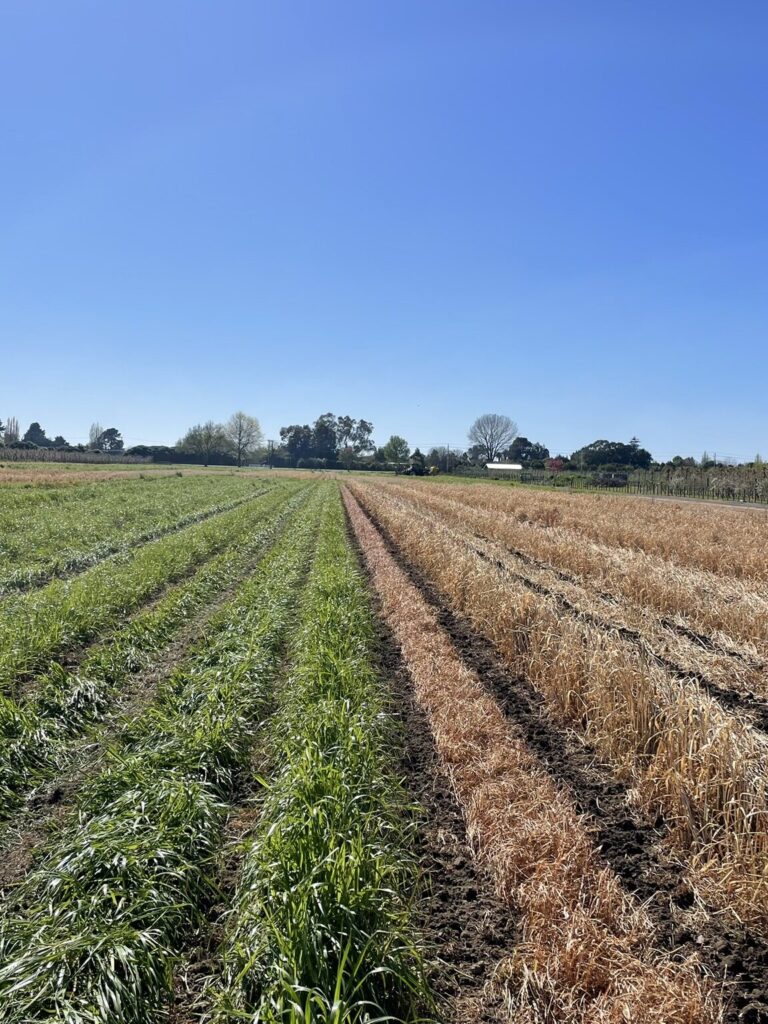
This year, our Carbon Positive trial is growing maize for Nicolle Grain. The Conventional treatment was sprayed out with Glyphosate and Sharpen eight weeks before planting, while the Hybrid and Regenerative treatments were strip-sprayed with Glufosinate and Torus. However, due to the large biomass of the triticale cover crop, the strips in the Regenerative treatment were narrower than intended. To address this, the entire Regenerative treatment was broadcast-sprayed with Glyphosate, Fulvic acid, Li700, and Sharpen six weeks before planting.
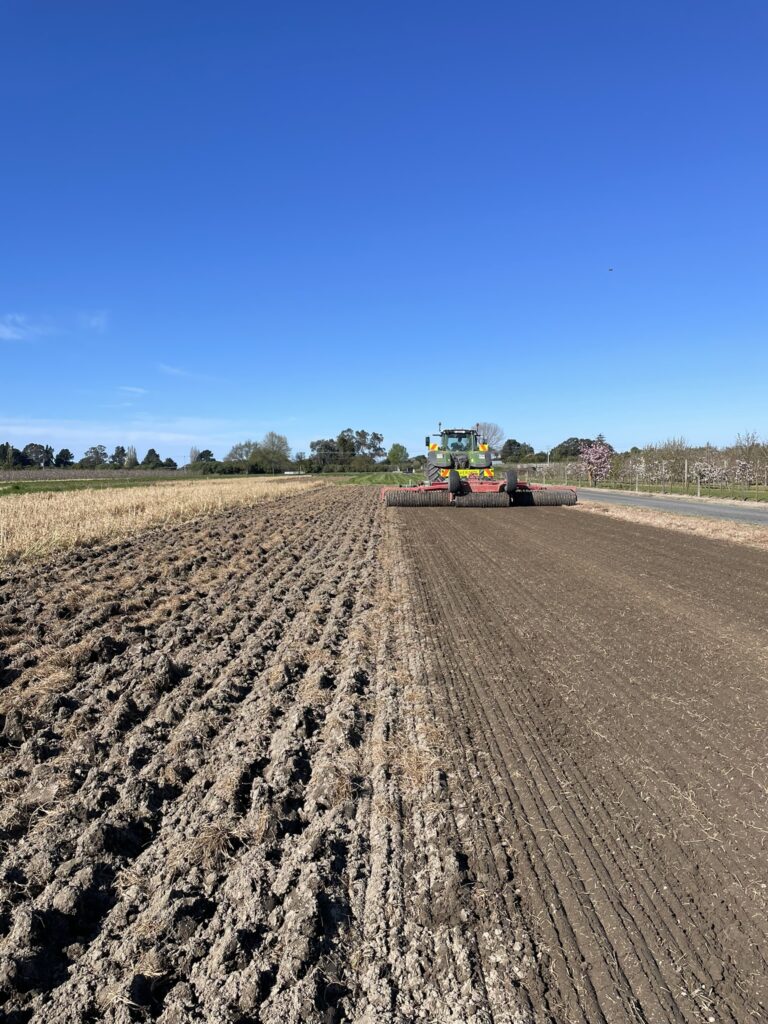
One week before planting, the Conventional treatment was disc-ripped and rotary-hoed, while the Hybrid and Regenerative treatments were strip-tilled twice before being rolled. The Hybrid treatment was also broadcast-sprayed with Glyphosate, Fulvic acid, Pulse, and Sharpen to terminate the remaining living strips.
Both the Hybrid and Regenerative treatments received an application of BioStart N and Mycorrcin. However, applying these biological products resulted in some soil compaction, as the tractor wheel tracks did not align perfectly with the maize rows. To address this, an additional pass with the strip tiller was completed before planting.
Planting
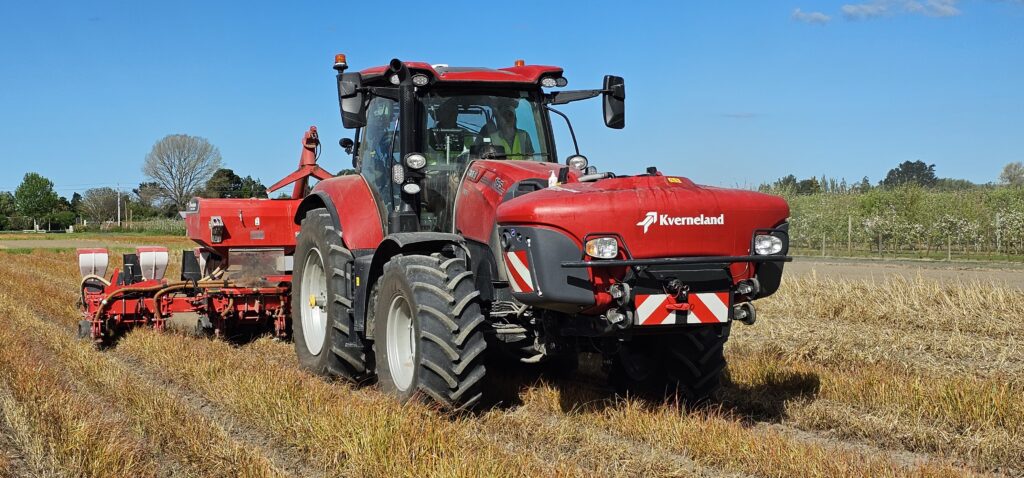
The maize was planted on 13 October. Each treatment received a different combination of seed treatments, fertiliser and crop protection inputs:
- Conventional: Planted with treated seed and 200 kg/ha of Cropzeal 20N. Strip-sprayed a pre-emergent herbicide and insecticide mix over the planting rows.
- Hybrid: Received the same inputs as the Conventional treatment, plus a T-Start Plus coating on the treated seed.
- Regenerative: Planted with untreated seed coated in T-Start Plus and received 100 kg/ha of Cropzeal 20N. No pre-emergent herbicide or insecticide was applied.
Slug bait was applied across all three treatments the day after planting.
Soil nitrate
Over winter, soil nitrate levels declined across all three treatments, with nitrate-N falling below 10 kg/ha from late May onwards.
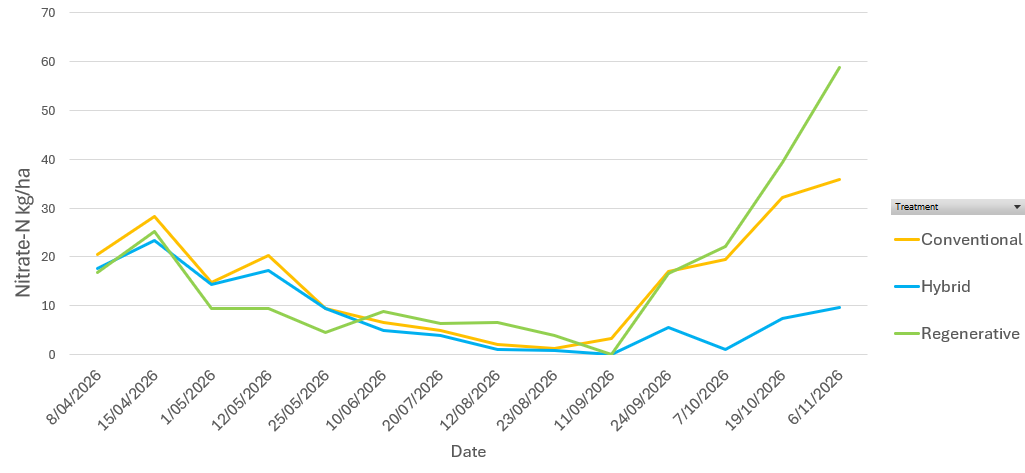
Since late September, soil nitrate levels have increased considerably in the Conventional and Regenerative treatments. In contrast, levels have remained relatively low in the Hybrid treatment. Living ryegrass cover crop remained in place until one week before planting and would have continued taking up any available nitrogen during this period.
Since planting in October, we have avoided sampling directly in the maize planting rows, where fertiliser was applied. This allows us to monitor changes in soil nitrate resulting from natural soil nitrogen mineralisation, rather than including the nitrogen supplied through fertiliser.
The results suggest that the Regenerative treatment is mineralising more nitrogen than the other two treatments.
Soil Nitrate levels when considering starter fertiliser
At planting, the Conventional and Hybrid treatments each received 40 kg N/ha, while the Regenerative treatment received 20 kg N/ha.
On 19 October, the N Quick test found 32 kg N/ha in Conventional, 7 kg N/ha in Hybrid, and 39 kg N/ha in Regenerative. Therefore, assuming no fertiliser uptake, the estimated nitrate levels were:
- Conventional: 32 kg N/ha + 40 kg N/ha starter = 72 kg N/ha
- Hybrid: 7 kg N/ha + 40 kg N/ha starter = 47 kg N/ha
- Regenerative: 39 kg N/ha + 20 kg N/ha starter = 59 kg N/ha
By 6 November, assuming 5% of the maize N requirement had been taken up1, the estimated nitrate levels were:
- Conventional: 59 kg N/ha
- Hybrid: 33 kg N/ha
- Regenerative: 62 kg N/ha
Interestingly, despite receiving half the nitrogen fertiliser applied to the Conventional and Hybrid treatments, the Regenerative treatment had a slightly higher nitrate level than the Conventional treatment.
Side dressing
The FAR Soil Nitrogen Supply Calculator was used to make management decisions before side dressing. This calculator considers potentially mineralisable nitrogen (PMN), climate, irrigation, starter fertiliser N, and Mineral N results before side dressing.
Maize requires 336 kg N/ha to achieve a target yield of 14 T/ha.
Using the FAR tool, the Conventional treatment’s PMN, soil mineral nitrogen and starter fertiliser were estimated to supply 188 kg N/ha of this requirement. This leaves a further 148 kg N/ha to be supplied through side dressing. Applying 300 kg/ha of urea at side dressing will provide an additional 138 kg N/ha. This brings the total estimated nitrogen supply for the Conventional treatment to 326 kg N/ha, which is close to the estimated requirement of 336 kg N/ha for the target yield.
The Hybrid treatments PMN, mineral N, and starter N were estimated to supply 156 kg N/ha, meaning a further 180 kg N/ha is required to reach the 14 T yield. The Hybrid will be sidedressed with 200 kg/ha of Urea, which provides 92 kg N/ha. This means the Hybrid treatment still requires an additional 88 kg N/ha
The Regenerative treatments PMN, mineral N, and starter N were estimated to supply 201 kg N/ha, meaning a further 135 kg N/ha is required to reach the 14 T yield. The Regenerative treatment will be sidedressed with 100 kg/ha of Urea, which provides 46 kg N/ha. This means the Hybrid treatment still requires an additional 89 kg N/ha.
Rather than giving the Hybrid and Regenerative treatments their full N requirement at side dressing, they will receive foliar applications containing liquid urea, Fertrion Combi 2, Bio Marinus and fulvic acid. Additionally, we expect more mineral nitrogen to become available through the breakdown of the cover crops, particularly in the Hybrid treatment, where the ryegrass strips were sprayed out only one week before planting.
- English, E., Ketterings, Q., Czymmek, K., Gabriel, A., Flis, F., & Lawrence, J. (2017). Nitrogen uptake by corn (Agronomy Fact Sheet Series, Fact Sheet #98). Cornell University Nutrient Management Spear Program. https://nmsp.cals.cornell.edu/publications/factsheets/factsheet98.pdf ↩︎