
Skip to content
Menu
LandWISE – Promoting sustainable land management
  • Welcome
    • About
    • LandWISE Committee and Staff
    • Contact
  • Projects
    • Carbon Positive
      • Carbon Positive Reports
    • Nitrachek: Farmer Friendly Nitrate Testing
    • SLAKES: a cost-effective measure of soil structural stability
    • Soil Repair after Cyclone Gabrielle
    • Vegetable Production Nitrogen Management
    • Best Management of Nitrates in Process Cropping
    • Future Proofing Vegetable Production
    • Herbicide Resistance Management
  • Events
    • Soil Health for Profit
      • Soil Health for Profit Presenters
        • What makes a farm “regenerative”?
        • Soil and Plant Nutrition at Harvest Moon
        • Regenerative agriculture principles in Kiwifruit production
        • Carbon Positive: Applying Regenerative Principles to Intensive Process Vegetable Production 2025-2026
        • Carbon Positive: making sense of carbon data
        • A Career in Cropping ? building soil
        • Cyclone Gabrielle Research Symposium: Lessons for the management of highly productive land
        • Cyclone Recovery: Turning sediment to soil
        • Cascading impacts of Cyclone Gabrielle ? and why soil health is business resilience
        • Lessons Learned from 20 Years of Cover Crop and Soil Health Research and Extension
        • Technologies at Harvest Moon
        • Do all nitrogenamendmentshave the same footprint?
        • Answers Under Foot: Should Soil Health Be Our #1 Sustainability Goal?
        • Going way back: LandWISE?s History of Minimum Tillage
        • Crop Stacking: The best practice of tomorrow
        • Long-term evaluation of tillage systems for maize silage in New Zealand
        • Minimising Tillage at Ludlow Farms
        • Long-Term Maize Establishment andCover Crop Research in the Waikato
        • Minimum tillage discussion panel
    • Cyclone Gabrielle Research Symposium
    • Getting to Carbon Positive!
      • Getting to Carbon Positive – Presenters
    • Rebuilding Our Soils
      • Rebuilding Our Soils – Presenters
    • Events Archive
  • Tools
    • Fertiliser Application Equipment Calibration
      • Fertspread Spreader Calibration
      • Fertspread Placement Calibration
    • Nitrachek Calculator
    • Irrigation Evaluation – IRRIG8
      • IRRIG8: Centre Pivot Calibration
      • IRRIG8: Centre Pivot Evaluation
      • IRRIG8: Linear Move Calibration
      • IRRIG8: Linear Move Evaluation
      • IRRIG8: Solid Set Calibration
      • IRRIG8: Solid set irrigation evaluation
      • IRRIG8: Travelling Irrigator Calibration
      • IRRIG8: Travelling Irrigation Evaluation
      • IRRIG8: Sprayline calibration
      • IRRIG8: Sprayline Evaluation
      • IRRIG8: Drip Micro Calibration
      • IRRIG8: Drip Micro Evaluation
      • IRRIG8: Pressure and energy
    • Soil Infiltration Calculator
      • Disc Permeameter User Guide
      • Disc Permeameter Calculator: Frequently Asked Questions
    • Carbon Calculator
    • ANOVA Tool for statistical significance
  • Blog
  • Sign Up
  • Login
  • Members Only
    • Online Learning
  • Account
  • Site Search
LandWISE – Promoting sustainable land management

Carbon Positive: Maize Root growth

Posted on November 25, 2026

To get an idea of how far the maize roots have penetrated into the soil, we dug up an average-looking plant from each of the three treatments. The aim was to carefully excavate a 20 × 20 cm cube of soil around each plant, allowing us to lift out the root system and see how deep the roots had grown.

Hybrid

In the Hybrid treatment, we successfully lifted out a cube of soil and could see a good fibrous root system developing. The soil was slightly drier than in the Conventional and Regenerative treatments, but the roots appeared to be establishing well.
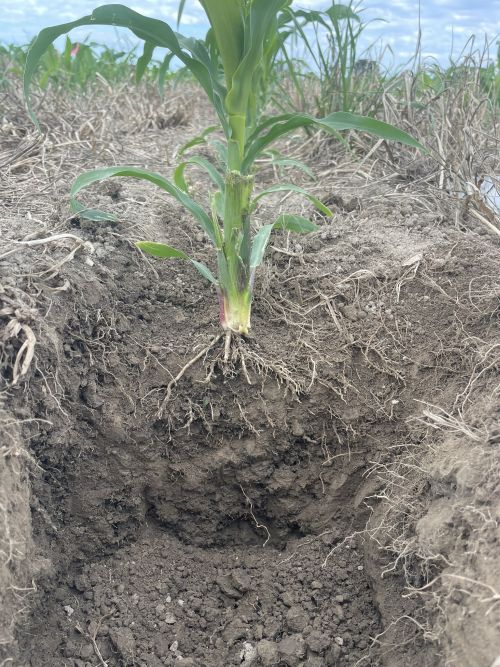
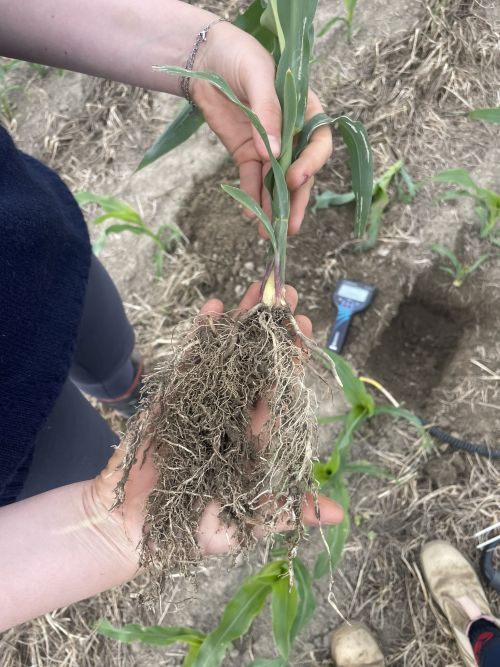
Hybrid maize roots from a 20 x 20 cube of soil.

Regenerative

The Regenerative treatment showed a similar result to the Hybrid, with a good root system extending beyond 20 cm into the soil. The soil had good moisture and was relatively crumbly.
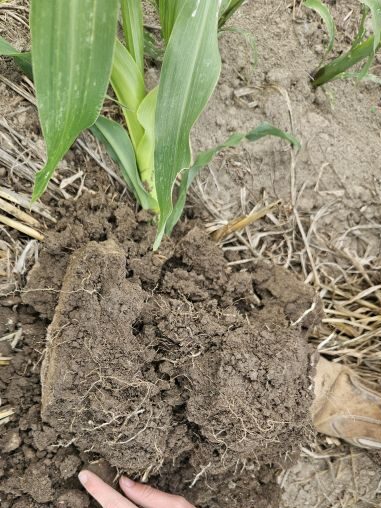
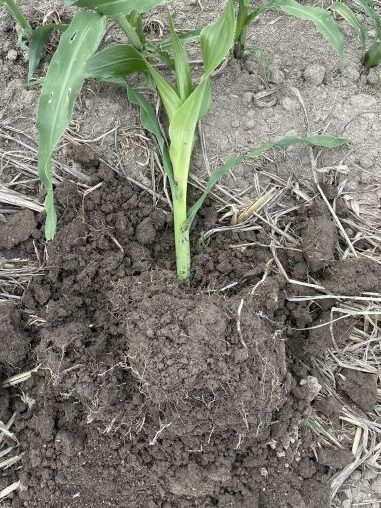
Regenerative maize roots in a 20 x 20 cube of soil

Conventional

The Conventional treatment was noticeably harder to dig, with a compacted layer (hardpan) at approximately 12 cm. This layer appears to have formed following disc ripping and subsequent power harrowing.

When excavating the plant, we could only dig down to 12 cm before the spade was unable to penetrate further. As a result, we could only lift out a much shallower section of soil compared with the other two treatments.

It was also evident that the maize roots were struggling to penetrate the hardpan, with many appearing to grow sideways rather than down through the soil profile.
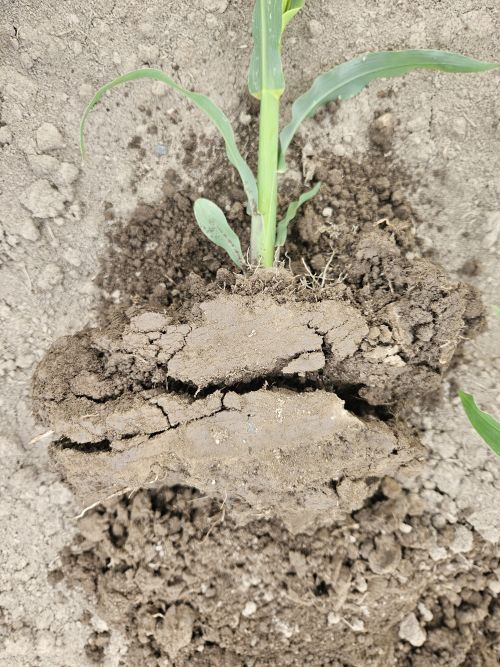
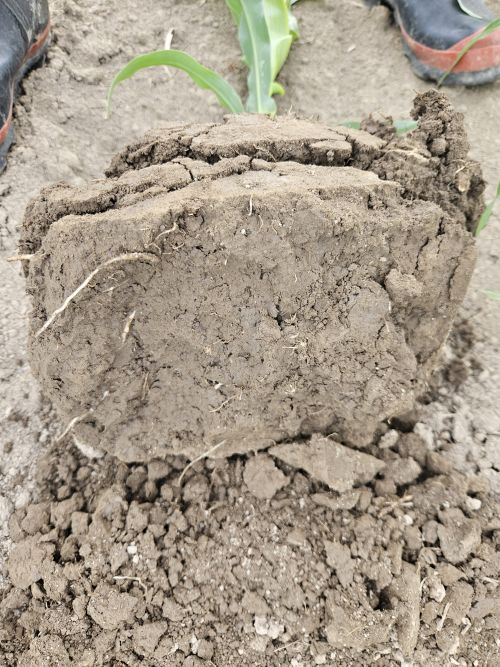
Conventional maize roots in a 12 x 20 cube of soil

What’s happening beneath the surface?

To get a better understanding of soil compaction across the three treatments, we plan to carry out penetrometer measurements soon. This will help identify where compaction is occurring and if the plants roots will be able to penetrate through it.

Related

  • Carbon Positive: Maize Root growth
  • Carbon Positive: Tomato Trial Ahead of Tomatoes 2027
  • Carbon Positive: The Maize is Planted, and Soil Nitrogen is on the Rise
  • Pesky Pūkeko versus Maize Carbon Positive Trial
  • Electrify Hawke’s Bay EXPO
  • Carbon Positive Update
  • 2026 Winter Cover Crops
  • 2026 – Food Quality Maize
  • Soil Health for Profit – James Hunter
  • Soil Health for Profit – Charlie White
  • Soil Health for Profit – Josh Wing
  • Soil Health for Profit – Pranoy Pal

RECENT POSTS

  • Carbon Positive: Maize Root growth
  • Carbon Positive: Tomato Trial Ahead of Tomatoes 2027
  • Carbon Positive: The Maize is Planted, and Soil Nitrogen is on the Rise
  • Pesky Pūkeko versus Maize Carbon Positive Trial
  • Electrify Hawke’s Bay EXPO

CATEGORIES

  • Agritech
  • Arable crops
  • Asparagus
  • Conference
  • Courses
  • Cover crops
  • Crop protection
  • Cultivation
  • Events
  • Fresh Vegetables
  • Irrigation
  • Membership
  • Nitrate
  • Nutrition
  • People
  • Permanent crops
  • Pests
  • Process Crops
  • Projects
  • Protected cropping
  • regenerative agriculture
  • Regulations
  • Research
  • soil health
  • Sustainable technology
  • Uncategorized
  • Water resources
  • Weeds
©2023 LandWISE – Promoting sustainable land management

Disclaimer: Any information on the LandWISE website or linked LandWISE resources is of a general nature only. We endeavour to provide accurate and adequate information relating to the subject matters contained in it. It has been prepared and made available to all persons and entities strictly on the basis that LandWISE, its researchers and authors are fully excluded from any liability for damages arising out of any reliance in part or in full upon any of the information for any purpose. No endorsement of named products is intended nor is any criticism of other alternative, but unnamed product.